

Burdock
Botanical name
Greater burdock - Arctium lappa L.
Lesser burdock - Arctium minus (Hill) Bernh.
Woolly burdock - Arctium tomentosum Mill.
Family
Asteraceae
Common name
Bardana, Beggar's Buttons, Edible Burdock, Little Burdock, Common Burdock, Lappa, Downy Burdock
Information about the plant
Burdock (genus Arctium) is native to Europe and Western Asia, except for tropical regions. It was introduced to America. Burdock grows in forests and forest steppes; in Central Europe, it is often found on roadsides, fences, and river gravel.
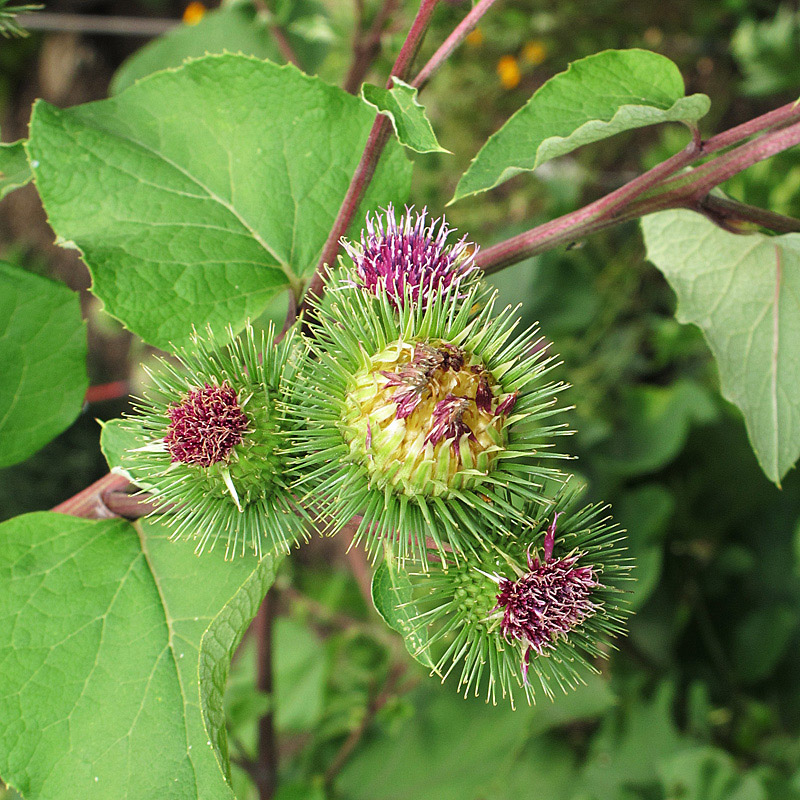
Burdock is a large-leaved composite plant with purple flower heads. A characteristic feature is the bracts surrounding the flower head in several circles, the tips of which end in barbs. These barbs cause the ripe fruit clusters to cling to animal fur and, unfortunately, often to clothing as well. This is how the plant ensures the spread of its ripe fruit. Nevertheless, the word ‘burdock’ is associated with something (unpleasant) sticky or clingy, often in a figurative sense as well.
The flower head of the greater burdock measures 3 to 5 cm in diameter, while that of the lesser burdock is significantly smaller, measuring 1 to 3 cm in diameter (Latin “minus”). The bracts of the woolly burdock are connected to each other in a cobweb-like, woolly manner (Latin “tomentosus”). Only the outer bracts of this species are barbed. The roots of burdocks are fleshy, thick, spindle-shaped, up to 60 cm long and branched. Burdocks bloom from July to August.
The genus name Arctium is derived from the Greek word “arctos” = bear, referring to the shaggy hairs on the leaves, bracts, and bristly, hooked fruits, reminiscent of a bear's shaggy coat. The species epithet lappa is derived from the Latin “lappa” (= burdock), emphasizing the adhesive nature of the fruits. In French, the plant is called “bardane”, derived from Medieval Latin “bardana” (= burdock). This linguistic root appears in the original name of the drug, “Bardanae radix” (= burdock root).
Medicinally used parts of plants (herbal drug)
In the past, the dried roots of all three Arctium species, as well as those of related species, hybrids, or mixtures, were used. Today, only the root of the greater burdock (Arctium lappa) is approved in the European Pharmacopoeia (burdock root – Arctii radix). The former drug name ‘Bardanae radix’ is no longer used.
The roots are harvested in the autumn of the first year or in the spring of the second year. The commercially available drug is sourced from crops in Bulgaria, Poland, and Hungary.
Constituents of the herbal drug
Burdock roots contain 70% carbohydrates (inulin and mucilage), lignans, caffeoylquinic acids, polyacetylenes, flavonoids, sesquiterpene lactones, and small amounts of essential oil.
Quality of the drug
The quality of burdock root (Arctii radix) is specified in the European Pharmacopoeia (Ph. Eur.).
Medical applications
Recognised medical use
The HMPC has classified burdock root as a traditional herbal medicinal product (see ‘Traditional use’).
ESCOP: Internally for minor urinary tract complaints, by increasing the amount of urine and thus flushing the urinary tract. Externally, for seborrheic skin, eczema, furuncles, and acne. These applications are based on long-standing human use.
Traditional use
Burdock root has been classified by the HMPC as a traditional herbal medicinal product (Article 16a of Directive 2001/83/EC). Based upon long-standing use, burdock root can be used internally as a diuretic to flush the urinary tract in cases of mild urinary tract complaints and to stimulate the appetite; externally, it is used for seborrheic skin.
Herbal drug preparations in finished dosage forms
- Cut burdock root for tea preparation and for adding to baths
- Fluid extract
- Tincture
- Burdock root oil (hair oil): extracted with peanut oil in a ratio of 1:10 (warm extraction)
Dosage
Finished medicinal products: See patient information leaflet.
Tea: Drink one cup of burdock root tea one to three times daily. For external use, apply burdock root oil once daily.
Preparation of a tea
Add 2.5 g of finely chopped or powdered burdock root to 150 ml of cold water and leave to stand for several hours, then boil for approximately 1 hour and strain after cooling.
Notes
When treating urinary tract problems with burdock root, it is important to drink plenty of fluids! If you have edema due to impaired heart and kidney function, you should not use burdock root for flushing therapy. If fever, urinary retention, cramps during urination, or blood in the urine occur during treatment, consult a doctor. In cases of skin problems treated with external application of burdock root, consult a doctor if no improvement is seen after four weeks.
No studies are available on the safety of burdock root during pregnancy and lactation.
The use in children and adolescents under 18 years of age is not recommended due to a lack of evidence.
Side effects
None known.
Interactions
None known.
References
Herbal drug monographs
HMPC (2011, 2020), ESCOP (2016)
Further literature
Wichtl: Teedrogen und Phytopharmaka (Tea Drugs and Phytopharmaceuticals)
Schilcher: Leitfaden Phytotherapie (Guide to Phytotherapy)
Van Wyk: Handbuch der Arzneipflanzen (Handbook of Medicinal Plants)
Commentary on the European Pharmacopoeia (Burdock root, No. 2943 – in progress)