

Sandy Everlasting
Botanical name
Helichrysum arenarium (L.) Moench
Family
Asteraceae
Common name
Yellow Everlasting, Dwarf Everlasting, Immortelle, Sand Strawflower
Information about the plant
Sandy everlasting, also known as yellow everlasting or immortelle (‘the immortal’), is native to Central, Eastern, and Southern Europe as well as Central Asia, and is cultivated in the Balkans and Russia. It grows dry, nutrient-poor sandy soils, in sandy plains, and in pine forests.
The first part of the genus name Helichrysum may derive from the Greek word “helios” (= sun), due to the yellow color of the flowers. However, this is considered a linguistically impossible derivation, so there is still uncertainty in this regard. The second part of the genus name clearly refers to the flower color, as the Greek word “chrysos” means “gold”. The species epithet arenarium derives from the Latin word “arenosus” (= sandy), while “arenarius” means “growing on sandy soil”, reflecting the plant's preferred habitat. The name “strawflower” refers to the straw-like texture of the flowers, which do not fade, hence the plant is also known as immortelle (the immortal).
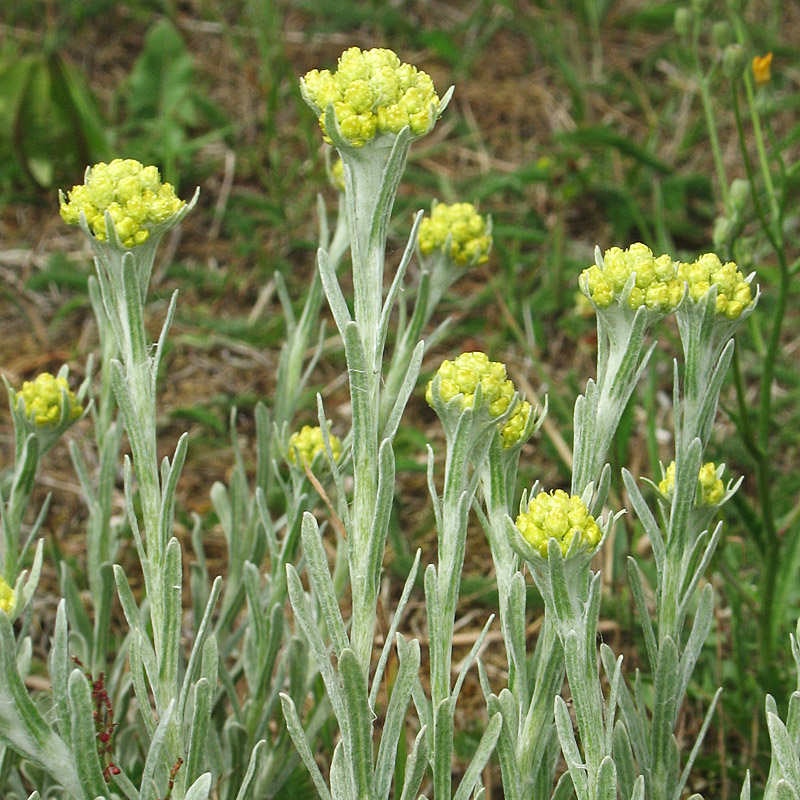
Sandy everlasting is an aromatic composite plant, 10 to 30 cm high, with yellow flower heads clustered in several umbels at the end of the stem. The stem and the narrow, elongated leaves are covered in grayish-white felt-like hairs; the leaves grow alternately and close to the stem. Lemon-yellow bracts surround the yellow-orange tubular florets like roof tiles, giving the flowers their straw-like appearance. The flowering period is from July to September.
Medicinally used parts of plants (herbal drug)
The flower heads (Helichrysi flos) are harvested and dried shortly before they fully bloom. The drug is also known as Flores Stoechados.
The commercially available drug is sourced from wild collections in Russia, Poland, and Turkey; in Germany, the plant is protected by law.
Constituents of the herbal drug
Sandy everlasting flowers (Helichrysi flos) contain flavonoids, chalcones, phthalides, esters and ester glycosides of angelic acid, essential oil, coumarins, phenolic carboxylic acids and their derivatives, as well as bitter compounds.
Quality of the drug
The quality of sandy everlasting flower (Helichrysi flos) is specified in the European Pharmacopoeia (Ph. Eur.).
Medical applications
Recognised medical use
The HMPC has classified sandy everlasting flower as a traditional herbal medicinal product (see ‘Traditional use’).
ESCOP: For symptomatic treatment of digestive disorders. In this indication, efficacy is plausible based on human experience and long-standing use.
Traditional use
Sandy everlasting flowers have been classified by the HMPC as a traditional herbal medicinal product (Article 16a of Directive 2001/83/EC). Based upon long-standing use, the flowers can be used internally to treat mild digestive complaints such as bloating and flatulence.
Herbal drug preparations in finished dosage forms
Cut sandy everlasting flowers for tea preparation, also in tea blends as a decorative ingredient.
Dosage
Finished medicinal product: Not applicable.
Tea: Drink one cup of sandy everlasting flower tea 1 to 3 times daily, 15 to 30 minutes before meals or when symptoms occur.
Preparation of a tea
Pour approximately 150 mL of boiling water over 1.5 g of finely chopped sandy everlasting flowers and strain after 5 to 10 minutes.
Notes
Sandy everlasting flowers can stimulate bile production. This drug should not be taken in cases of bile duct obstruction or inflammation, gallstones and other biliary disorders, or liver disease.
In case of allergies to Asteraceae, the intake of sandy everlasting flowers should be avoided (possible cross-allergy).
There are no studies available on safety during pregnancy and lactation. The use in children under 12 years of age is not recommended due to a lack of evidence.
Side effects
Allergic reactions are possible.
Interactions
None known.
References
Herbal drug monographs
HMPC (2016, 2023), ESCOP (2019), WHO (NIS)
Further literature
Commentary on the European Pharmacopoeia (Sandy everlasting flowers, No. 3089 – in progress)