

Dandelion
Botanical name
Taraxacum officinale F. H. Wigg.
Family
Asteraceae
Common name
Dandelion, Blowball, Faceclock, Lion’s-tooth
Information about the plant
The dandelion is an aggregate of numerous small species, now grouped under the section “Ruderalia”. The Flora Europaea lists 104 small species for Europe. Originally native only to the temperate regions of Eurasia, dandelion has now spread worldwide due to human influence. It grows in grasslands, meadows, fields, along roadsides, and is often found in ruderal habitats (hence the section of Ruderalia). Ruderal sites are areas that have been heavily impacted by human activity, such as rubble heaps, fallow land, roadsides, or railway embankments. In gardens, dandelions are often considered as ‘weeds’ because their deep roots make them difficult to remove and therefore difficult to control.
The genus name Taraxacum is derived from the Greek “taraxis” (= inflammation) and “akeomai” (= I heal), referring to the plant’s long-standing medicinal use. This is reinforced by the species epithet officinale, which suggests that it is an old medicinal plant, as the ‘officina’ is the salesroom of a pharmacy, and “officinalis” is commonly used in the pharmacy.
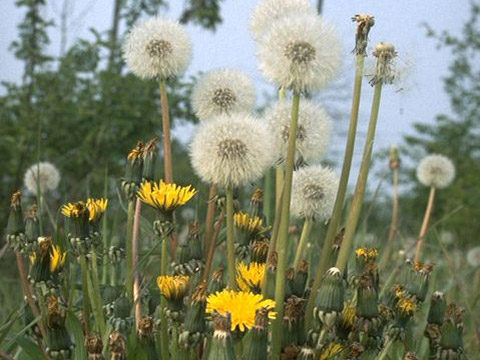
The dandelion is anchored in the soil with a long, strong, fleshy taproot. Above ground, it forms a basal rosette of several, very characteristically scab-like, lobed leaves, which have earned the plant the name ‘lion’s-tooth. A 10 to 15 cm long, hollow flower stalk grows from the leaf axils, bearing a bright yellow flower head composed of numerous golden-yellow, hermaphroditic ray florets. The flowering period is from March to May. The fruits are small, straw-colored, beaked, and bear a propeller-shaped pappus. The small fruits remain on the round flower base until fully ripe. Then the wind lifts them, and they fly with their ‘propeller’, effectively dispersing the plant. The fruits can also be easily blown away by mouth, which is reflected in the popular name ‘blowball’.
All parts of the dandelion have a white milky sap (in branching milk tubes). When the plant is damaged, the sap oozes out spontaneously and stains the skin and clothing brown after a short time.
Medicinally used parts of plants (herbal drug)
The whole plant is used, consisting of the herb and the roots, harvested before flowering (dandelion herb with root - Taraxaci herba cum radice). The root alone (dandelion root - Taraxaci radix), the herb (dandelion herb - Taraxaci herba), or the leaves (dandelion leaves - Taraxaci folium) are also used.
The commercially available drugs are sourced from Eastern European countries.
Constituents of the herbal drug
All parts of the dandelion contain sesquiterpene lactone bitter compounds, triterpene alcohols, phenol glycosides (taraxacoside), flavonoids, and carbohydrates.
Quality of the drug
The quality of the following drugs or drug preparations is specified in the European Pharmacopoeia (Ph. Eur.):
- Dandelion herb with root (Taraxaci herba cum radice)
- Dandelion root (Taraxaci Radix)
Medical applications
Recognised medical use
The HMPC has classified dandelion herb with root, dandelion root, and dandelion leaves as traditional herbal medicinal products (see ‘Traditional use’).
ESCOP: Dandelion leaves - supportive in treatments where increased urinary flow is desirable, e.g. in rheumatism and for the prevention of kidney stones. Dandelion root - to restore hepatic and biliary function; for dyspeptic complaints and loss of appetite.
Traditional use
Dandelion herb with root and dandelion root: Both drugs have been classified by the HMPC as traditional herbal medicinal products (Article 16a of Directive 2001/83/EC). Based upon long-standing use, they can be used to relieve mild digestive complaints (bloating, flatulence, delayed digestion) and temporary loss of appetite. They may also be used to increase urine output and thus flush the urinary tract in cases of mild urinary tract complaints.
Herbal drug preparations in finished dosage forms
- Cut dandelion herb with root, dandelion herb, or dandelion leaves for tea preparation
- Powdered drug in coated tablets
- Dry extracts in coated tablets
- Alcoholic extracts in drops
- Fluid extract in liquid preparations
- Fresh plant-pressed juice as a liquid preparation
- Taraxacum officinale homeopathic mother tincture of the whole plant in liquid preparations
Dosage
Finished medicinal product: See patient information leaflet.
Tea: Drink a cup of warm dandelion tea three times a day (dandelion herb, dandelion herb with root, or dandelion leaves). The tea should be taken half an hour before meals to stimulate appetite and after meals for digestive complaints. Average daily dose: 10 to 30 g of the drug.
Preparation of a tea
Add 3 to 5 g of finely chopped dandelion herb with root, dandelion root, dandelion herb, or finely chopped dandelion leaves to 150 mL of cold water, boil briefly, and strain after approximately 10 minutes.
Notes
If dandelion herbs, dandelion leaves, or dandelion roots are used for flushing therapy, drink sufficient fluids. Dandelion preparations must not be used in cases of kidney disease. If fever, urinary retention, cramps when urinating, or blood in the urine occur during treatment, medical advice should be sought.
Dandelion preparations should not be taken if you are allergic to Asteraceae (cross-allergy possible).
There are no safety studies on the use of dandelion herbs or dandelion root during pregnancy and lactation. The use of children under 12 years of age is not recommended due to a lack of evidence.
Side effects
Bitter substances may increase stomach acidity.
Interactions
None known.
References
Herbal drug monographs
HMPC (2011, 2020, 2022), ESCOP (2003)
WHO (Vol. 3, NIS)
Further literature
Commentary on the European Pharmacopoeia (Dandelion herb with root, No. 1851; Dandelion root, No. 1852)