
Lady's Bedstraw
Botanical name
Galium verum L.
Family
Rubiaceae
Common name
Lady's Bedstraw, Yellow Bedstraw
Information about the plant
Lady’s bedstraw is widespread throughout Europe and also occurs in Western Asia and North America. It mainly grows in meadows, semi-dry grasslands, warm fringe areas, and along roadsides. It prefers sunny, warm locations, often with southern exposure.
The genus name Galium is derived from the Greek word “gala” (= milk), referring to the property of the plant sap, which–similar to the gastric enzyme rennet–causes milk to curdle. In the past, bedstraw was used in cheese-making. The fresh plant juice contains “rennet,” a protease that, together with the plant's polyphenols, causes milk to curdle. The species epithet verum is derived from the Latin ‘verus’ (= genuine). According to Christian legend, the Virgin Mary laid the divine child on the straw of the bedstraw so that the donkey would leave it untouched in the manger. This is why the plant is also known as ‘Our Lady's bedstraw’.
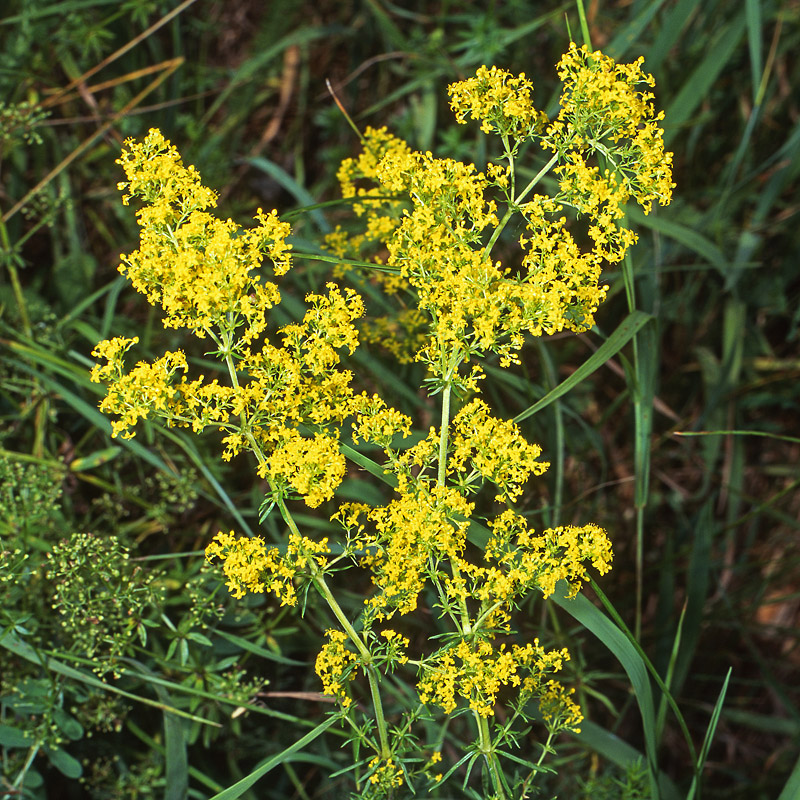
Lady’s bedstraw grows to a height of 30 to 80 cm. The leaves are arranged in whorls of 8 to 12 along the ascending, square stem. The individual leaves are spine-pointed and have rolled margins, giving them a needle-like appearance. Numerous small golden-yellow, four-petaled flowers are arranged in several terminal panicles. The fruits are smooth and black. The flowering period is from May to September.
Medicinally used parts of the herbal drug
The aerial parts harvested and dried during the flowering period (bedstraw – Galii veri herba) are used.
The commercially available drug is obtained from wild collections in Eastern Europe.
Constituents of the herbal drug
Bedstraw contains flavonoids, iridoid glycosides, and phenolic carboxylic acids.
Quality of the herbal drug
The quality of bedstraw (Galii veri herba) is specified in the German Drug Codex (DAC).
Medicinal application
Recognised medicinal use
Bedstraw has not been reviewed by either the HMPC or ESCOP.
Traditional use
Bedstraw has not yet been classified as a traditional herbal medicinal product (Article 16a of Directive 2001/83/EC).
Herbal drug preparations in finished dosage forms
- Chopped bedstraw for tea preparation.
Dosage
Finished medicinal product: Not applicable.
Tea: Drink one cup of bedstraw tea 2 to 3 times daily. Bedstraw tea can also be used externally several times a day as moist compresses.
Preparation of a tea
Add 4 to 5 g of finely chopped bedstraw to approximately 150 mL of boiling water and strain after 10 minutes.
Notes
No studies have yet been conducted on the safety of using bedstraw during pregnancy and lactation. Use in children under 12 years of age is not recommended due to a lack of data.
Side effects
None known.
Interactions
None known.