

Cola Nut
Botanical name
Cola acuminata
(P. Beauv.) Schott & Endl.
Cola nitida (Vent.) Schott & Endl.
Family
Malvaceae
Common name
Cola Nut Tree, Cola Tree, Kola, Abata Cola
Information about the plant
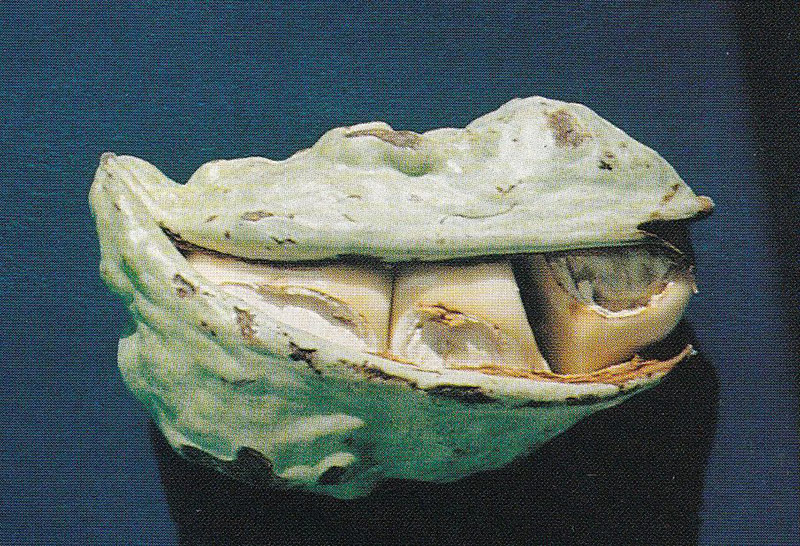
Photo: Teil einer "Kolanuss", aus Hänsel/Hölzl
Cola nuts have been a popular stimulant since ancient times. The kola tree became world-famous when its name was associated with the soft drink ‘Coca-Cola’. This led to a significant increase in demand for cola nuts in the last century, boosting their production enormously. The stimulating effect of cola nuts is due to their caffeine content, found in the seeds. Botanically, the cola nut is not a nut, but the seed of a follicle.
The seeds of two different types of cola are used for pharmaceutical purposes. Cola nitida is native to the hot, humid tropical rainforests of Central Africa and is now cultivated in tropical Africa, tropical South Africa, and tropical Asia to produce ‘nuts’. The species epithet nitida is derived from the Latin “nitidus” (= shimmering, shiny) and refers to its glossy leaves. Cola acuminata is native to tropical West Africa and is now also cultivated in many other tropical regions. Acuminata, from the Latin “acuminatus” (= pointed), probably refers to its pointed leaves.
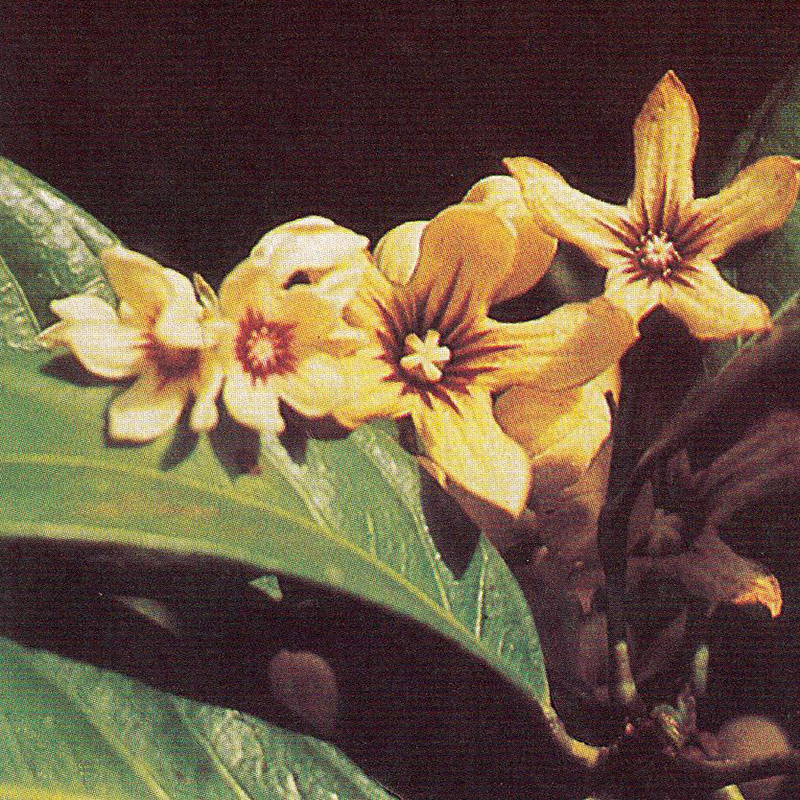
Cola nitida grows to a height of 10 to 15 meters with a tall, unbranched trunk. The leaves are long-petioled, elongated, ovate, and often drooping at the tip. It has 2.5 cm wide hermaphroditic and slightly smaller male flowers; the perianth is white to yellowish and five-lobed. After fertilization, a large star-shaped aggregate fruit develops with five short-stemmed, horizontally spread partial fruits with thick, leathery pericarp. When ripe, they shine green or brownish. Inside are up to ten kidney-shaped seeds (cola nuts) surrounded by a tough white seed coat (pulp). Their taste is juicy and bitter.
Cola acuminata grows up to 20 meters tall, with sparse foliage and branching starting above ground level. The fruits are also star-shaped, with five dark brown segments up to 20 cm long and 5 cm wide. These contain up to 14 seeds, arranged in two rows, egg-shaped or angular, 2 to 2.5 cm in diameter, with a white fleshy seed coat.
Medicinally used parts of plants (herbal drug)
The dried seeds removed from their husks (cola seeds – Colae semen) are used. They are supplied by Nigeria and other West African countries.
Constituents of the herbal drug
Cola seeds contain caffeine (approximately 2.5%) and a small amount of theobromine (0.1%). They also contain catechin, epicatechin, tannins, and oligomeric procyanidins. The starch content is approximately 40%. Small amounts of proteins, sugars, and minerals are also present.
Quality of the drug
The quality of cola seeds (Colae semen) is specified in the European Pharmacopoeia (Ph. Eur.).
Medical applications
Recognised medical use
The HMPC has classified cola seeds as a traditional herbal medicinal product (see ‘Traditional use’).
ESCOP: For the treatment of short-term physical and/or mental exhaustion. These applications are based on long-standing use in humans.
Traditional use
Cola seeds have been classified by the HMPC as a traditional herbal medicinal product (Article 16a of Directive 2001/83/EC). Based upon long-standing use, cola seeds can be used to treat symptoms of fatigue and sensation of weakness.
Herbal drug preparations in finished dosage forms
Cola seeds are available under the name "kola nuts" in powder, extract, liquid extract, and tincture forms.
Extracts from cola seeds are included in many liquid preparations, such as soft drinks, which are considered food products. Today, caffeine isolated from cola seeds is mainly added. Coca-Cola no longer contains cola seed extract, only caffeine.
Dosage
Finished preparations: See patient information leaflet or instructions for use.
Tea: For fatigue, drink one cup of warm cola seed infusion three times a day. Daily dose: 2 to 6 g of the drug (or equivalent preparations).
Preparation of a tea
Pour 150 mL of boiling water over 1 to 3 g of crushed cola seeds and strain after 5 minutes.
Notes
Cola seeds should not be used in cases of stomach or duodenal ulcers, high blood pressure, cardiac arrhythmia, or hyperthyroidism. Not recommended before bedtime, as their caffeine content may cause sleep disturbances.
No studies are available on the safety of cola seeds for use in children and adolescents under 18 years of age; use is not recommended.
Side effects
Possible insomnia, cardiovascular disorders such as hypertension and arrhythmia, nervous restlessness, or gastric and duodenal ulcers.
Interactions
Enhanced effect when combined with psychoanaleptic drugs.
References
Herbal drug monographs
HMPC (2012, 2021), ESCOP (2014)
Further literature
Commentary on the European Pharmacopoeia (Cola seeds, No. 1504)