

Mallow
Botanical name
Wild mallow -
Malva sylvestris L.
Common mallow -
Malva neglecta Wallr.
Family
Malvaceae
Common name
Blue Mallow, High Mallow, Round Dock, Cheeses, Dwarf Mallow, Cheeseweed
Information about the plant
The wild mallow and the common mallow likely originated in southern Europe and Asia but are now widespread in subtropical and temperate zones of both hemispheres. They grow on nitrogen-rich soils in warm locations.
The name was taken directly from the Latin ‘Malva’, though its origin is unclear. The species epithet sylvestris means ‘growing in the forest’ (Latin ‘silva’ = forest), synonymous with ‘growing wild’. The species epithet neglecta derives from the Latin ‘neglectus’ (= neglected, unnoticed), referring to plants initially overlooked in taxonomic classification. Linné did not list this mallow separately; the species was only recently described by Wallroth. In German, the common mallow is also called ‘Käsepappel’, which has nothing to do with the poplar tree. The word ‘cheese’ (Käse) refers to the cheese-like shape of the fruit, while ‘poplar’ (Pappel) refers to an edible pulp (= ‘cardboard’) prepared from the mucilaginous leaves. In the past, this was also used medicinally as a wound compress (cataplasm).
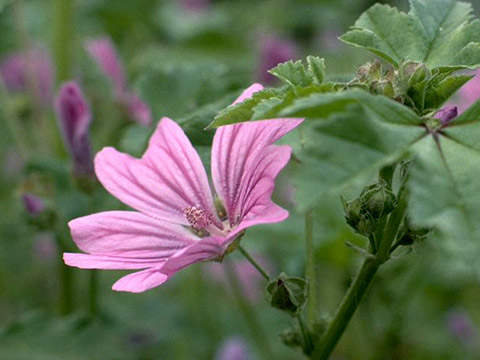
The wild mallow is 30 to 120 cm taller than the common mallow, which is only 10 to 50 cm tall. Both mallows are branched, prostrate to arching. The leaves are roundish or kidney-shaped, cordate at the base, and 5- to 7-lobed. The flowers are borne on long stalks, and the sepals are hairy. The five petals of the wild mallow are pinkish-purple to purple, each with three dark longitudinal stripes, 20 to 30 mm long. The five petals of the common mallow are light pink to white with slightly darker veins, 15 mm (maximum 20 mm) long. The wild mallow flowers from May to September; the common mallow, from June to November. Malva sylvestris is divided into 2 subspecies: M. sylvestris subsp. mauritiana (L.) Boiss ex Cout., the Mauritanian wild mallow, and M. sylvestris L. subsp. sylvestris, the common wild mallow.
Medicinally used parts of plants (herbal drug)
The leaves of the wild mallow and the common mallow (mallow leaves - Malvae folium) are used.
The commercially available leaf drug is sourced from Bulgaria, Albania, and Morocco.
The flowers of the wild mallow are used medicinally, with both subspecies (subsp. sylvestris and subsp. mauritiana) serving as mother plants (mallow flowers - Malvae sylvestris flos).
The commercially available flower drug is sourced from Hungary, the Czech Republic, and some Balkan countries.
Constituents of the herbal drug
Mallow leaves contain mucilage and flavonoids; mallow flowers contain mucilage and anthocyanins (violet-blue coloring agents).
Quality of the drug
The quality of the following drugs or drug preparations is specified in the European Pharmacopoeia (Ph. Eur.):
- Mallow leaves (Malvae folium)
- Mallow flowers (Malvae sylvestris flos)
Medical applications
Recognised medical use
The HMPC has classified mallow leaves and mallow flowers as traditional herbal medicinal products (see ‘Traditional use’).
ESCOP: Mallow flowers: Dry cough, irritation of the mucous membranes of the mouth, throat, and stomach.
Traditional use
The HMPC has classified mallow leaves and mallow flowers as traditional herbal medicinal products (Article 16a of Directive 2001/83/EC). Based upon long-standing use, mallow leaves and flowers can be used as a soothing medication for irritation of the mucous membranes of the mouth and throat, as well as for associated dry, irritating coughs, and for the relief of mild gastrointestinal complaints.
Herbal drug preparations in finished dosage forms
- Cut mallow leaves for tea preparatio
- Cut mallow flowers for tea preparation
Dosage
Finished medicinal product: See patient information leaflet.
Tea: Drink a cup of mallow leaf tea or mallow flower tea several times a day. Daily dose: 5 g. A combination with other drugs is beneficial, e.g. linden blossom, ribwort, chamomile blossom (cold tea).
Preparation of a tea
Add 2 to 4 g of finely chopped mallow leaves or 1 to 2 g of finely chopped mallow flowers to 150 mL of cold water and briefly bring to the boil, or pour boiling water over. Strain after 5 to 10 minutes. Leave to stand for 5 to 10 hours as a cold infusion, then boil briefly before drinking.
Notes
No safety studies are available on the use of mallow leaves or flowers during pregnancy and lactation. Its use is not recommended for coughs in children under 6 years of age, as these symptoms should be treated by a doctor.
Side effects
None known.
Interactions
None known.
References
Herbal drug monographs
Further literature
Commentary on the European Pharmacopoeia (Mallow leaves, No. 2931; Mallow flowers No. 1541)