

Curly Mint
Botanical name
Mentha crispa is a collective term for several curled-leaf Mentha species, such as M. aquatica L. var. crispa (L.) Benth., M. spicata L. var. crispa (Benth.) Danert, M. longifolia (L.) Huds. var. crispa (Benth.) Danert, and other Mentha species and forms. The list of botanical names for Mentha crispa in the literature is inconsistent, and numerous synonyms exist.
Family
Lamiaceae
Common name
Curled Mint, Curly Mint, Crinkled Mint
Information about the plant
The genus name Mentha is derived from the nymph Minthe. According to Greek mythology, she was transformed into the plant known in ancient times as “minthe” or “mintha”. Curled mint is characterized by its curled leaves (Latin: “crispus” = curled), as seen in the above-mentioned varieties of M. aquatica (water mint), M. spicata (spearmint), and M. longifolia (horse mint). These species differ in their habit, which is why no uniform botanical description can be given for ‘curly mint’.
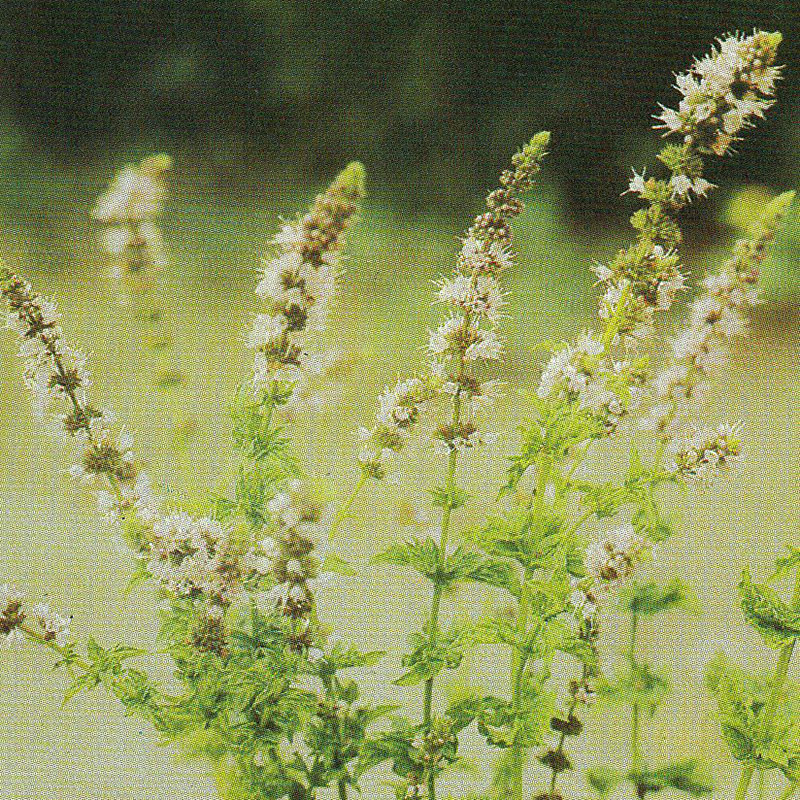
As is typical of Lamiaceae, the curled, serrated leaves are arranged in opposite pairs on a square stem, and the flowers form dense spikes. The corolla, with upper and lower lips, is pale purple, pink, or white.
An important aspect of using the above-mentioned Mentha varieties as ‘curly mint’ is their spearmint-like aroma, released when the leaves are rubbed. This oil is marketed as ‘spearmint oil’ and is used worldwide to flavor mouthwashes, toothpaste, and chewing gum, among other products. The leaves themselves are used to season meat dishes, salads, vegetables, and sauces. The demand for curly mint is high, so it is cultivated in many countries.
Medicinally used parts of plants (herbal drug)
The leaves (curly mint leaves – Menthae crispae folium) are used for their intense spearmint aroma, caused by essential oil rich in (−)-L-carvone. It is extracted by steam distillation.
Main cultivation areas: North America, China, India, England, CIS countries.
Constituents of the herbal drug
Curly mint leaves contain essential oil (spearmint oil), Lamiaceae tannins (mainly rosmarinic acid), flavonoids. Spearmint oil contains 40–80% (−)-L-carvone, plus (−)-dihydrocarvone, dihydrocuminyl acetate, limonene, other monoterpenes, and sesquiterpenes.
Quality of the drug
There is no pharmacopoeial quality description available for curly mint leaves (Menthae crispae folium).
The quality of spearmint oil (Menthae crispae aetherolum) is specified in the German Drug Codex (DAC). The listed source plants are M. spicata L. var. crispa (L.) Benth., M. aquatica Hell. var. crispa (L.) Benth., and M. longifolia Nath. var. crispa Benth.
Medical applications
Recognised medical use
Curly mint leaves and spearmint oil have not been evaluated by HMPC or ESCOP.
Curly mint leaves are commonly used similarly to peppermint leaves as a carminative (to relieve flatulence) for digestive complaints, while spearmint oil is used for inhalation to treat colds. It is often found in mouthwashes and toothpaste.
Traditional use
Curly mint leaves and spearmint oil have not been classified as traditional medicinal products.
Curly mint leaves: To support digestive function (traditional use according to Article 16a of Directive 2001/83/EC).
Herbal drug preparations in finished dosage forms
- Curly mint leaves for tea preparation
- Spearmint oil as a flavoring agent in some liquid medicines, mouthwashes, and toothpastes
Dosage
Curly mint leaves as tea: Drink one cup of freshly prepared warm curly mint tea several times a day. For inhalation, add 3 to 4 drops of spearmint oil to hot water and inhale.
Preparation of a tea
Pour 150 mL of hot water (not boiling!) over 1.5 g of crushed curly mint leaves for 5 to 10 minutes, then strain.
Notes
Curly mint leaves and spearmint oil are mainly used in folk medicine. Therefore, no detailed information on adverse effects and safety is available. The use during pregnancy or lactation, and in children, is not recommended.
Side effects
Use caution with spearmint oil. Undiluted oil must not come into contact with mucous membranes or broken skin. Sensitive patients may develop adverse respiratory reactions after inhalation.
Interactions
None known.