
Kava-kava
Botanical name
Piper methysticum G. Forst.
Family
Piperaceae
Common name
Kava Pepper, Kava
Information about the plant
The rhizome of kava-kava was already being used on the Pacific Islands more than 3,000 years ago in religious ceremonies. From there, knowledge of its effects spread to the Indigenous peoples of Australia and Hawaii and eventually to the United States. Kava-kava has relaxing, performance-enhancing, and anxiolytic effects. In higher doses, it can cause euphoria. Kava-kava was, and still is, consumed at religious festivals. The rhizome is either chewed or mixed with water or coconut milk and drunk.
The “intoxicating” property of kava-kava is reflected in the species epithet methysticum, derived from the Greek word methystikos (= intoxicating, intoxication). The actual origin of kava-kava is unknown, and no wild form is known today, only several sterile cultivated varieties (producing only male flowers). These are grown on many Pacific Islands between the northern and southern tropics and in New Guinea.
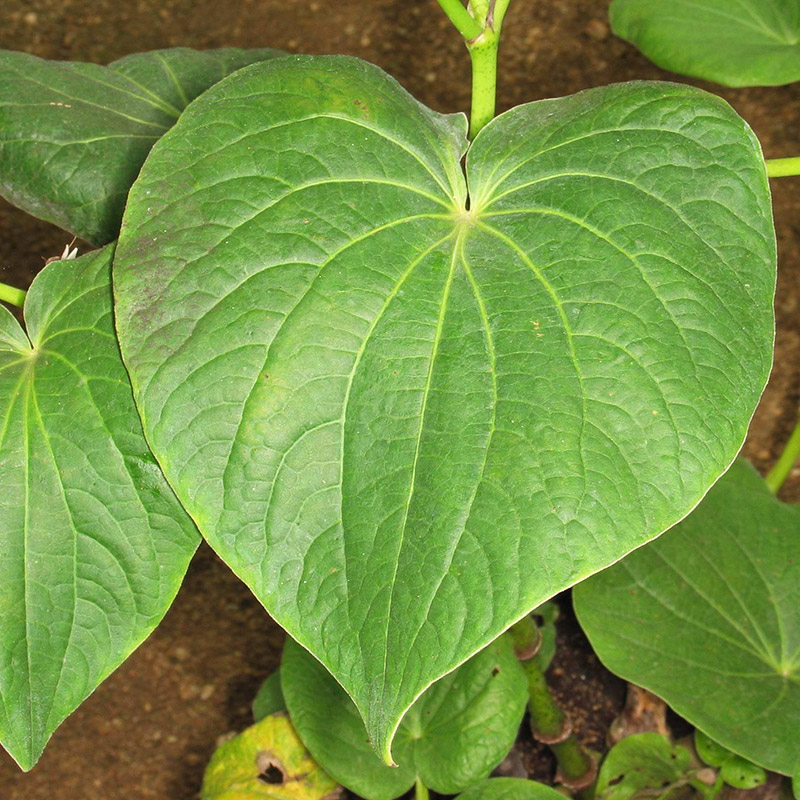
Kava-kava is a 2 to 3 meters tall, dioecious shrub with a knotty main stem. Its leaves are very large (13–28 cm long, 10–22 cm wide), downy on the underside, deeply cordate at the base, and have large stipules. Numerous small flowers are arranged in spike-like clusters up to 9 cm long. The dried rhizome consists of irregular transverse and longitudinal pieces, varying considerably in size and shape: 3 to 20 cm in length and 1 to 5 cm in diameter.
Medicinally used parts of plants (herbal drug)
The dried rootstock (kava-kava rootstock – kava-kava rhizoma) is used after it has been peeled, cut, and usually stripped of its roots. The drug typically comes from crops in Polynesia and Melanesia.
Constituents of the herbal drug
Kava-kava rootstock contains 5 to 6% kava pyrones (styrylpyrones, kavalactones), including kavain, dihydrokavain, methysticin, dihydromethysticin, and yangonin, as well as chalcones (flavokavin A to C) and flavanones.
Quality of the drug
The quality of kava-kava rootstock was previously specified in the German Drug Codex (DAC). Today, the drug is no longer permitted for medicinal purposes; therefore, no current pharmacopoeia quality description is available.
Medical applications
Recognised medical use
In 2018, the HMPC concluded in a public statement that, following an assessment of the risk-benefit ratio, the risks of kava-kava rootstock outweigh the benefits. Serious liver damage, in some cases fatal, had been observed in humans using kava-kava rootstock; in addition, carcinogenic potential was also demonstrated in animals.
The 2003 ESCOP monograph likewise refers in detail to the hepatotoxic effects. The indication listed was anxiety, tension, and restlessness of various non-psychotic origins.
Traditional use
Not applicable.
Herbal drug preparations in finished dosage forms
Kava-kava rootstock is no longer used medicinally for the reasons outlined above. In 2007, after years of dispute with drug manufacturers in Germany, approval for all kava-kava-containing drugs was revoked due to suspected harmful effects. In February 2015, this decision was overturned in court, provided that measures were taken to ensure products could be marketed without posing an unacceptable risk to public health. This decision was confirmed in court in 2019, making a possible comeback for kava-kava medicines seem likely. However, as the HMPC (see above) classified the benefit-risk ratio as negative at the European level in 2018, the German authority (BfArM) felt compelled to act and accepted the HMPC's assessment, especially since the documents submitted by the manufacturers in the meantime were unable to refute the HMPC's concerns about kava-kava-containing medicines. The authorization of such medicines was therefore revoked again.
Homeopathic kava-kava medicines from D4 onwards are not affected by this revocation.
Dosage
Not applicable.
Preparation of a tea
Not applicable.
Notes
The use of products containing kava-kava rootstock is not recommended, as hepatotoxic effects cannot be ruled out. Unusual tiredness, weakness, loss of appetite, and weight loss are signs of possible liver damage, as are yellowing of the conjunctiva or skin, dark urine, and pale stools.
Side effects
See notes. Accommodation disorders, pupil dilation, and balance disorders are possible.
Interactions
An increase in the effects of central active drugs (including barbiturates, psychotropic drugs) and alcohol is possible.