

Lungwort
Botanical name
Pulmonaria officinalis L.
Family
Boraginaceae
Common name
Lungwort, Common Lungwort, Jerusalem Cowslip
Information about the plant
Lungwort is native to Europe and can be found from central Sweden to central Italy, as well as in central and southern Russia. It prefers moderately moist soils and commonly grows in herb-rich beech and mixed beech forests, as well as in moist riparian woodlands. In the Alps, lungwort is found in high montane coniferous forests.
Due to its lung-like leaves, lungwort has been used as a medication for lung diseases since the 15th century. The cloudy white spots on the upper surface of the leaves were thought to resemble pulmonary alveoli and, according to the doctrine of signatures, it was used as a medication for diseases of the upper respiratory tract and lungs. The botanical genus name Pulmonaria also reflects this traditional use (Latin “pulmo” = lung, “pulmonaris” = healing for the lungs). The species epithet officinalis suggests that it is an old medicinal plant, as the “officina” is the salesroom of a pharmacy and “officinalis” means commonly "used in the pharmacy".
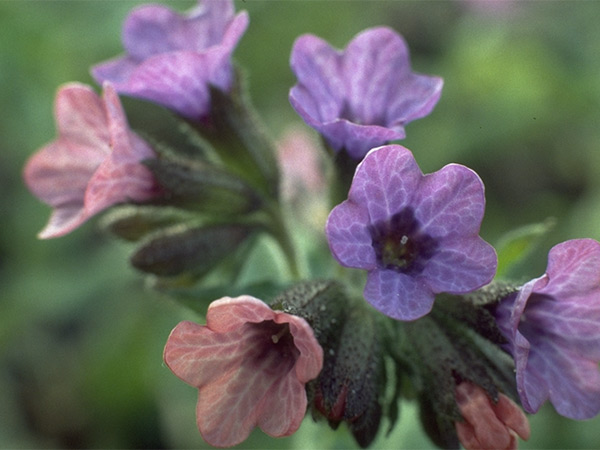
Flower spikes and leaf rosettes emerge simultaneously from an underground rhizome. The rosette leaves and the four to seven stem leaves are very rough to the touch, characteristic of rough-leaved plants, as they are covered with short, spiny tubercles (aculeoli), between which long bristles are found. The slightly whitish spots on the upper leaf surface are distinctive. There are several flowers at the end of a 10- to 20-meter-high stem. The corolla tubes are enclosed within narrow, five-lobed calyx tubes. Pale pink, purple, and blue flowers appear simultaneously due to a color change during the flowering period. A ring of hairs can be seen inside the corolla tube. The flowering time is from March to April.
Medicinally used parts of plants (herbal drug)
The dried herb harvested at flowering time, consisting of leaves, flowers, and stems (Pulmonaria herba), is used.
The commercially available drug is sourced from the northern Balkan countries.
Constituents of the herbal drug
Lungwort contains mucilage polysaccharides, tannins, flavonoids, and allantoin; mineral substances include silicic acid.
Quality of the drug
The quality of the lungwort (Pulmonariae herba) is specified in the German Pharmacopoeia (DAB).
Medical applications
Recognised medical use
Lungwort has not been evaluated by the HMPC or the ESCOP.
Traditional use
Lungwort has not been classified as a traditional medicinal product according to Article 16a of Directive 2001/83/EC.
Herbal drug preparations in finished dosage forms
Cut lungwort for tea preparation, but only up to 5 g per 100 g of tea in mixtures as an ‘other ingredient’.
Dosage
Finished medicinal product: Not applicable.
Tea: Not applicable.
Preparation of a tea
Not applicable.
Notes
As there are no data on the risks associated with the use of lungwort and more effective herbal alternatives are available for coughs, the use of lungwort during pregnancy and lactation, as well as in children and adolescents under 18 years of age, is not recommended.
Side effects
None known.
Interactions
None known.
References
Herbal drug monographs
None available.
Further literature
Commentary on the German Pharmacopoeia (Lungwort).