

Blackthorn
Botanical name
Prunus spinosa L.
Family
Rosaceae
Common name
Sloe berry bush, Sloe, European blackthorn
Information about the plant
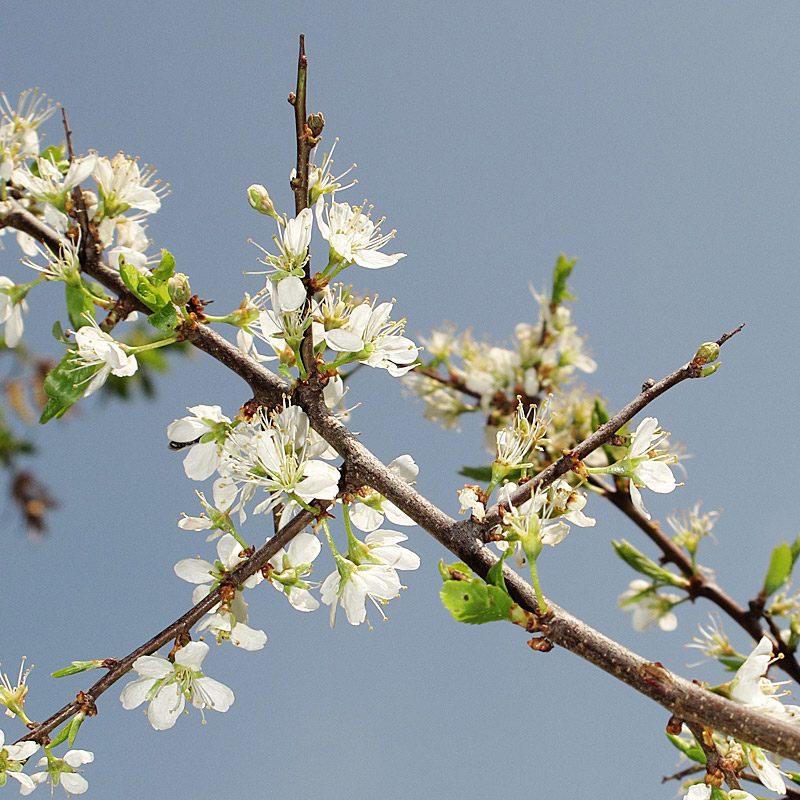
Photo: P. Schönfelder
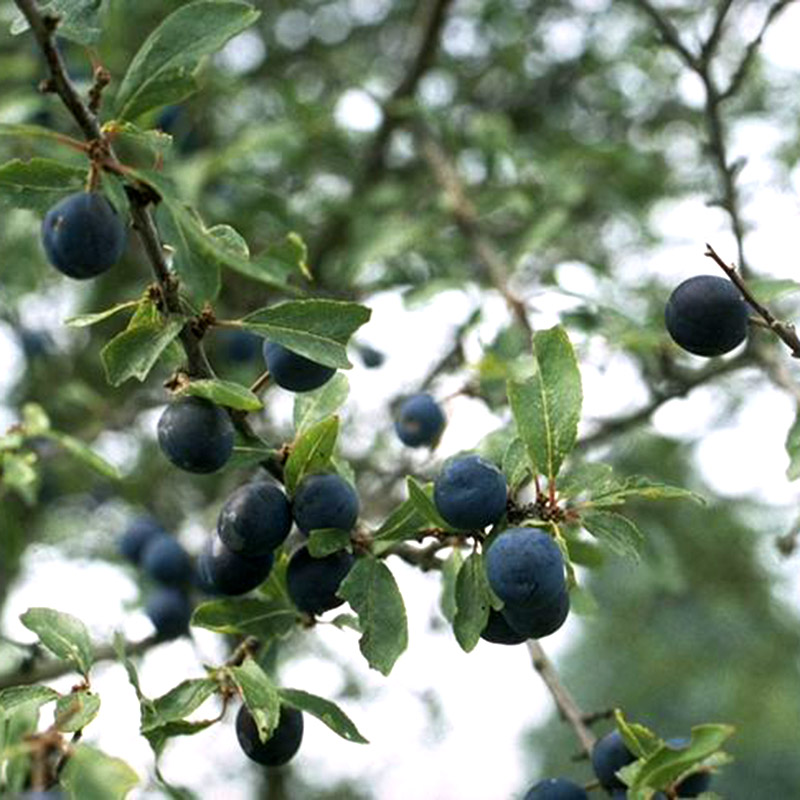
Blackthorn, also known as European blackthorn or sloe, is primarily found in Europe, extending north to southern Scandinavia, south to North Africa, and east to the Caspian Sea. It is a shrub about 4 m tall with numerous sparse, heavily thorny branches, which is reflected in the species epithet spinosa (Latin ‘spinosus’ = thorny). The long and short shoots often grow at a 90° angle to one another, which makes the shrub appear densely branched. The bark of the branches is black, which is why the shrub is also called “blackthorn”. The genus name Prunus was adopted directly from Latin and means “plum tree,” from “prunum” (= plum). Blackthorn is closely related to the plum tree (Prunus domestica).
The shrub is particularly decorative during flowering (March to April), when numerous white flowers bloom on the still-bare branches, resembling a wedding dress. After the flowers have faded, the narrow leaves, 2 to 4 cm long, become visible.
The berry-like stone fruits (drupes) do not ripen until October or November; they are bluish-black and have a waxy bloom. The pulp is green, tastes sour and astringent (tannins!), and only becomes more palatable after frost. The stone cannot be separated from the pulp.
Medicinally used parts of plants (herbal drug)
The fully opened, dried flowers (blackthorn flowers – Pruni spinosae flos) and the fresh or dried fruits harvested in late autumn (blackthorn fruits – Pruni spinosae fructus) are used.
Commercially available blackthorn flowers come from wild collections in eastern and southern Europe.
Constituents of the herbal drug
Blackthorn flowers contain flavonoids, triterpenes, and sterols. Blackthorn fruits contain tannins.
Quality of the drug
The quality of blackthorn flowers (Pruni spinosae flos) is specified in the German Drug Codex (DAC). No pharmacopoeial quality specification is available for blackthorn fruits (Pruni spinosae fructus).
Medical applications
Recognised medical use
Blackthorn flowers
The HMPC discontinued work on blackthorn flowers and blackthorn twig tips due to insufficient data.
ESCOP: Blackthorn flowers have not been reviewed.
In folk medicine, blackthorn flowers are used to treat colds, digestive problems, bladder and kidney complaints, and for “blood purification.”
Blackthorn fruits
Blackthorn fruits have not been evaluated by either the HMPC or ESCOP.
Traditional use
Blackthorn flowers and blackthorn fruits have not yet been classified as traditional herbal medicinal products (Article 16a of Directive 2001/83/EC).
Herbal drug preparations in finished dosage forms
- Blackthorn flowers for tea preparation
- Blackthorn fruits for aqueous infusion
Dosage
Finished medicinal products: Not applicable.
Herbal tea: Blackthorn flowers: Drink one cup of blackthorn flower tea 1 to 2 times daily, or 2 cups in the evening.
Blackthorn fruits: Gargle or rinse the mouth with tea several times daily.
Preparation of a tea
Blackthorn flowers: Pour approximately 150 mL of boiling water over 1 to 2 g of blackthorn flowers and strain after 5 to 10 minutes.
Blackthorn fruits: Pour 150 mL of boiling water over 1 to 2 g of finely chopped fruits and strain after 10 minutes.
Notes
There are currently no studies available on the safety of blackthorn flowers and blackthorn fruit during pregnancy and lactation. Use in children and adolescents under 18 years of age is not recommended due to a lack of evidence.
Side effects
None known.
Interactions
None known.