

Common Evening Primrose
Botanical name
Oenothera biennis L.
Family
Onagraceae
Common name
Evening primrose, Evening star, Sundrop, King's cure-all, Fever-plant, German rampion
Information about the plant
The common evening primrose is native to North America and was introduced to Europe in the 17th century. It now grows throughout Europe in sunny locations, except in the far north and far south, on railway embankments, sandy fields, rubbish dumps, quarries, and riverbanks. It is cultivated in America and Europe to extract evening primrose oil from its seeds.
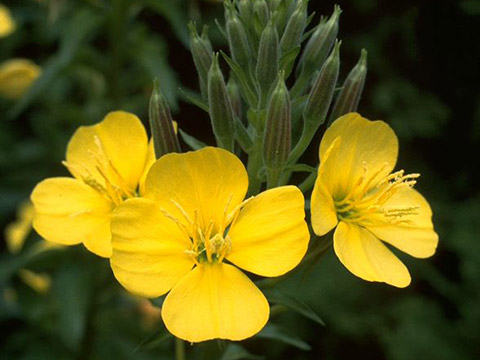
The genus name Oenothera is derived from the Greek words ‘oinos’ (= wine) and ‘ther’ (= wild animal), as in ancient times it was believed that the wine-scented root could be used to tame wild animals. The species epithet biennis means “biennial.” The common name evening primrose refers to its large, pale-yellow flowers, which grow in candle-shaped inflorescences and only bloom in the evening or at night.
The evening primrose is biennial. In the first year, it only forms a rosette of leaves pressed to the ground. In the second year, a stem up to 1 m high develops, branching in the upper part. The stem leaves are short-petioled, elongated-lanceolate, about 10 cm long, and finely toothed. The light yellow, fragrant 2.5 to 3 cm flowers grow in spikes. After fertilization, elongated, four-sided, downy capsules up to 3 cm long develop, containing over 200 small, dark gray to brown-black seeds. The flowering period is from June to September.
The red-calyx evening primrose, Oenothera lamarckiana de Vries, which is also found in Europe and America, can also be used to extract evening primrose oil. It is considered to be a hybrid with red-striped sepals and larger flowers (4 to 6 cm long).
Medicinally used parts of plants (herbal drug)
The fatty oil obtained from the crushed seeds by hot pressing and refining (purification) is used (refined evening primrose oil - Oenotherae oleum raffinatum).
Cold-extracted evening primrose oils using solvents (hexane) are also available, whereby the solvent is removed by distillation.
The oil is sourced from various countries in Europe and America.
Constituents of the herbal drug
Evening primrose oil consists of triglycerides, predominantly double-unsaturated linoleic acid (65 to 80% of the oil). Its content of γ-linolenic acid, a triple-unsaturated fatty acid, is 8 to 14%.
Quality of the drug
The quality of refined evening primrose oil (Oenotherae oleum raffinatum) is specified in the European Pharmacopoeia (Ph. Eur.).
Medical applications
Recognised medical use
The HMPC has classified evening primrose oil as a traditional herbal medicinal product (see “Traditional use”).
ESCOP: Evening primrose oil has not been reviewed.
Traditional use
The HMPC has classified evening primrose oil as a traditional herbal medicinal product (Article 16a of Directive 2001/83/EC). Based upon long-standing use, evening primrose oil can be used internally to relieve itching in acute or chronic dry skin.
Herbal drug preparations in finished dosage forms
Evening primrose oil in soft capsules.
Dosage
Finished medicinal product: See patient information leaflet.
Take 2 g of evening primrose oil 2 to 3 times daily. The daily dose is 4 to 6 g. The oil can be ingested directly or mixed into food.
Preparation of a tea
Not applicable.
Notes
Patients with undiagnosed epilepsy may develop temporal lobe seizures. Patients with schizophrenia may also be affected. Patients with known epilepsy should be carefully monitored.
During pregnancy, common evening primrose oil should only be taken when strictly indicated. The use of evening primrose oil in children under 12 years of age is not recommended due to a lack of evidence.
Side effects
Nausea, indigestion, and headaches may occur. Hypersensitivity reactions of the skin are also possible.
Interactions
None known.
References
Herbal drug monographs
Further literature
Commentary on the European Pharmacopoeia (Refined evening primrose oil, No. 2104)