

Castor oil plant
Botanical name
Ricinus communis L.
Family
Euphorbiaceae
Common name
Castor bean, Palma Christi, Miracle tree
Information about the plant
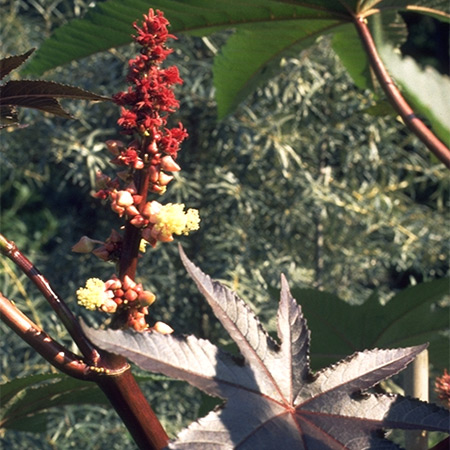
The origin of the castor oil plant is still unclear. Its seeds were found in Egyptian tombs dating back to 4000 BC, but it remains uncertain whether the plant originated in India or Ethiopia. Today, it is cultivated in all warmer countries and grows in Mediterranean regions as a tree-like shrub 3 to 5 m high, while in the tropics and subtropics it grows up to 12 m high. North of the Alps and in temperate America, it reaches a height of only 2 m and thus resembles a bushy herb. It is exceptionally fast-growing, which is why it is also called the “miracle tree”. The castor oil plant is known for its large, long-petioled, palmately lobed leaves, which are greenish or reddish in color. The inflorescence is panicle-like, 15 to 50 cm long, with male flowers clustered at the base and female flowers on stalks at the top.
Its decorative seeds are very popular. They are found in walnut-sized, softly spiny, three-compartment capsules, each containing one seed. The seeds are bean-sized and have a hard, reddish-brown marbled shell. The marbled appearance resembles a dog tick or wood tick (Latin: ricinus), which explains the genus name Ricinus. The species epithet communis means common, i.e., widespread and not rare.
Castor seeds are used in India and Africa to make decorative necklaces. This is not without risk, as the seeds are highly toxic (caution with children!). They contain ricin, a protein consisting of two chains. Its B-chain mediates the uptake of the A-chain into the cell, where it inactivates the ribosome and inhibits protein synthesis. The cell responds with programmed cell death (apoptosis). Symptoms of intoxication include nausea, bloody vomiting, bloody diarrhea, and ultimately circulatory collapse.
Medicinally used parts of plants (herbal drug)
The fatty oil from the seeds is used, obtained by cold pressing (virgin castor oil - Ricini oleum virginale). The toxic ricin does not pass into the oil but remains in the press cake, which is used as fertilizer.
Constituents of the herbal drug
Castor oil consists of 70% triricinolein, a triglyceride of unsaturated ricinoleic acid (12-hydroxyoleic acid). Other fatty acids include oleic, linoleic, palmitic, and stearic acids; ß-sitosterol.
Quality of the drug
Thequality of the following drugs is specified in the European Pharmacopoeia (Ph. Eur.):
- Virgin castor oil (Ricini oleum virginale)
- Refined castor oil (Ricini oleum raffinatum)
- Hydrogenated castor oil (Ricini oleum hydrogenatum)
Medical applications
Recognised medical use
The HMPC has classified castor oil as a laxative for the short-term treatment of occasional constipation as a “well-established use”.
ESCOP: Castor oil has not been reviewed.
Since castor oil, unlike all other oils, is soluble in diluted alcohol (70%), it is also used as a hair and skin care product when dissolved in alcohol (70%).
Traditional use
No listing as a traditional herbal medicinal product (Article 16a of Directive 2001/83/EC).
Herbal drug preparations in finished dosage forms
There are no finished medicinal products available. The oil can be used directly, possibly with raspberry syrup to improve the taste, or in soft gelatin capsules.
Dosage
1 to 2 tablespoons or 4 to 6 g (10 to 30 mL) as a single dose. At higher doses, defecation occurs within 2 to 4 hours; at lower doses, after 6 to 8 hours.
Preparation of a tea
Not applicable.
Notes
Castor oil should only be taken for no longer than 1 to 2 weeks. It should not be used in cases of intestinal obstruction, acute inflammatory bowel disease (ulcerative colitis, Crohn's disease), abdominal pain of unknown origin, or bile duct disease.
Castor oil must not be used during pregnancy, as ricinoleic acid absorbed into the blood vessels releases prostaglandin E2, which can trigger uterine contractions. Use during lactation is also not recommended. The dose must be reduced when used in children and adolescents (5 to 15 mL).
Side effects
Spasmodic gastrointestinal symptoms may occur.
Interactions
Drugs with a narrow therapeutic range (e.g., digitalis preparations, Marcurmar) must not be taken at the same time, but only after bowel evacuation.
References
Herbal drug monographs
Further literature
Commentary on the European Pharmacopoeia (Virgin castor oil, No. 0051; Refined castor oil, No. 2367; Hydrogenated castor oil, No. 1497)