

Couch grass
Botanical name
Agropyron repens (L.) P. Beauv. (Syn. Elymus repens (L.) Gould)
Family
Poaceae
Common name
Quackgrass, Common couch, Twitch, Dog grass, Witchgrass, Quickgrass, Wickens, Grandmother grass
Information about the plant
Couch grass is a grass that is widespread throughout the Northern Hemisphere. It has also been introduced to Greenland, South America, Australia, and New Zealand. It grows on roadsides, in fields, and on garden land and is widespread as a weed.
The genus name Agropyron is derived from the Greek ‘agrios’ (= wild) or ‘agros’ (= field) and ‘pyros’ [= wheat (grain)], meaning ‘wild wheat’, which makes it clear that some species to wheat. The species epithet repens translates as ‘creeping’, referring to the underground creeping parts of the plant (rhizome, rootstock). Couch grass owes its name to these creeping rhizomes, which make it a highly proliferative weed that is difficult to control. The currently accepted name, Elymus repens (L.) Gould, is based on molecular genetic studies.
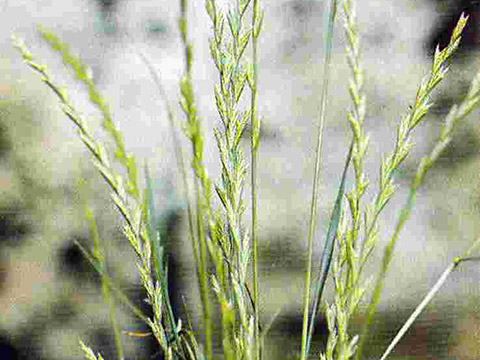
Couch grass is a grass that grows to a height of 20 cm to 1.5 m with an underground, creeping rhizome (an underground shoot). The stem, called a “culm” in grasses, is erect. The leaf sheaths are bright green or blue-gray, 5 to 15 mm wide, flat, and rough to the touch due to many short hairs. The leaf veins appear as white lines when held up to the light. The spikes are about 10 cm long; the spikelets are 3- to 5- flowered and arranged in two rows on the spike axis. The glumes end in a 2 to 4 mm long awn-like tip. The flowering period is from July to September.
Medicinally used parts of plants (herbal drug)
The whole or cut rhizome (couch grass rhizome - Graminis rhizoma), which has been cleaned of secondary roots, washed, and dried, is used. The Latin name for the drug is derived from the Latin word ‘gramen’ (= grass, genitive: ‘graminis’).
The commercially available drug is sourced from various Balkan countries.
Constituents of the herbal drug
Couch grass rhizome contains mucilage, polysaccharides (tricin), and sugar alcohols.
Quality of the drug
The quality of couch grass rhizome (Graminis rhizoma) is specified in the European Pharmacopoeia (Ph. Eur.).
Medical applications
Recognised medical use
The HMPC has classified couch grass rhizome as a traditional herbal medicinal product (see “Traditional use”).
ESCOP: For the treatment of irritable bladder and other urinary tract disorders.
Traditional use
Couch grass rhizome has been classified by the HMPC as a traditional herbal medicinal product (Article 16a of Directive 2001/83/EC). Based upon long-standing use, couch grass rhizome can be used to increase urine output and to flush the urinary tract, providing relief for mild urinary tract complaints.
Herbal drug preparations in finished dosage forms
- Cut couch grass rootstock for tea preparation
- Fluid extracts in liquid preparations
- Tinctures in drops
Dosage
Finished medicinal product: See patient information leaflet.
Tea: Drink one cup of couch grass rhizome tea 2 to 4 times daily. Daily dose 10 to 20 g of the drug. It may be combined with other herbal drugs such as restharrow root, goldenrod herb, birch leaves, or stinging nettle leaves (bladder and kidney tea, urinary tea).
Preparation of a tea
Pour approximately 150 mL of boiling water over 5 to 10 g of chopped couch grass rhizome and strain after 10 minutes.
Notes
During flushing therapy, it is important to drink plenty of fluids! Flushing therapy with couch grass rhizome should not be used in cases of edema due to impaired heart or kidney function. If fever, urinary retention, cramps when urinating, or blood in the urine occur during treatment, medical advice should be sought.
No studies on the safety of using couch grass rhizome during pregnancy and lactation are available. Use in children and adolescents under 18 years of age is not recommended due to a lack of evidence.
Side effects
None known.
Interactions
None known.
References
Herbal drug monographs
Further literature
Commentary on the European Pharmacopoeia (Couch grass rootstock, No. 1306)