
Lingonberry
Botanical name
Vaccinium vitis-idaea L.
Family
Ericaceae
Common name
Cowberry, Mountain cranberry, Partridgeberry, Foxberry
Information about the plant
The lingonberry is a dwarf shrub that grows in the cool and temperate regions of Europe and Asia (as far as East Asia). In southern Europe, it can be found in the Pyrenees, the mountains of northern Italy, and the Balkan Peninsula, while its range extends northward to northern Norway and the circumpolar Arctic region (including Greenland). This distribution of lingonberry across continental, Arctic, and alpine climate zones (in the Alps up to 2310 m) is facilitated by the protective cover of insulating snow. Snow cover limits the plant’s possible growth height.
The genus name Vaccinium is derived from the Latin words ‘bacca’ (= berry) and ‘baccinium’ (= berry bush), which is also used for bilberry (V. myrtillus), bog bilberry (V. uliginosum), and small cranberry (V. oxycoccos). The species epithet vitis-idaea refers to the flowers arranged in multi-flowered, hanging clusters, expressed here by vitis (= vine) in the sense of “grape cluster”; idaea probably refers to the red color of the berries, which are reminiscent of raspberries (Rubus idaeus).
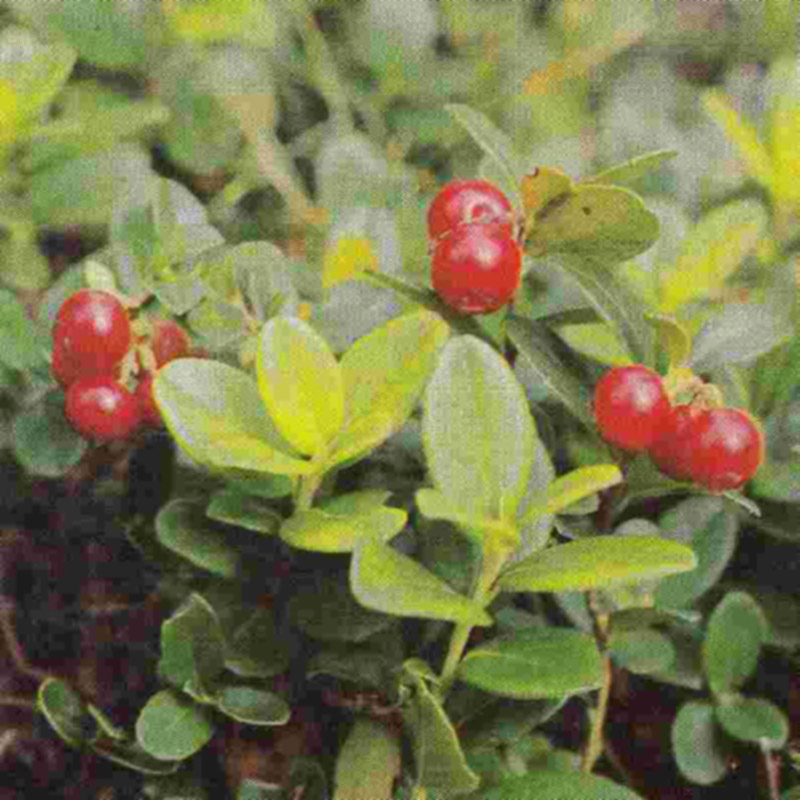
The lingonberry is an evergreen dwarf shrub, up to 30 cm tall and loosely branched. The leaves are leathery, shiny, and oval. The leaf margin is revolute (turned downwards), and the underside of the leaves is dotted with brown glands. Several white, bell-shaped flowers with reddish calyces and four to five corolla lobes grow in terminal clusters. The flowering period is from June to July. In late summer, spherical, shiny red fruits with hard seeds develop. Lingonberries are also used to make jams and juices and are served as lingonberry sauce with game dishes.
Medicinally used parts of the herbal drug
The dried leaves (Vitis idaea folium – lingonberry leaves) are used.
The commercially available drug comes from wild collections, mostly from northern European countries (Norway, Sweden, and Finland).
Constituents of the herbal drug
Lingonberry leaves contain arbutin (a hydroquinone glucoside) and other phenolic glycosides, as well as tannins, flavonoids, and triterpenes.
Quality of the herbal drug
The quality of lingonberry leaves (Vitis idaeae folium) is specified in the German Drug Codex (DAC).
Medicinal application
Recognised medicinal use
Lingonberry leaves have not been reviewed by HMPC or ESCOP.
Traditional use
Lingonberry leaves have not been classified as a traditional herbal medicinal product (Article 16a of Directive 2001/83/EC).
Herbal drug preparations in finished dosage forms
- Chopped lingonberry leaves for tea preparation
Dosage
Finished medicinal product: Not applicable.
Tea: Drink one cup of warm lingonberry leaf tea up to four times daily. Daily dose 6 to 12 g of the drug or 400-840 mg of hydroquinone derivatives, calculated as arbutin. It is advisable to combine with other drugs such as restharrow root, orthosiphon leaves, or birch leaves.
Preparation of a tea
Pour approximately 150 mL of boiling water over 2.5 g of finely chopped or coarsely powdered lingonberry leaves and strain after 10 to 15 minutes. To keep the tannin content as low as possible, cold maceration is preferred. For this, leave the herb to stand in cold water for 6 to 12 hours, then strain the herb and heat the tea.
Notes
There are no studies available on the safety of using lingonberry leaves during pregnancy and lactation. Use in children and adolescents under the age of 18 is not recommended due to a lack of evidence.
Men should consult a doctor to determine the cause of urinary tract problems before using lingonberry leaves.
Adequate fluid intake is recommended in cases of urinary tract infection.
Side effects
None known.
Interactions
None known.