

Coriander
Botanical name
Coriandrum sativum L.
Family
Apiaceae
Common name
Cilantro, Chinese parsley
Information about the plant
Coriander, native to the Middle East and mentioned as early as in Egyptian papyri, is a popular herb now cultivated worldwide, particularly in Southeast Europe and Morocco. Wild populations are rare, occurring mostly as weeds in fields when the easily rolling fruits contaminate other seeds.
It is believed that the genus name Coriandrum is related to the Greek word “koris” (meaning “bug”), because when crushed, the herb emits a bug-like odor caused primarily by the aldehydes decanal and trans-2-decenal. Nevertheless, coriander is a popular spice in Asian and Indian cuisine. Its long tradition as a cultivated plant is also reflected in the species epithet sativum (Latin “sativus” = cultivated, planted, sown).
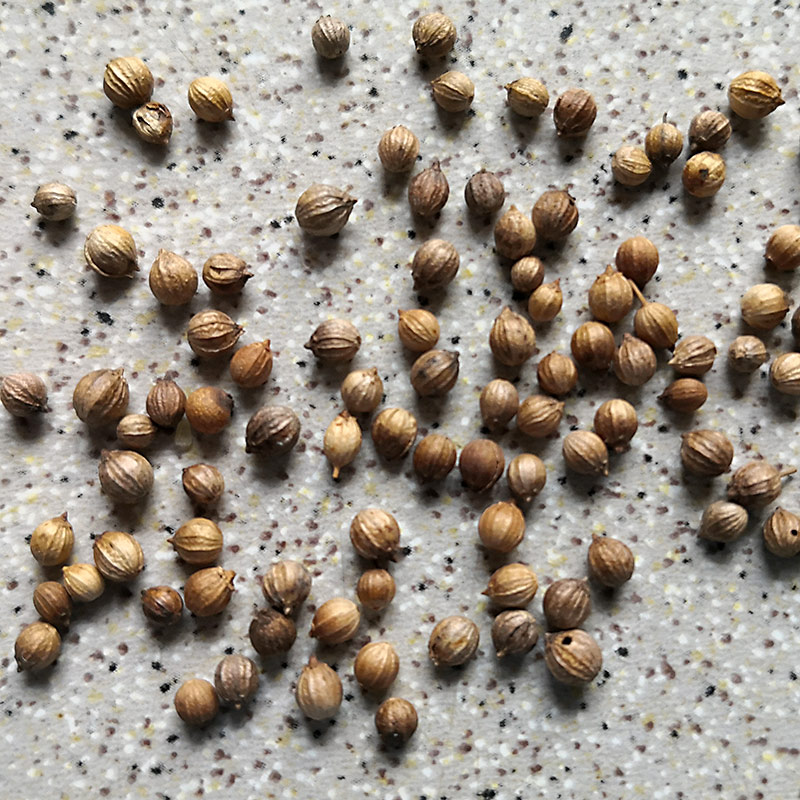
Coriander is an annual plant with a spindle-shaped root. Growing to a height of 40 to 60 cm. It flowers from June to July with small white or pale pink flowers in long-stalked, 3- to 5-rayed compound umbrellas. The outer petals of the marginal flowers are radiant, 3 to 4 mm long, and deeply divided into two oblong-ovate lobes. The inner flowers of the umbel are not radiant. The basal leaves are long-stalked, entire, or 3-lobed. The stem leaves are 2- to 3-pinnately divided with linear lobes. The fruits are spherical cremocarps, 1.5 to 5 mm in diameter, which are rarely split into mericarps. Each mericarp has five sinuous main ribs and, alternating with them, four straight, distinctly protruding secondary ribs. They are used as a sausage spice, to flavor baked goods, and in curry powder.
Medicinally used parts of plants (herbal drug)
The dried, ripe, spherical cremocarps (coriander – Coriandri fructus) are used, together with their characteristic odor, which is clearly noticeable when crushed. This odor is produced by the essential oil contained in the fruits.
Commercially available coriander comes from Morocco, although some southeastern European countries also cultivate the plant. The essential oil (coriander oil – Coriandri aetheroleum) is also used. It is extracted from ripe, crushed fruits by steam distillation.
Constituents of the herbal drug
Coriander fruits contain essential oil (“coriander oil”) with the monoterpene linalool as its main component, which is also responsible for the pleasant aroma of the oil. Other constituents of the oil include camphor, γ-terpinene, α-pinene, geranyl acetate, and other monoterpenes. They also contain fatty oil (in the seeds), proteins, sterols, phenolic carboxylic acids, phthalides, and coumarins or isocoumarins.
Quality of the drug
The quality of the following drugs and drug preparations is specified in the European Pharmacopoeia (Ph. Eur.):
- Coriander (Coriandri fructus)
- Coriander oil (Coriandri aetheroleum)
Medical applications
Recognised medical use
Coriander and coriander oil have not been reviewed by the HMPC or ESCOP.
Traditional use
Coriander has not been classified as a traditional herbal medicinal product (Article 16a of Directive 2001/83/EC).
Herbal drug preparations in finished dosage forms
- Crushed coriander seeds for tea preparation (usually in tea blends).
Dosage
Finished medicinal products: See patient information leaflet.
Herbal tea: Drink one cup of warm coriander tea several times a day. To stimulate appetite, drink it half an hour before meals. For digestive complaints, drink it after meals. Daily dose: 3 g.
Coriander oil: Take 1 to 3 drops of oil 2 to 3 times a day, mixed with a little honey.
Preparation of a tea
Pour 150 mL of boiling water over 1 to 3 g of freshly crushed coriander seeds, stand for 10 to 15 minutes, then strain.
Notes
In case of allergies to Apiaceae plants (anise, fennel, caraway, celery, or dill), coriander products should be avoided.
There are currently no studies available on the safety of coriander use during pregnancy or lactation. Children under 12 years of age should not consume coriander.
Side effects
None known.
Interactions
None known.
References
Herbal drug monographs
None available.
Further literature
Commentary on the European Pharmacopoeia (Coriander, No. 1304; Coriander Oil, No. 1820)