

Sea squill
Botanical name
Drimia maritima (L.) Stearn, Syn.: Urginea maritima (L.) Baker
Family
Asparagaceae
Common name
Sea onion, Red squill, Maritime squill
Information about the plant
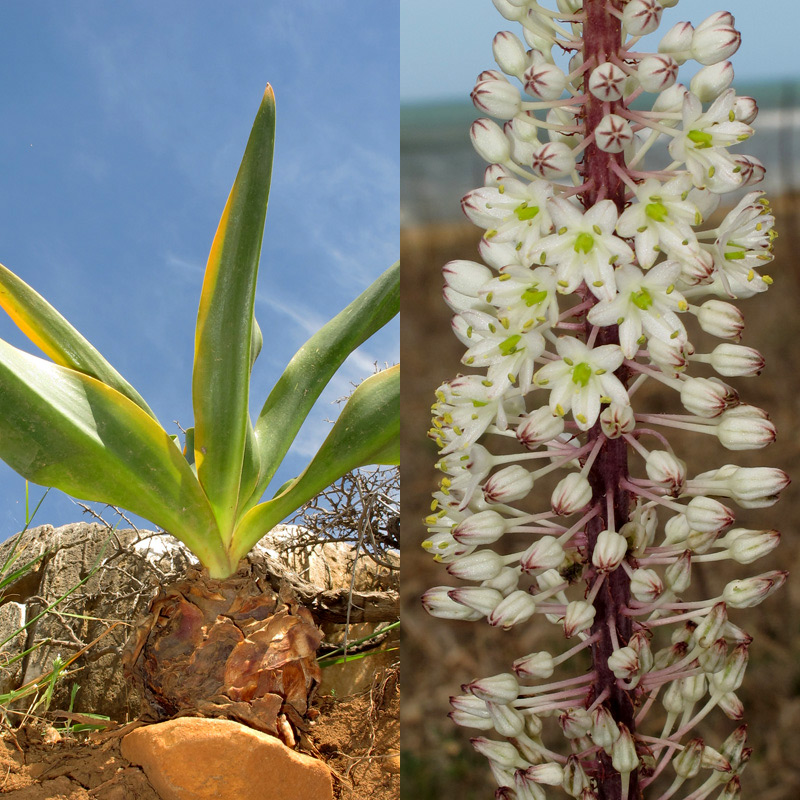
Sea squill (poisonous plant!) is found throughout the Mediterranean region, where it grows in sandy coastal areas and on dry, rocky slopes near the coast, and less frequently on rocky terrain or in olive groves inland. Extensive karyological and morphological studies have shown that the sea squill represents a species complex comprising at least six species. The sea squill used for medicinal purposes, Drimia maritima s.str., is hexaploid and forms a greenish-white bulb.
The name “sea onion” refers to the large bulb, a characteristic feature of the plant, which can weigh up to 2.5 kg. Because it commonly grows along the coast, it is called “sea onion.” This is also reflected in the species epithet maritima. The genus name has changed several times over the years. The plant was formerly called Scilla, which highlighted the similarity of the flowers to those of scilla, or blue star; later it was called Urginea, and today Drimia. The name scilla is still used in the drug designation.
The bulb is very large, with a diameter of up to 20 cm. Like the kitchen onion, it consists of lower leaves (= bulb scales), the outer ones brown and membranous, the inner ones white and thick. In spring, up to 20 elongated leaves sprout in the form of a basal rosette. When these dry up in the hot summer, a thick flower stalk 50 to 1.50 m high emerges from the center, bearing up to 100 star-shaped white flowers arranged in a cluster about 60 cm long. The fruit is an egg-shaped, three-compartment capsule containing shiny black seeds. All parts of the plant are poisonous!
Medicinally used parts of the herbal drug
The dried, medium-sized, fleshy bulb scales (sea onion - Scillae bulbus), cut into transverse or longitudinal strips after flowering, are used.
The commercially available drug comes from cultivated crops in the Mediterranean region.
Constituents of the herbal drug
Sea onion contains cardioactive steroids in the form of bufadienolides, mainly scillaren A and proscillaridin A, as well as mucilage and organic acids. The bufadienolides are responsible for the toxicity of the plant.
Quality of the herbal drug
Until 2014, the quality of sea squill (Scillae bulbus) and standardized sea squill powder (Scillae pulvis normatus) was specified in the German Pharmacopoeia (DAB). Today, the pharmacopoeias (Ph. Eur., DAB, DAC) no longer contain quality specifications for sea squill.
Medicinal application
Recognised medicinal use
Sea onion has not been evaluated by either the HPMC or the ESCOP.
Traditional use
Due to its content of bufadienolides, which have a strong effect on the heart and are also responsible for the plant’s toxicity, sea onion cannot be classified as a traditional herbal medicinal product (Article 16a of Directive 2001/83/EC).
Herbal drug preparations in finished dosage forms
Sea onion is a component of certain homeopathic cardiac remedies, combined with other cardiac drugs (like hawthorn, lily of the valley, strophanthus, and adonis). It is used for nervous heart problems, heart failure, and to help cardiovascular disorders.
Preparations contain scilla (Urginea maritima) in homeopathic dilutions D3 and D4.
Dosage
Finished medicinal products: See patient information leaflet.
Tea: Due to the narrow therapeutic range of sea onion (toxic effect of bufadienolides), tea infusions must not be used.
Preparation of a tea
Not applicable.
Notes
Medical advice is required before treatment with sea onion. Sea onion must not be used during therapy with digitalis cardiac glycosides or in cases of potassium deficiency.
Sea onion must not be used during pregnancy or lactation. The clinical indications are not relevant in children and adolescents under 18 years of age; therefore, use in this age group is not recommended.
Side effects
Nausea, vomiting, cardiac arrhythmia.
Interactions
Increased efficacy and side effects with concomitant use of quinidine, calcium, laxatives, or during long-term corticosteroid therapy.