

Common polypody
Botanical name
Polypodium vulgare L.
Family
Polypodiaceae
Common name
Adder's fern, Wall fern
Information about the plant
Ferns (Pteridophyta) are classified as vascular plants (cormophytes) because they consist of a shoot axis, leaves, and roots. They are on the same level as seed plants (Spermatophyta), but unlike them, they reproduce by spores rather than seeds. Therefore, they do not produce flowers.
Geologically, ferns are older than seed plants and already formed vast forests during the Carboniferous period (i.e., around 300 million years ago), mainly in the form of tree ferns, which today occur primarily in the tropics. In the forests of temperate zones, ferns grow as leafy plants, their leaves often referred to as “fronds.” The sporangia, which contain the spores, form on their underside. When ripe spores fall to the ground, they grow into the so-called prothallium, a small, rooted “leaflet” on which antheridia (male) and archegonia (female) develop. These fuse to form a zygote, from which the fern (sporophyte) with roots, shoot axis, and fronds develops through cell division and differentiation. Fern plants also include club mosses and horsetails. The “true ferns” form their own group, the Pteridopsida.
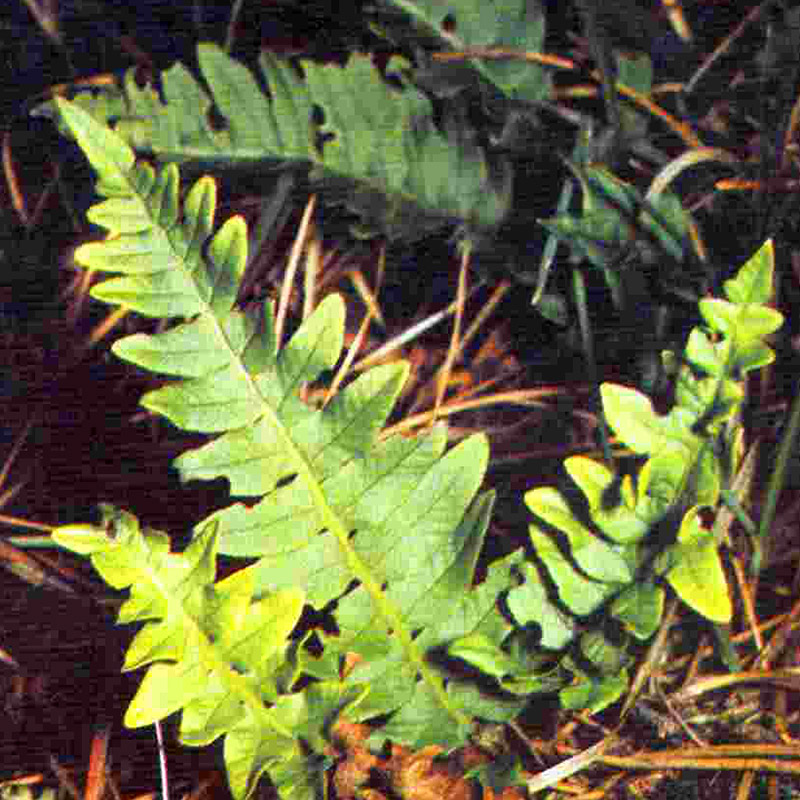
The polypod is perennial and evergreen, forming very dense stands in semi-shaded, moist locations, mostly in forests. It can also be found on walls and rocks. The fronds are up to 70 cm long, with petioles about one-third the length of the fronds, simply pinnate, with pinnules arranged alternately on the rachis, entire and leathery. When the spores are ripe (July to October), circular sori (sporangia clusters; singular: sorus, from the Greek ‘soros’ = vessel) can be found on the underside of the fronds. They give the fronds a spotted appearance, hence the name ‘Tüpfelarm’ (spotted fern in German). The rhizome (underground shoot) grows horizontally along the surface, is brown-scaled, and covered with numerous leaf remnants. It gives the genus name Polypodium, derived from the Greek ‘poly’ (= many) and ‘podion’ (= little foot).
Medicinally used parts of the herbal drug
The dried rhizome (Polypodii rhizoma), from which scales, leaf remnants, and roots have been removed, is used. The fern fronds (Polypodii folium) are also used in anthroposophic medicine.
Constituents of the herbal drug
Polypody rhizome contains ecdysterone (a phytoecdysteroid), saponins (including osladin, which has a strong sweet taste), phloroglucinol derivatives, bitter compounds, and tannins.
Quality of the herbal drug
No pharmacopoeial quality description is available for polypody rhizome.
Medicinal application
Recognised medicinal use
The HMPC has classified polypody rhizome as a traditional herbal medicinal product (see “Traditional use”).
ESCOP: Polypody rhizome has not been evaluated.
Traditional use
Polypody rhizome has been classified by the HMPC as a traditional herbal medicinal product (Article 16a of Directive 2001/83/EC). Based upon long-standing use, polypody rhizome can be used as an expectorant for coughs and colds and for the short-term treatment of occasional constipation.
Herbal drug preparations in finished dosage forms
- Cut polypody rhizome for tea preparation
Dosage
Finished medicinal product: Not applicable.
Tea: Drink one cup of polypody rhizome 3 to 4 times a day. The dose may be increased slightly to treat constipation.
Preparation of a tea
Pour approximately 150 mL of boiling water over 2 to 3 g of finely chopped polypody rhizome, and strain after 10 minutes.
Notes
Polypody rhizome should not be used for longer than 1 week.
In the absence of sufficient data, use during pregnancy and lactation is not recommended. Use in children under 12 years of age is not recommended due to a lack of adequate data.
Side effects
None known.
Interactions
None known.