

Feverfew
Botanical name
Tanacetum parthenium (L.) Sch. Bip.
Family
Asteraceae
Common name
Bachelor's buttons, Featherfew
Information about the plant
Feverfew is native to Transcaucasia, the Caucasus, Western Asia, and the Balkan Islands, and has been widespread throughout Europe since the Middle Ages. It was later introduced to North and South America. In Germany, feverfew is mainly cultivated as a garden plant, so wild populations often arise from cultivated plants that have escaped into the wild. Therefore, it is often found near gardens, on fences, in bushes, along hedges, and on roadsides; it also thrives in cemeteries, rubbish dumps, and on wasteland.
Feverfew was already known in ancient times. Theophrastus, Galen, and Dioscorides referred to the plant as “parthénium” (Greek “parthénos” = virgin), which indicates its popular use in treating women's ailments. Linné adopted this name as an epithet for the original genus name Matricaria (Matricaria parthenium L.), derived from mater (Latin = mother) and/or matrix (Latin = womb). This is also associated with the traditional use of the plant for female ailments, as reflected in the German names “Mutterkraut” (mother herb) and “Jungfernkraut” (maiden herb). After Linné, botanical reclassification of the plant led to further names and the currently accepted scientific name Tanacetum parthenium (L.) Sch. Bip.
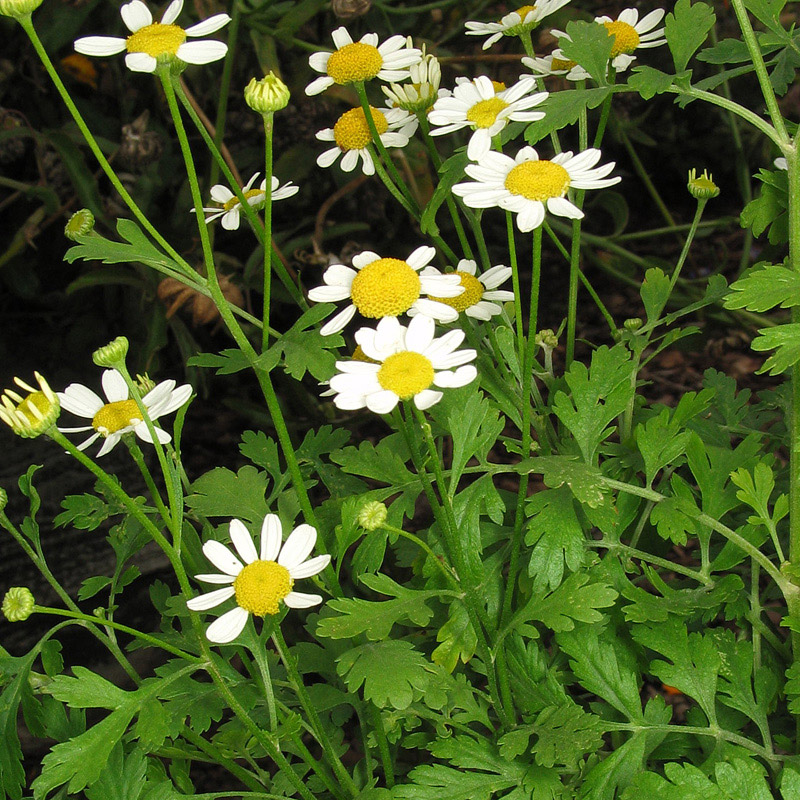
The plant is perennial and grows to a height of 30 to 80 cm. Its flat flower heads are surrounded by roof tile-like bracts and are strikingly large, measuring 1.2 to 2.2 cm in diameter. A wreath of white ray florets with three rounded teeth surrounds numerous yellow tubular florets. The flower heads grow in loose umbels of 5 to 20 (up to 30). Cultivated forms of feverfew usually have “double” flowers consisting only of ray florets. The leaves of feverfew are pinnately lobed, with 2 to 5 pairs of simple to double pinnately lobed, coarsely notched, blunt-tipped leaflets. They are yellow-green and grow on a bare, branched stem. The flowering time is from June to August.
Medicinally used parts of the herbal drug
The herb harvested during flowering (feverfew herb - Tanaceti parthenii herba), consisting of leaves, stems, and flowers, is used.
The commercially available drug comes from cultivations in Spain, England, and Central Europe.
Constituents of the herbal drug
Feverfew contains essential oil (main component camphor), sesquiterpene lactone bitter compounds (parthenolide), and flavonoids.
Quality of the herbal drug
The quality of feverfew (Tanaceti parthenii herba) is specified in the European Pharmacopoeia (Ph. Eur.).
Medicinal application
Recognised medicinal use
The HMPC has classified feverfew as a traditional herbal medicinal product (see “Traditional use”).
ESCOP: For prophylaxis of migraine.
Traditional use
Feverfew has been classified by the HMPC as a traditional herbal medicinal product (Article 16a of Directive 2001/83/EC). Based upon long-standing use, feverfew can be used for the prevention of migraines if no serious medical concerns are present.
Herbal drug preparations in finished dosage forms
Powdered feverfew used as a tea infusion or in coated tablets and tablets.
Dosage
Finished medicinal product: See patient information leaflet.
Tea: Drink 2 to 3 cups of feverfew tea daily, before each meal, for several months, then reduce the dose.
Note: Preparing tea is not particularly useful, as the active ingredients in feverfew are poorly released into the tea. The powdered herb can be taken directly: 100 mg once daily or 200 mg three times daily. Daily dose is 100 to 600 mg.
Preparation of a tea
Pour boiling water over 150 mg of powdered feverfew, leave to stand for 10 minutes and filter through a paper filter.
Notes
In case of allergies to Asteraceae, the use of feverfew should be avoided (possible cross-allergy).
There are no safety studies available on the use of feverfew during pregnancy and lactation. Use in children and adolescents under 18 years of age is not recommended due to a lack of evidence.
Side effects
Mild gastrointestinal discomfort may occur.
Interactions
None known.
References
Herbal drug monographs
HMPC (2020), ESCOP (2014), WHO Vol. 2
Further literature
Commentary on the European Pharmacopoeia (feverfew, No. 1516)