
Arctic root
Botanical name
Rhodiola rosea L.
Family
Crassulaceae
Common name
Rhodiola, Golden root, Roseroot
Information about the plant
Arctic root is distributed throughout the circumpolar region and grows in Arctic areas (Alaska, Iceland). It is also found in the mountainous regions of central and northern Europe, Russia (Siberia), Kazakhstan, China, Japan, Korea, Mongolia, and on the eastern coast of North America. It grows in rock crevices, on stony spring meadows, pasturelands, boulder fields, and on forested or rocky slopes.
The genus name Rhodiola is derived from the Greek “rhodios” (= rosy, rose-like), which refers to the pleasant rose-like scent of its underground parts. This scent is further emphasized by the species epithet rosea.
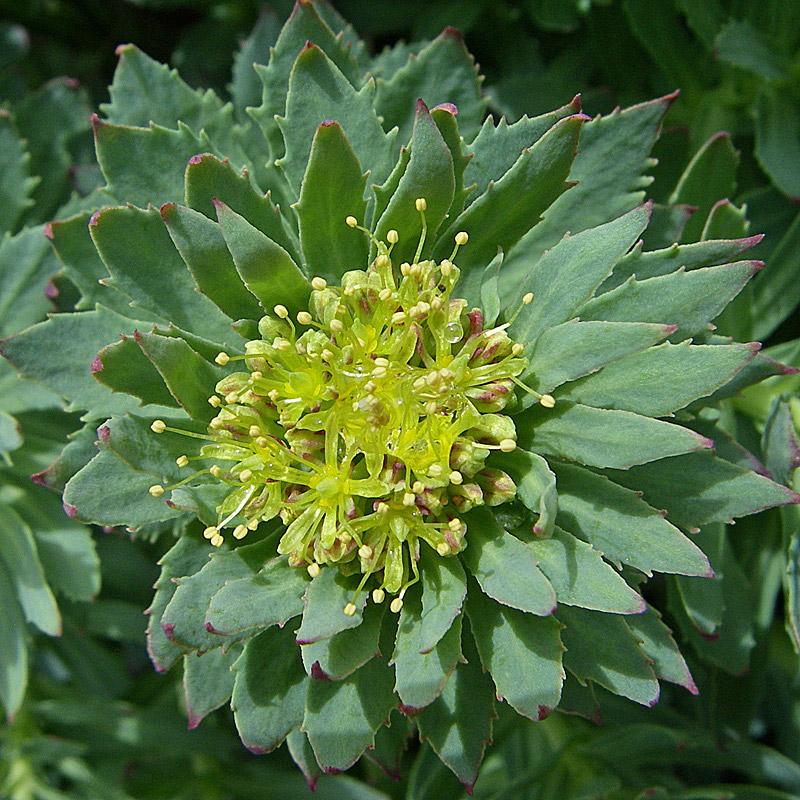
Arctic root is a succulent plant, 10 to 60 cm tall, with a robust rhizome (underground stem) that smells particularly of roses when dried. The shoots are alternate and densely covered with gray-green, oval to narrow-lanceolate leaves. The yellow flowers are densely clustered in a hemispherical corymb; in bud, they are pinkish-red. The flowering time is from April to August.
Medicinally used parts of plants (herbal drug)
The dried underground parts, consisting of the rhizome and attached roots, are used (Rhodiola rhizome and root – Rhodiolae rhizoma et radix).
The commercially available drug came originally from controlled wild collections in Siberia and Scandinavia. Today, rhodiola rhizome is cultivated in Russia, some Scandinavian countries, and Germany. In Switzerland, a variety particularly rich in active constituents called “Mattmark” was cultivated, which now dominates the market.
Constituents of the herbal drug
Rhodiola rhizome and roots contain phenylethanoids, benzyl alcohol derivatives, phenylpropanoid derivatives, flavonoids, flavolignans, and essential oil.
Quality of the drug
A pharmacopoeial quality specification for rhodiola rhizome and root (Rhodiolae rhizoma et radix) is not currently available.
Medical applications
Recognised medical use
The HMPC has classified rhodiola rhizome and root as a traditional herbal medicinal product (see “Traditional Use”).
ESCOP: Arctic root has not been reviewed.
Traditional use
Rhodiola rhizome and root have been classified by the HMPC as a traditional herbal medicinal product (Article 16a of Directive 2001/83/EC). Based upon long-standing use, arctic roots can be used internally to relieve stress symptoms such as fatigue and exhaustion.
Herbal drug preparations in finished dosage forms
- Dry extracts in capsules and coated tablets.
Dosage
To guarantee efficacy, arctic root should only be taken in the form of finished medicinal products with a specified extract of content. The dosage can be found in the patient information leaflet.
Preparation of a tea
Not applicable.
Notes
There are currently no studies available on the safety of using arctic root during pregnancy and lactation. Use in children and adolescents under 18 years of age is not recommended due to a lack of evidence.
Side effects
None known.
Interactions
None known.