

Peru balsam / Tolu balsam
Botanical name
Myroxylon balsamum (L.) Harms var. pereirae (Royle) Harms – Peru balsam
Myroxylon balsamum (L.) Harms var. balsamum – Tolu balsam
Family
Fabaceae
Common name
Peru balsam, Balsam of Peru, Black balsam
Tolu balsam, Balsam of Tolu, Thomas balsam
Information about the plant
The Peru balsam tree grows in Central America, primarily in El Salvador, Costa Rica, Guatemala, Nicaragua, Ecuador, and southern Mexico. At the time of the Spanish conquest of Central and South America, Central America belonged to the Viceroyalty of Peru, which is why the balsam extracted from the tree was shipped from there and named “Peru balsam”.
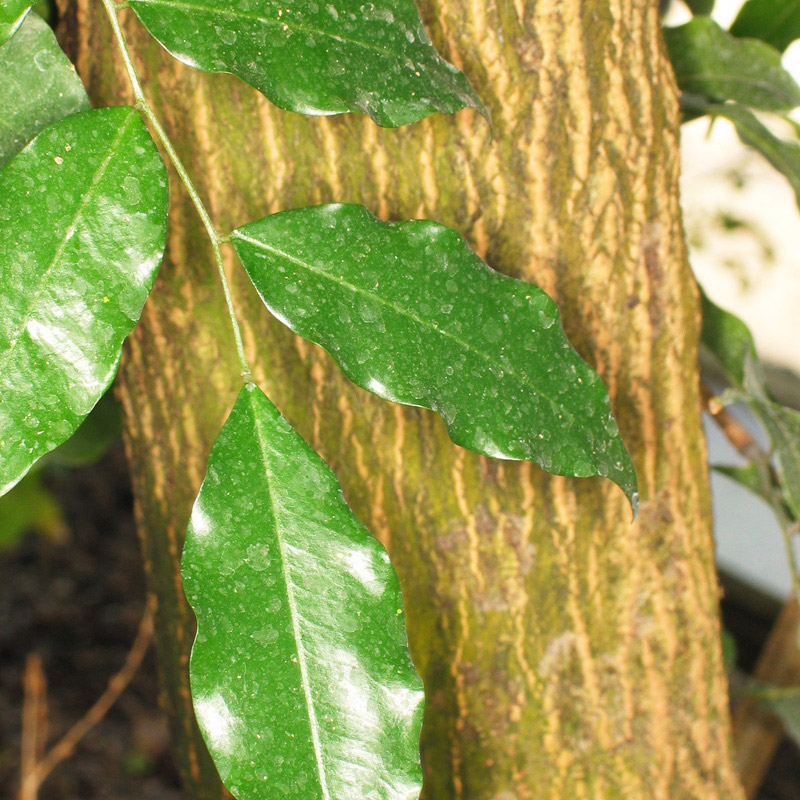
The tree grows to a height of 15 to 20 m. The bark of the trunk and branches is gray-brown and smooth, with numerous light-colored lenticels. The leaves are imparipinnate, with 7 to 11 leaflets. The bluish-white “butterfly” (papilionaceous) flowers grow in abundant clusters. The upper flower is rounded, clawed, and much larger than the other four. The fruits are brown pods, each containing one seed.
The Tolu balsam tree, also a pinnate tree, grows to a height of 25 m and begins to branch at a height of 12 to 18 m. It occurs in northern South America, in Venezuela, Colombia, Ecuador, and Guatemala. The name was used and adopted by the original inhabitants, who lived in Santiago de Tolu (northern Colombia). In 1841, Henri Etienne Sainte-Claire Deville distilled Tolu balsam using a dry distillation process, which produced toluene (C6H5-CH3), a solvent that is still widely used in chemistry today.
Peru balsam is a dark brown, viscous secretion produced in schizogenous secretion cavities. It is harvested between November and April from trees that are around 10 years old. Part of the bark is removed from the trunk, creating a wound that stimulates balsam production to close the wound (living resin!). After about a week, the balsam exudes and is absorbed onto cloths, from which it is obtained by pressing or boiling. The wound stimulus can be intensified by heating with torches or spirit burners. Peru balsam is brown, viscous, and smells like vanilla.
Tolu balsam is also extracted by living resin. The bark of the trunk is cut in a V-shape about 20 times parallel to each other, and a small cavity is formed at the lower end of the wound. The wound triggers a strong flow of balsam, which is collected in containers. Upon exposure to air, it turns into a reddish-brown, brittle crystalline mass with a vanilla-like odor.
Medicinally used parts of plants (herbal drug)
Peru balsam: The balsam obtained from the incised and heat-treated trunks (Balsamum peruvianum). It is imported from El Salvador.
Tolu balsam: The resinous balsam obtained from the trunk (Balsamum tolutanum) is used. It is imported from Colombia and Venezuela.
Constituents of the herbal drug
Peru balsam
The resinous content of Peru balsam consists of 50 to 70% of an ester mixture, with benzyl benzoate and benzyl cinnamate as the main components. Approximately 20 to 30% of resin components are benzoic and cinnamic acid esters of higher alcohols. It also contains nerolidol, vanillin, cinnamic acid, benzoic acid, benzyl ferulate, and benzyl isoferulate.
Tolu balsam
The resinous content of Tolu balsam consists largely of toluresin, an ester of a tannin-like resin alcohol (toluresinotannol) with benzoic acid and cinnamic acid. Both acids also occur in free form. It also contains benzyl benzoate, benzyl cinnamate, and essential oil.
Quality of the drug
The quality of Peru balsam (Balsamum peruvianum) and Tolu balsam (Balsamum tolutanum) is specified in the European Pharmacopoeia (Ph. Eur.).
Medical applications
Recognised medical use
Peru balsam
The HMPC has evaluated Peru balsam and finalized its assessment. After assessing the risk-benefit ratio, a statement was issued explaining why the use of Peru balsam cannot be recommended. Peru balsam has been shown to be highly allergenic and may cause allergic skin reactions, angioedema (Quincke's edema), as well as bronchoconstrictive and anaphylactic reactions.
ESCOP: Peru balsam has not been reviewed.
Tolu balsam
Tolu balsam has not been evaluated by the HMPC or ESCOP.
Traditional use
Not classified as a traditional herbal medicinal product (Article 16a of Directive 2001/83/EC).
Herbal drug preparations in finished dosage forms
Peru balsam at concentrations of 5 to 20% in ointment formulations, often in combination with other ingredients
Dosage
Finished medicinal products: See patient information leaflet.
Apply ointments containing Peru balsam several times a day. For large areas, use a 10% concentration.
Preparation of a tea
Not applicable.
Notes
Peru balsam ointments should not be applied for longer than one week. Peru balsam should not be used in children and adolescents under the age of 18 due to a lack of evidence.
Side effects
Allergic skin reactions, mostly type IV contact hypersensitivity, but also immediate-type reactions (urticaria, bronchoconstriction). Photodermatoses and phototoxic reactions occur rarely.
Interactions
None known.
References
Herbal drug monographs
HMPC (2016)
Further literature
Commentary on the European Pharmacopoeia (Peru balsam, No. 0754, Tolu balsam, No. 1596)