

Wild thyme
Botanical name
Thymus serpyllum L.
Family
Lamiaceae
Common name
Creeping thyme, Mother of thyme, Breckland thyme, Elfin thyme
Information about the plant
Wild thyme grows over a wide area in Europe and Asia. In southern countries, it is found mainly in mountainous regions. It grows on sandy plains, semi-arid grasslands, dry meadows, in sparse forests, and along roadsides. Since wild thyme occurs over a very large area with diverse ecological conditions – which influence its morphological characteristics – it is a highly variable species. Wild thyme has a strong tendency to hybridize. Some taxonomists use the name “Thymus serpyllum s.l.” (sensu latiore = in the broad sense). Others combine this collective species with the closely related Thymus pulegioides L.
There is no consensus on the origin of the genus named Thymus. It can be traced back to the Greek ‘thymos’ (= courage, strength) or to the Greek ‘thymiama’ (= incense), as thyme (Thymus vulgaris L.) was used for ritual burning due to its aromatic scent. The species epithet serpyllum is derived from the Latin ‘serpere’ (= to creep).
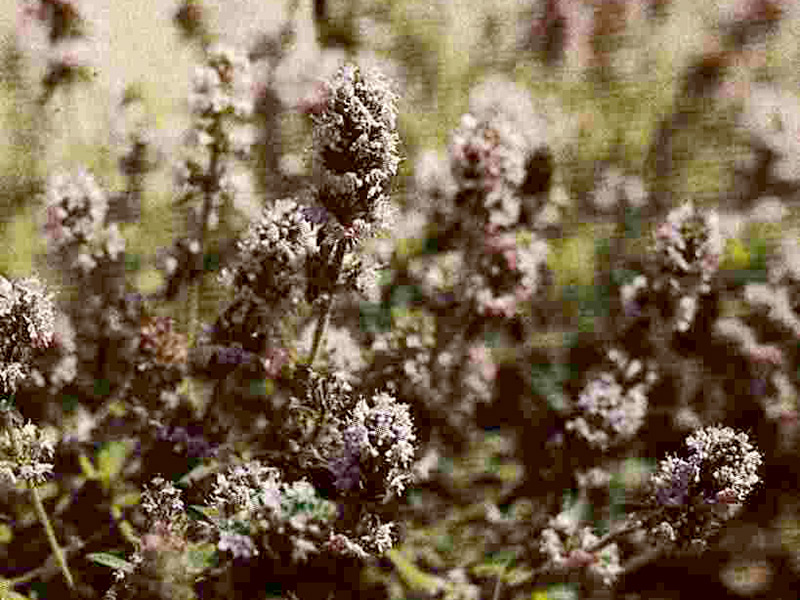
Wild thyme is an aromatic dwarf shrub spreading to ascending stems that are woody at the base. The small leaves are ovate, ciliate at the base, and arranged in opposite pairs on the stem. The pinkish-purple flowers are arranged in elongated heads (pseudowhorls). Depending on the region, the flowering period is from May to October. Wild thyme has a characteristic spicy scent due to its essential oil, wild thyme oil. This is found in glandular scales on the leaf surface and is released when these glands are damaged.
Medicinally used parts of plants (herbal drug)
The dried, flowering aerial parts (wild thyme herb - Serpylli herba) are used, with their spicy smell due to the essential oil contained in the drug. It is found in glandular scales on the leaf surface and is released when the glands are damaged.
The commercially available drug comes from Ukraine and the Balkans.
Constituents of the herbal drug
Wild thyme contains essential oil (“wild thyme oil”), Lamiaceae tannins, flavonoids, and triterpenes. Wild thyme oil consists of 20 to 40% carvacrol, 5 to 15% p-cymene, 5 to 15% γ-terpinene, and other monoterpenes.
Quality of the drug
The quality of wild thyme (Serpylli herba) is specified in the European Pharmacopoeia (Ph. Eur.).
Medical applications
Recognised medical use
Wild thyme has not been reviewed by the HMPC.
ESCOP: Catarrh of the upper respiratory tract. As a bath additive, supportive in acute or chronic respiratory diseases. These applications are based on long-standing use.
Traditional use
Wild thyme has not been classified as a traditional herbal medicinal product (Article 16a of Directive 2001/83/EC). Wild thyme is used in combination with other herbal drugs to support mucus clearance in the respiratory tract (traditional use according to Article 16a of Directive 2001/83/EC).
Herbal drug preparations in finished dosage forms
- Wild thyme as tea, including tea bags, in combination with other herbal drugs
- Aqueous decoction
Dosage
Finished medicinal product: See patient information leaflet.
Tea: Drink one cup of freshly prepared tea warm several times a day (also in combination with other herbal drugs as cough and bronchial tea). Daily dose 4 to 6 g of drug.
Preparation of a tea
Pour 150 mL of hot water (not boiling!) over 1.5 to 2 g of finely chopped wild thyme, leave to stand for 10 minutes, then strain.
Notes
No studies have been published on the safety of wild thyme during pregnancy or lactation. Use in children under 12 years of age is not recommended due to a lack of evidence.
Side effects
None known.
Interactions
None known.
References
Herbal drug monographs
ESCOP (2014)
Further literature
Commentary on the European Pharmacopoeia (Wild thyme, No. 1891)