
Mastic Tree
Botanical name
Pistacia lentiscus L.
Family
Anacardiaceae
Common name
Mastic, Lentisk, Mastic Gum, Mastiha, Masticha
Information about the plant
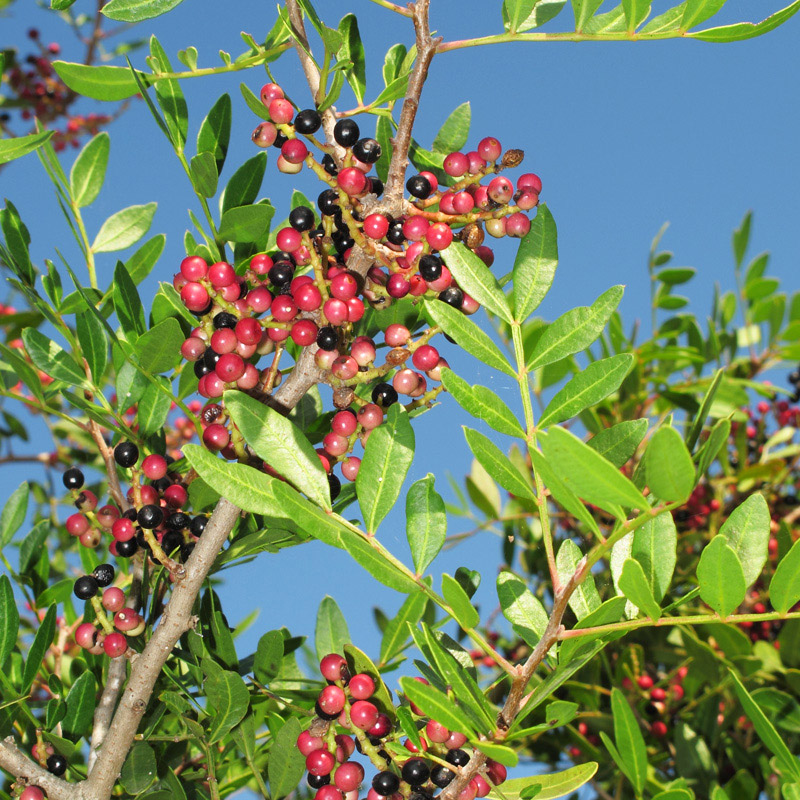
The mastic tree is widespread in the Mediterranean regions of Europe and Africa, growing in Turkey, Lebanon, Israel, Jordan, Syria, and the Canary Islands. It is cultivated on the Greek island of Chios and, to a lesser extent, on neighboring islands. The tree grows to a height of 1 to 3 m, and although it grows in hot regions, its leaves remain green even during the dry season. The leaves are pinnate, with 8 to 12 pinnae arranged in pairs; the individual leaflets are up to 3 cm long, broadly lanceolate, leathery, and shiny on the upper surface.
The flowers are unisexual and arranged in short, dense inflorescences in the leaf axils; the male flowers have conspicuous dark red anthers, while the female flowers are greenish. The spherical fruits, 3 to 4 mm in diameter, are red at first and later turn black. The leafy branches are often used as green accents in bouquets. The flowering period is from March to June.
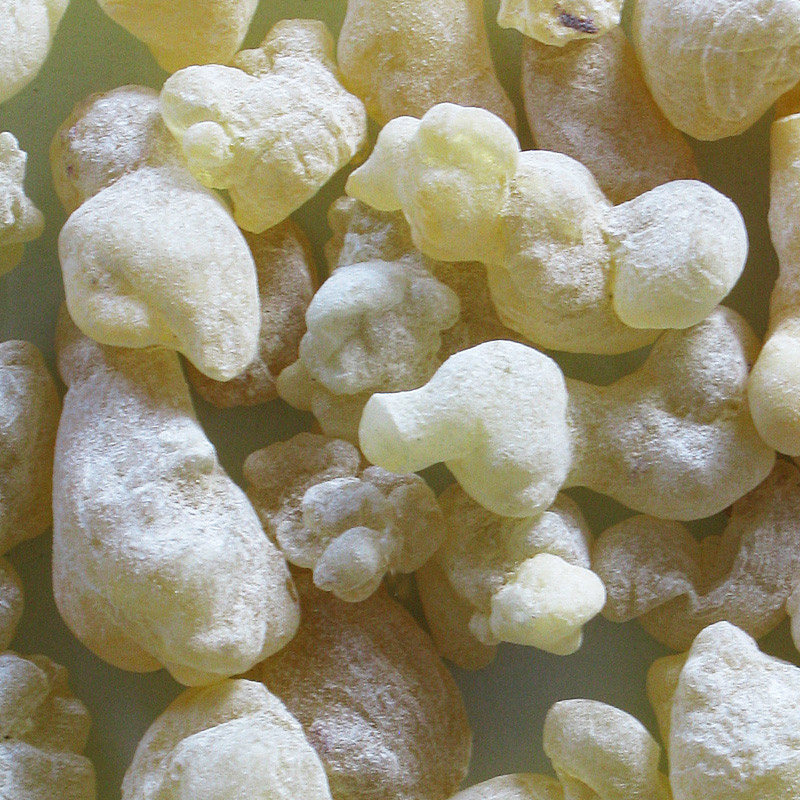
The yellow, irregular, spherical or pear-shaped, hard, glassy fragments are traded as “mastic.” In Greece, mastic is known as “tears of Chios.” Each tree can yield about 4 to 5 kg of mastic per year. The name “mastic” is derived from the Latin ‘mastichum’ or the Greek “mastichao” (= to grind with the teeth, to chew); in the eastern Mediterranean region, it is used as a chewing resin to freshen the breath. Technically, mastic serves(ed) as a putty or adhesive for fixing wound dressings.
Medicinally used parts of the herbal drug
The resinous balm (mastic) is used. It flows from the trunks and branches after cutting and hardens.
Constituents of the herbal drug
Mastic consists of a complex mixture of triterpenes, with a protein fraction consisting of arabinogalactan protein. Additionally, it contains a polymer of myrcene (cis-1,4-poly-ß-myrcene) and essential oil (consisting mainly of monoterpenes).
Quality of the herbal drug
The quality of mastic is specified in the European Pharmacopoeia (Ph. Eur.).
Medicinal application
Recognised medicinal use
The HMPC has classified mastic (Pistacia lentiscus – resina) as a traditional herbal medicinal product (see “Traditional use”).
ESCOP: Mastic has not been reviewed.
Traditional use
Mastic has been classified by the HMPC as a traditional herbal medicinal product (Article 16a of Directive 2001/83/EC). Based upon long-standing use, mastic can be used internally for mild dyspeptic complaints and externally for mild skin inflammations and minor wounds.
Herbal drug preparations in finished dosage forms
- Powdered mastic for direct consumption
- Powdered mastic in solid medicinal forms
- Powdered mastic in ointments
Dosage
Finished medicinal products: see patient information leaflet.
Powder: 0.35 to 0.5 g of mastic, taken 3 to 4 times daily.
For external use, mastic powder is incorporated into ointments at a concentration of 9 to 11%.
Preparation of a tea
Not applicable.
Notes
There are no studies available on the safety of mastic during pregnancy and lactation. Internal use in children and adolescents under the age of 18 is not recommended due to a lack of data.
Side effects
None known.
Interactions
None known.
References
Herbal drug monographs
HMPC (2016, 2020)
Further literature
Commentary on the European Pharmacopoeia (Mastic, No. 1876)