
Glandular Plantain
Botanical name
Plantago afra L. [Syn. Psyllium afrum (L.) Mirb.]
Family
Plantaginaceae
Common name
Glandular plantain, Flea-seed plantain
Information about the plant
Glandular plantain is native to the Mediterranean region (southern Europe and northern Africa) and western Asia. The genus name Plantago, derived from the Latin "planta" (= sole of the foot) together with the common plant suffix -ago, refers partly to the flat, oval leaves of broadleaf plantain (P. major), which lie close to the ground in rosettes, and partly to the fact that plantain often grows in places trampled by feet.
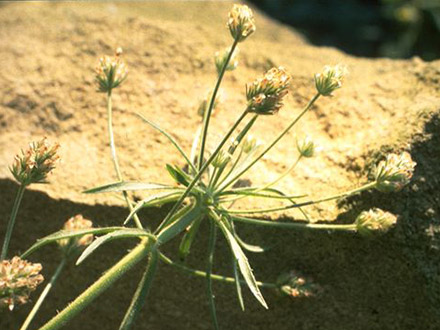
Glandular plantain, however, is characterized by small, very narrow linear leaves. In the leaf axils of the upper leaves are the scapes bearing the small flowers in short, densely flowered spikes. The fruit ripens into a capsule with a two-part lid, each part containing two small, elliptical, reddish-brown, shiny seeds. These resemble fleas, which has earned the plant the common names "flea herb" and "flea-seed plantain." This is also expressed in the synonymous Latin genus name of the plant (Psyllium): Latin, "psyllium" (= flea), which has also been retained in the drug name (Psyllii semen).
Constituents of the herbal drug
Psyllium and Indian psyllium seeds contain mucilage in the seed coat and fatty oil in the endosperm.
Quality of the drug
The quality of the following drugs and drug preparations is specified in the European Pharmacopoeia (Ph. Eur.):
- Psyllium seeds (Psyllii semen)
- Indian psyllium seeds (Plantaginis ovatae semen)
- Indian psyllium husks (Plantaginis ovatae seminis tegumentum)
Medical applications
Recognised medical use
The HMPC has accepted the internal use of psyllium and Indian psyllium seed (or Indian psyllium husk) as "well-established use" for chronic constipation and for softening the stool in cases of painful bowel movements after rectal or anal examinations, anal fissures, and hemorrhoids. Indian psyllium husk is also approved for internal use in patients whose daily intake of dietary fiber needs to be increased in order to improve constipation-dominant irritable bowel syndrome and to support the treatment of hypercholesterolemia.
ESCOP: Indian psyllium seeds or psyllium husks: for occasional constipation and when easy bowel evacuation with soft stools is desired (e.g. for anal fissures, hemorrhoids, after rectal examinations, and during pregnancy); also to increase daily fiber intake, e.g. in irritable bowel syndrome, and to support the symptomatic treatment of non-specific diarrhea. An additional indication for Indian psyllium husk is adjunctive use with a low-fat diet in patients with mild to moderate hypercholesterolemia.
Traditional use
No listing as a traditional herbal medicinal product (Article 16a of Directive 2001/83/EC)
Herbal drug preparations in finished dosage forms
- Whole or crushed psyllium
Dosage
Take 25 to 40 g psyllium seeds (daily dose) in three single doses with plenty of fluids (very important: at least 200 mL per dose). Psyllium can be taken after soaking in water, milk, or juice. During therapy with psyllium, an adequate intake of fluid must be ensured in every case.
Indian psyllium husks: Since the swellable mucilage is located in the seed husk, psyllium husks have a significantly greater swelling capacity per unit weight than the seeds. Therefore, 7 to 11 g of Indian psyllium husks (daily dose) in three divided doses is sufficient. It is also important to drink plenty of fluid (at least 200 mL per dose).
Notes
Make sure you drink plenty of fluids!
Psyllium seeds should not be taken in cases of suspected intestinal obstruction (ileus), severe abdominal pain accompanied by nausea and vomiting, diseases of the esophagus and swallowing difficulties, or stenosis of the gastrointestinal tract. Psyllium should also not be taken immediately before bedtime. Use in children under 6 years of age is not recommended due to a lack of evidence.
Interactions
Psyllium seeds and psyllium husks should be taken 0.5 to 1 hour before or after other medicines, as they may otherwise delay the absorption of other drugs from the gastrointestinal tract.
References
Herbal drug monographs
HMPC (2013), ESCOP (2016, 2020), WHO Vol. 1
Further literature
Commentary on the European Pharmacopoeia (Psyllium seeds, No. 0858, Indian psyllium, No. 1333, Indian psyllium husks, No. 1334)