

Cranberry
Botanical name
Vaccinium macrocarpon Aiton
Family
Ericaceae
Common name
American cranberry, Large cranberry
Information about the plant
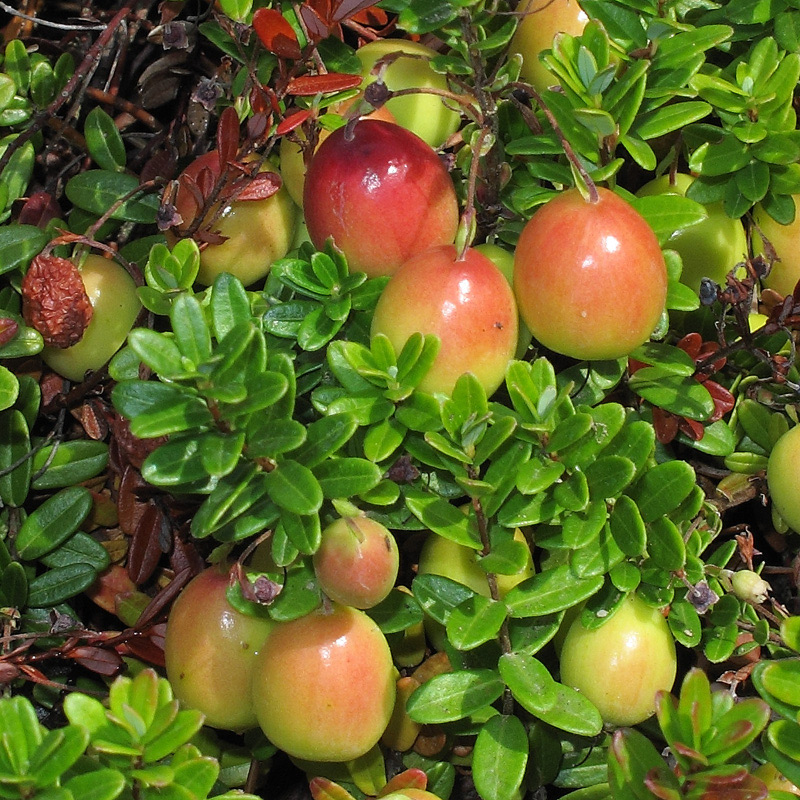
The large cranberry is native to eastern North America, where it grows in bogs like the small-fruited cranberry (V. oxycoccos L.), which is common in our region. The berries of the large cranberry, known as “cranberries”, are 10 to 20 mm in diameter, bright red, and fleshy when ripe. When eaten raw, the berries taste sour, but they are usually cooked and are very popular as compote, jam, and jelly.
The large cranberry is cultivated in the northwestern states of North America using cuttings in large water basins with adjustable water levels. When the berries are ripe, they are mechanically dislodged at a high water level. They then float on the water and are collected. Approximately 300,000 tons are processed annually in the USA, only a small portion of which is used for pharmaceutical purposes. The American name “cranberry” (plural: “cranberries”) is also common in German-speaking countries.
The large cranberry grows up to 15 cm tall, with creeping shoots, narrow elliptical leathery leaves, and small white to pink flowers with a deeply four-parted corolla with upturned tips. The genus name Vaccinium is derived from the Latin ‘bacca’ (= berry) and ‘baccinium’ (= berry bush). It is also used for the blueberry (Vaccinium myrtillus), lingonberry (V. vitis-idaea), and bog bilberry (V. uliginosum). The species epithet macrocarpon refers to its large fruits and is derived from the Greek ‘makros’ = large and ‘karpos’ = fruit.
Medicinally used parts of plants (herbal drug)
The fresh or dried ripe fruits (cranberries - Vaccinii macrocarponii fructus, Macrocarponii fructus) and the juice pressed from the ripe fruits are used.
The commercially available drug comes from cultivated crops in North America.
Constituents of the herbal drug
Cranberries contain organic acids (malic acid and citric acid), catechin tannins, oligomeric proanthocyanidins, anthocyanin flavonoids, vitamin C, and phenolic carboxylic acids.
Quality of the drug
The quality of cranberries is not specified in European pharmacopoeias (Ph. Eur., DAB, DAC), as they do not have established medicinal status in Europe. They are available on the market as dietary supplements and are therefore subject to food legislation. A liquid cranberry preparation is listed in the United States Pharmacopeia Convention (2005).
Medical applications
Recognised medical use
The HMPC has classified cranberry fruit juice (DER 1:0.6-0.9) as a traditional herbal medicinal product (see “Traditional use”).
ESCOP: Prevention of urinary tract infections.
Traditional use
Cranberry fruit juice has been classified by the HMPC as a traditional herbal medicinal product (Article 16a of Directive 2001/83/EC). Based upon long-standing use, cranberry fruit juice can be used to relieve symptoms of mild lower urinary tract inflammation, such as burning sensation during urination and/or frequent urination in women, after a doctor has ruled out any more serious conditions. Cranberry fruit juice can also be used for the prevention of uncomplicated inflammation of the lower urinary tract.
Herbal drug preparations in finished dosage forms
There are currently no finished medicinal products available on the market, as cranberries are considered dietary supplements. As such, the following products are available on the market
- Cranberry juice (pure juice)
- Fruit juice concentrates
- Dry extracts in capsules
Dosage
Finished medicinal product: Not applicable.
Adults: Drink 300 to 700 mL of cranberry juice containing at least 160 mg/L proanthocyanidins in 2 to 3 divided portions throughout the day. Alternatively, 400 to 500 mg of dried cranberry extract in capsules twice daily. Children and adolescents (2 to 18 years): Drink 15 mL/kg of cranberry juice daily.
Preparation of a tea
Not applicable.
Notes
The use of cranberries during pregnancy and lactation, as well as in children under 12 years of age, is not recommended due to a lack of evidence.
Men should consult a doctor to determine the cause of urinary tract symptoms before using cranberries.
In case of urinary tract inflammation, plenty of fluids should be taken.
Side effects
None known.
Interactions
Interactions may occur with anticoagulant drugs such as phenprocoumon (Marcurmar) and warfarin due to the content of antioxidant ingredients that can inhibit cytochrome P 450.