
Yerba mate
Botanical name
Ilex paraguariensis A. St.-Hil.
Family
Aquifoliaceae
Common name
Mate, Yerba mate, Paraguay tea
Information about the plant
The genus Ilex includes shrubs or trees with very hard, evergreen leaves that are spiny-toothed at the margins. Because these spines can cause injury, the genus is known in German as “Stechpalme” (holly). The common holly (Ilex aquifolium L.) is a popular ornamental shrub in Europe; its leafy branches and red fruits are often used in autumnal flower arrangements. In the past, these evergreen branches were woven into the “palms” used on Palm Sunday, which is consecrated on this church holiday (“holly”).
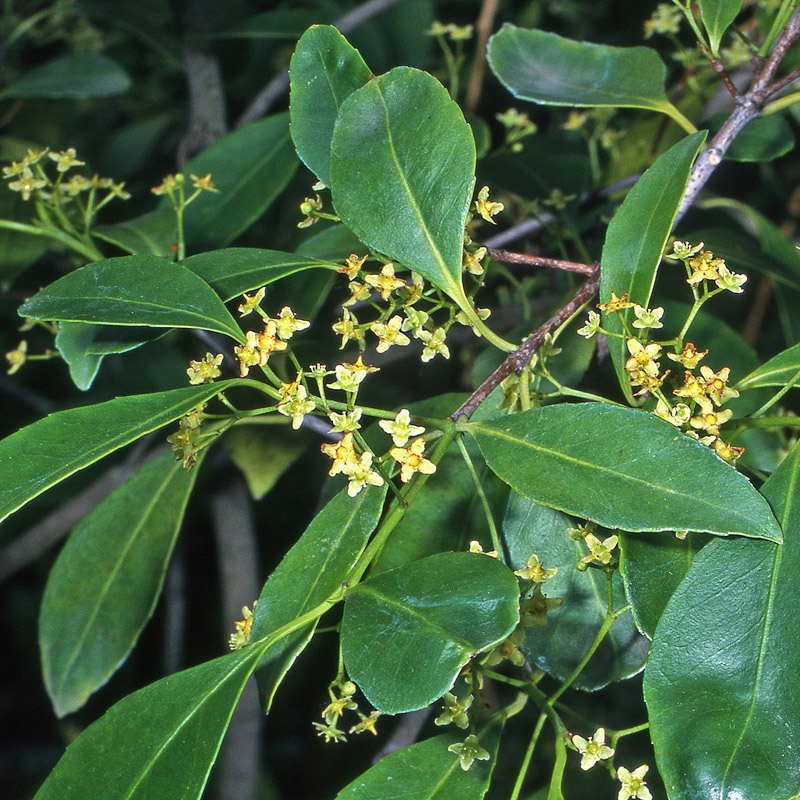
The mate tree (Ilex paraguariensis) is native to Brazil, Paraguay, and Uruguay. It grows to a height of 6 to 14 meters, but on plantations it is kept at only 2 to 5 meters to facilitate leaf harvesting. The leaves are leathery, 6 to 20 cm long and 3 to 9 cm wide, and have the serrated margins characteristic of Ilex species. The white flowers grow in clusters of 40 to 50 in the leaf axils. The round, red drupes contain 4 to 8 seeds.
Medicinally used parts of the herbal drug
The leaves are used. They are harvested between May and September and, to prevent them from turning black, are briefly heated over a fire in wire mesh drums or metal cylinders (“zapekieren” in German). This process inactivates the phenoloxidases (enzymes) responsible for blackening and produces the aromatic substances typical of mate tea. The leaves are then crushed or pulverized.
The drug comes mainly from Brazil, with smaller quantities from Argentina and Paraguay. Roasted mate tea is also available on the market; to produce it, the dried leaves undergo an additional heating process. Mate tea is a popular national beverage in many parts of South America, especially Brazil.
Constituents of the herbal drug
Mate leaves contain caffeine (0.4 to 1.6%), theobromine (0.3 to 0.45%), and traces of theophylline. They also contain caffeoylquinic acids, flavonoids, saponins, and tannins.
Quality of the herbal drug
The quality of mate leaves (Mate folium) is specified in the European Pharmacopoeia (Ph. Eur.), while the quality of “roasted mate leaves” (Mate folium tostum) and “green mate leaves” (Mate folium viride) is specified in the German Drug Codex (DAC).
Medicinal application
Recognised medicinal use
The HMPC has classified mate leaves as a traditional herbal medicinal product (see “Traditional use”).
Traditional use
Mate leaves have been classified by the HMPC as a traditional herbal medicinal product (Article 16a of Directive 2001/83/EC). Based upon long-standing use, mate leaves can be used to treat fatigue and weakness, and to increase urine output, thereby flushing the urinary tract and supporting the treatment of mild urinary tract complaints.
Herbal drug preparations in finished dosage forms
- Cut mate leaves, loose or in tea bags, for tea preparation
- Powdered drug in coated tablets
Dosage
Finished medicinal product: See patient information leaflet.
Tea: For symptoms of fatigue, drink one cup of warm mate leaf tea 2 to 3 times daily. Daily dose: 2 to 4 g of the drug.
For urinary tract complaints, drink one cup of warm mate leaf tea 1 to 2 times daily. Daily dose: 2.5 to 5 g of the drug.
Preparation of a tea
Pour 150 ml of hot (not boiling) water over 2 to 3 g of mate leaves and strain after 5 to 10 minutes. As with black tea, the stimulating effect is stronger when brewed briefly than when left to stand for a long time.
Notes
Mate tea should not be consumed by patients with stomach or duodenal ulcers, high blood pressure, cardiac arrhythmia, or hyperthyroidism, nor should it be consumed if reduced fluid intake is recommended. Mate tea should not be consumed before bedtime, as its caffeine content may disrupt sleep.
Due to a lack of evidence, the use of mate tea in children and adolescents under the age of 18 is not recommended.
Side effects
None known.
Interactions
Patients taking MAO inhibitors should use mate leaves with caution, as these medications may enhance their effects. The caffeine contained in mate preparations reduces the effects of sedatives and increases the side effects of sympathomimetics (substances that mimic the sympathetic nervous system).
References
Herbal drug monographs
HMPC (2011, 2021)
Further literature
Commentary on the European Pharmacopoeia (Mate leaves, No. 2678)