

Wild Strawberry
Botanical name
Fragaria vesca L.
Family
Rosaceae
Common name
Woodland strawberry, Alpine strawberry, European strawberry
Information about the plant
Woodland strawberries are widespread throughout Europe, temperate Asia, and North America. They grow well in sandy or loamy soils in forests, along forest paths, and at forest edges. Their red berries are popular for collecting because of their delicate, fruity aroma. In the food sector, however, the garden strawberry or pineapple strawberry (Fragaria x ananassa) is used, which originated in Europe around 1750 from a hybridization of the Chilean strawberry and the Virginia strawberry. It is cultivated in numerous varieties today. Strawberries are enjoyed raw or made into jam, fruit puree, and fruit juices.
The genus name Fragaria was adopted from Latin, where the strawberry was originally called ‘fragum’, then ‘fragaria’ in Medieval Latin. The species epithet vesca can be interpreted as ‘small, weak’, as the fruits of the wild strawberry are small compared to those of the garden strawberry, which was introduced to North America as early as 1624, as was the whole plant. The German name ‘Erdbeere’ (earth berry) comes from the fact that the fruits of this small plant often lie on the ground.
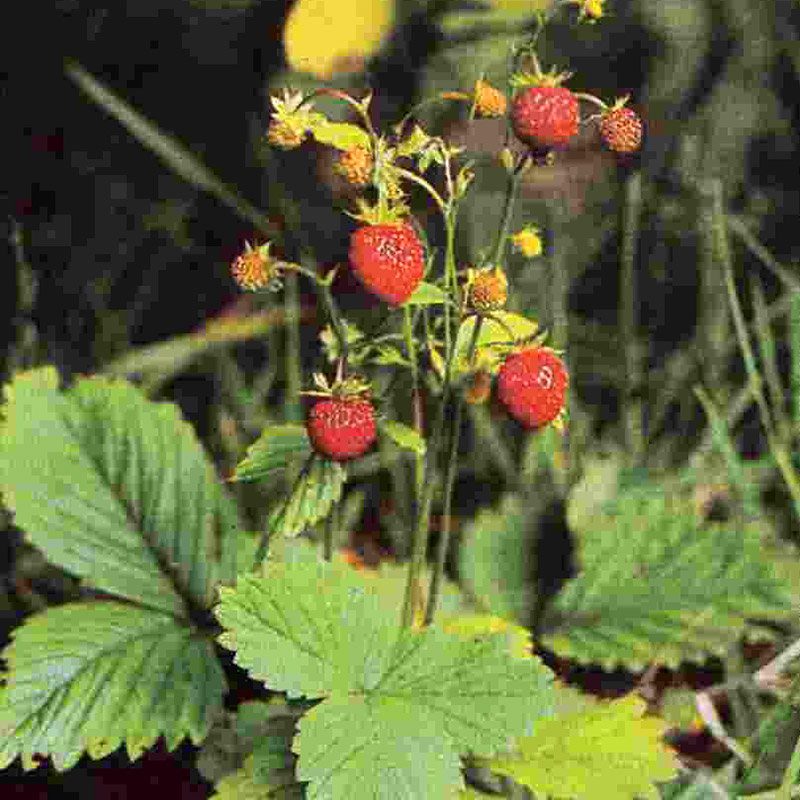
The wild strawberry grows to a height of only 20 cm and spreads via rooted runners. Its leaves form a basal rosette. They are trifoliate, with ovate-elliptical leaflets with sharply serrated margins and hairy undersides. The white flowers grow in cymes. Botanically, the strawberry is an aggregate fruit. The red, fruity part of the berry is the flower axis, which becomes fleshy as it ripens. It is intended to attract animals to spread the seeds. The “berry” contains numerous small green or brown nuts, each with a seed.
Medicinally used parts of plants (herbal drug)
In addition to wild strawberries, the following strawberry varieties are used for medicinal purposes: garden strawberry (F. x ananassa (Duch.) Guedes), musk or cinnamon strawberry (F. moschata West.), and hill strawberry (F. viridis West.). Hybrids and mixtures of different varieties are also used.
The dried leaves (strawberry leaves – Fragariae folium) collected during the flowering period are used.
The commercially available drug comes from Eastern and Southern European countries.
Constituents of the herbal drug
Strawberry leaves contain tannins (condensed tannins and ellagitannins), flavonoids, and phenolic carboxylic acids.
Quality of the drug
The quality of strawberry leaves (Fragariae folium) is specified in the German Drug Codex (DAC).
Medical applications
Recognised medical use
The HMPC has classified strawberry leaves as a traditional herbal medicinal product (see “Traditional use”).
ESCOP: Strawberry leaves have not been evaluated.
Traditional use
The HMPC has classified strawberry leaves as a traditional herbal medicinal product (Article 16a of Directive 2001/83/EC). Based upon long-standing use, strawberry leaves can be used for the relief of symptoms associated with minor urinary tract complaints, in addition to the general recommendation of sufficient fluid intake to increase the urine output. They can also be used for the symptomatic treatment of mild diarrhea.
Herbal drug preparations in finished dosage forms
- Chopped strawberry leaves for tea preparation
- Powdered drug in tablets
Dosage
Finished medicinal product: See patient information leaflet.
Tea: Drink 1 cup of warm strawberry leaf tea between meals 3 to 4 times daily. Daily dose 6 to 8 g of the drug. The tea can also be used as a mouthwash and gargle.
Preparation of a tea
Pour approximately 150-200 mL of boiling water over 4-5 g of finely chopped strawberry leaves and strain after 5 to 10 minutes. It is also possible to prepare it cold and bring it briefly to a boil.
Notes
If allergies to strawberries (fruit) are known, the use of strawberry leaves should be undertaken with caution.
During flushing therapy, plenty of fluids should be taken. If edema is present as a result of impaired heart or kidney function, flushing therapy with strawberry leaves should not be used. If complaints or symptoms such as fever, dysuria, spasms or blood in urine occur during use, a doctor should be consulted.
In the absence of sufficient data, use during pregnancy and lactation is not recommended. Use in children under 12 years of age is not recommended due to a lack of evidence.
Side effects
None known.
Interactions
None known.