

Lily of the valley
Botanical name
Convallaria majalis L.
Family
Asparagaceae
Common name
May Bells, Our Lady's Tears, Mary's Tears, Glovewort
Information about the plant
Lily of the valley is a poisonous plant (!) native to Europe and Northeast Asia and is now naturalized in North America. In Europe, it grows in sparse deciduous forests and bushes. It is also a popular garden plant.
The name "lily of the valley" refers to its early flowering period in May and its bell-shaped flowers. The genus name Convallaria is derived from the Latin "lilium convallium" (= lily of the valleys), because it prefers warm, low-lying areas in summer. The species epithet majalis can be translated as "blooming in May."
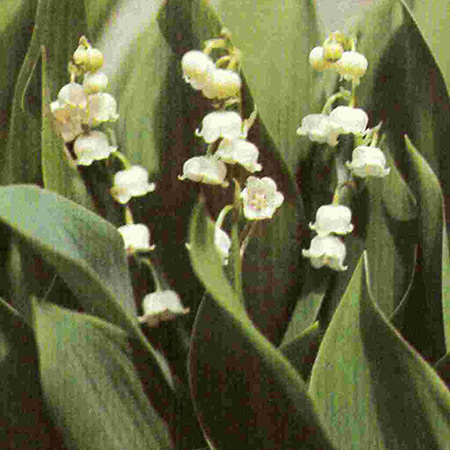
Lily of the valley is a perennial plant that survives the winter with an underground creeping rhizome (rootstock) and thus spreads very effectively. Each plant consists of two to four 12 to 18 cm long, parallel-veined leaves with a waxy feel on the upper surface, which grow upwards from the rhizome. Between these is the 20 to 35 cm long flower stalk, at the top of which approximately 10 stalked white, spherical, bell-shaped flowers hang in a loose, one-sided cluster. The six small petal lobes are curved outward. The fruits are red berries containing 3 to 6 seeds. They are poisonous! The flowering period is from May to June.
Medicinally used parts of the herbal drug
The dried herb harvested during flowering, consisting of leaves, flowers, and stems (lily of the valley herb - Convallariae majalis herba), is used.
The commercially available drug comes from wild collections in Eastern Europe.
Constituents of the herbal drug
Lily of the valley contains cardiac steroids in the form of cardenolides (cardenolide glycosides), mainly convallatoxin, convalloside, and convallotoxol. These are responsible for the plant's toxicity.
Quality of the herbal drug
The quality of lily of the valley herb (Convallariae majalis herba) and standardized lily of the valley powder (Convallariae pulvis normatus) was specified in the German Pharmacopoeia (DAB) until 2014. The German Homeopathic Pharmacopoeia (HAB) contains a monograph entitled "Convallaria majalis for homeopathic preparations."
Medicinal application
Recognised medicinal use
In the past, lily of the valley leaves were used in folk medicine to treat heart failure; however, this is problematic due to the narrow therapeutic range (strong toxic effects of cardenolides!) and should no longer be practiced. Therefore, lily of the valley leaves have not been reviewed by either the HMPC or ESCOP.
Traditional use
The content of cardenolides, which have a strong effect on the heart and are responsible for the plant's toxicity, prohibits the classification of lily of the valley as a traditional herbal medicinal product (Article 16a of Directive 2001/83/EC).
Herbal drug preparations in finished dosage forms
Lily of the valley herb is a component of cardiac remedies in homeopathy, combined with other cardiac drugs (including sea onion, hawthorn, adonis, and strophanthus). It is found in the following preparations
- Convallaria majalis homeopathic mother tincture
- Convallaria majalis homeopathic dilutions D1 to D4
Dosage
Finished medicinal products: See patient information leaflet.
Tea: Due to the narrow therapeutic range of lily of the valley herb (toxic effect of cardenolides!), tea must not be used.
Preparation of a tea
Not available.
Notes
Lily of the valley herb is toxic (strong cardiac effect!), so the drug or finished medicinal products may only be used under medical supervision.
Children and adolescents under the age of 18 must not use lily of the valley herb.
Side effects
Nausea, vomiting, cardiac arrhythmia.
Interactions
Increased efficacy and therefore increased side effects with concomitant administration of quinidine, calcium, laxatives, and during long-term corticosteroid therapy.