

Agrimony
Botanical name
Agrimonia eupatoria L.
Family
Rosaceae
Common name
Church steeples, Sticklewort
Information about the plant
Agrimony is widespread in Central and Atlantic Europe, ranging from the Azores and North Africa through Europe to western Asia, and north to southern Scandinavia. It grows in sunny, dry locations, on roadside embankments, and at the edges of bushes. The etymology of the Latin genus name is unclear, but the species epithet eupatoria is thought to refer to the medicinal use of agrimony for liver disorders and is a transformation of the Greek word ‘häpar’ (= liver), with ‘eu’ (= good) meaning ‘healthy’. Hemp-agrimony, Eupatorium cannabinum L., was also used in the past to treat liver disorders.
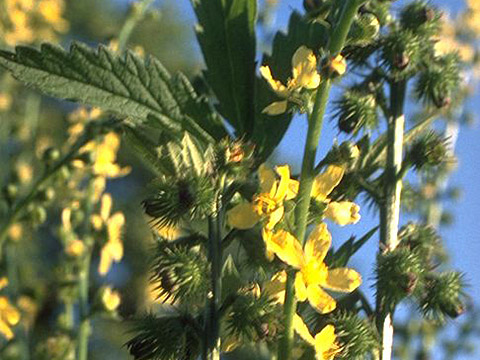
Agrimony is a perennial plant, 30 to 100 cm tall, with a long, hairy stem. The leaves are odd-pinnate, with large stipules and serrated margins. The underside of the leaves is densely gray-felted; the upper side is dark green and silky-hairy. The numerous golden-yellow flowers, 5 to 8 mm wide, grow in long spikes at the end of the stem. The flowers in a spike bloom from bottom to top, so that fruits form in the lower part of the spike while the flowers in the upper part are still blooming bright yellow. The fruits are conical and furrowed at the base and have many hooks. This allows the ripe fruits to ‘claw’ onto fur and clothing, where they are transported and thus spread. The flowering time is from June to August.
Medicinally used parts of the herbal drug
The dried shoot tips collected during flowering, consisting of stems, leaves, flowers, and fruits (agrimony herb - Agrimoniae herba), are used.
The commercially available drug is sourced from Bulgaria, Hungary, and Croatia.
Constituents of the herbal drug
Agrimony herb (Agrimoniae herba) contains tannins mainly catechin tannins and flavonoids.
Quality of the herbal drug
The quality of agrimony herb (Agrimoniae herba) is specified in the European Pharmacopoeia (Ph.
Medicinal application
Recognised medicinal use
The HMPC has classified agrimony herb as a traditional herbal medicine (see “Traditional use”).
ESCOP: Internally for mild diarrhea; externally for gargling in cases of inflammation of the oral and pharyngeal mucosa, and as a compress or rinse to support wound healing. These indications are based on findings of human experience and long-standing use.
Traditional use
Agrimony herb has been classified by the HMPC as a traditional herbal medicinal product (Article 16a of Directive 2001/83/EC). Based upon long-standing use, agrimony herb can be used internally for the symptomatic treatment of mild diarrhea, externally as a mouthwash or gargle for mild inflammation of the mouth and throat, and for the treatment of mild skin inflammation and small, superficial wounds.
Herbal drug preparations in finished dosage forms
- Chopped agrimony herb for tea preparation
- Liquid extract in liquid preparations
- Tincture in drops
Dosage
Finished medicinal product: See patient information leaflet.
Tea: Drink one cup of agrimony herb tea 2 to 4 times daily. Daily dose: 3 to 6 g of the drug.
External use: Apply an aqueous decoction of agrimony herb to the skin in the form of a compress three times daily. The aqueous decoction can also be used for gargling and as a bath additive.
Preparation of a tea
Pour approximately 150 mL of boiling water over 1.5 to 4 g of finely chopped agrimony herb and strain after 10 minutes.
Notes
If diarrhea persists for more than 3 to 4 days, it is recommended to consult a physician.
No studies on safety during pregnancy and lactation are available. Use in children under 12 years of age is not recommended due to a lack of evidence.
Side effects
None known.
Interactions
None known.
References
Herbal drug monographs
HMPC (2015, 2023), ESCOP (2019)
Further literature
Commentary on the European Pharmacopoeia (Agrimony herb, No. 1587)