

Opium poppy
Botanical name
Papaver somniferum L.
Family
Papaveraceae
Common name
Breadseed poppy
Information about the plant
Opium poppy, native to the western Mediterranean region and Asia Minor, is now cultivated throughout Asia, Russia, the Balkans, and Turkey in many forms, varieties, and cultivars. It is a source of valuable oil as well as opium, which is used in pharmaceuticals. Opium poppy is named after this substance, as its narcotic effects were already known in ancient times, a fact reflected in the species epithet somniferum: Latin ‘somnus’ = sleep, ‘ferre’ = to carry, ‘fero’ = I carry. Opium poppies may, however, only be cultivated for opium production under strict government supervision in a few countries. Opium poppies can sometimes be found growing wild along field edges in Europe.
The oil is extracted by cold-pressing the poppy seeds that fall out of the pores of the dry capsules. The seeds are also used as a topping on rolls (“poppy seed rolls”), in cakes (“poppy seed cakes”), and in desserts. Austria is a major producer of opium poppies. Opium is extracted from the unripe poppy capsules. For the extraction method, see the section “Medicinally used part of the plant (herbal drug).” Legal cultivation of poppies for opium production occurs in India, Turkey, and countries of the former Soviet Union. Afghanistan, Pakistan, and the “Golden Triangle” on the border of Thailand, Myanmar, and Laos are known for illegal cultivation.
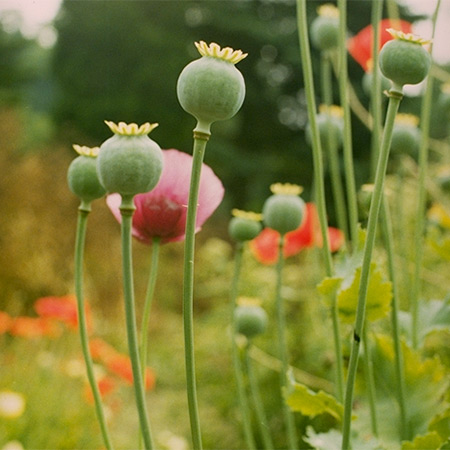
Opium poppy is an annual plant that grows to a height of 30 to 130 cm; its oblong-ovate leaves are arranged along the stem, with the upper leaves clasping the stem. A characteristic is that the stem and leaves are covered with a blue-green bloom. All parts of the plant contain laticifers, so that a white milky sap is secreted when the plant is damaged. The flower hangs downward in the bud stage, but becomes upright when it blooms. The four petals, which range from violet to white depending on the variety, form a flower up to 10 cm in diameter. A dark spot at the base of the petals is characteristic. The two sepals fall off when the flower blooms. Numerous stamens surround the pistil with its 8 to 12 stigmas, corresponding to the number of carpels. The pistil develops into a round capsule after pollination. As the fruit matures, the walls below the ring of stigmas separate, forming pores (scatter poppy). This opening does not occur in some varieties (closed poppy). The seeds are blue-gray or other colors, depending on the variety. The flowering time is from June to August; the fruit ripens from July to September.
Medicinally used parts of plants (herbal drug)
Medicinally, the dried milky sap of the unripe capsules is used (opium—Opium crudum). To obtain it, several horizontal and/or vertical incisions are made in the capsule wall in the poppy fields in the evening, while the capsules are still unripe and green, using special knives. A white milky sap exudes from the laticifers and solidifies overnight through the oxidation of phenolic constituents into a brownish mass. To prevent further browning, the sticky opium is scraped off before sunrise using special knives and marketed as “raw opium,” formed into balls, bricks, or cubes. The production of opium is regulated by international conventions.
Constituents of the herbal drug
Opium contains alkaloids (morphine, codeine, thebaine, noscapine, papaverine, etc.), latex, fats, proteins, sugars, mucilage, and resinous substances.
Quality of the drug
The quality of the following drugs and drug preparations is specified in the European Pharmacopoeia (Ph. Eur.):
- Opium (Opium crudum)
- Standardized dry extract of opium (Opii extractum siccum normatum)
- Standardized opium powder (Opii pulvis normatus)
- Standardized opium tincture (Opii tinctura normata)
Medical applications
Recognised medical use
Opium, opium preparations, and the alkaloids isolated from them (morphine, codeine, noscapine, etc.) are highly potent medicinal substances and must not be used in phytotherapy. For this reason, opium has not been reviewed by the HMPC and ESCOP.
The use of opium and opium preparations is regulated by the Narcotics Act. The pure alkaloids have analgesic (morphine, codeine) or antitussive (codeine, noscapine) effects and are available only as isolated substances in finished medicinal products. Opium tincture is used in hospitals under medical supervision as an emergency medication for severe diarrhea of unknown cause.
Traditional use
Due to its content of highly potent alkaloids, opium cannot be classified as a traditional herbal medicinal product (Article 16a of Directive 2001/83/EC).
Herbal drug preparations in finished dosage forms
Not applicable. Only finished pharmaceutical products containing the isolated alkaloids are available on the market. Morphine is a potent analgesic (narcotic). Codeine is used as an analgesic in combination with other pain-relieving substances and, like noscapine, is also included in finished pharmaceutical products for dry coughs. These products are available only by prescription.
Dosage
Not applicable.
Preparation of a tea
Not applicable.
Notes
Opium and opium preparations are subject to the Narcotics Act. They must therefore only be used under the supervision and control of a physician.
References
Herbal drug monographs
Not applicable.
Further literature
Commentary on the European Pharmacopoeia (Opium, No. 0777; Standardized Dry Opium Extract, No. 1839; Standardized Opium Powder, No. 1840; Standardized Opium Tincture, No. 1841).