
Horseradish
Botanical name
Armoracia rusticana G. Gaertn., B May & Scherb
Family
Brassicaceae
Common name
Red cole
Information about the plant
Horseradish is native to the Volga-Don region. It reached Central Europe in the early Middle Ages and is now found throughout most of Europe and on other continents. It is cultivated as a spice plant and also grows wild in ruderal locations such as roadsides, embankments, ditches, fences, and fields.
The genus name Armoracia is derived from the Latin ‘armoracius’ (= growing by the sea; originally Celtic, then Latinized). The species epithet rusticana (Latin ‘rusticanus’ = rural, peasant) refers to the taste of this spice plant, native to Eastern Europe, which was considered peasant food in earlier times.
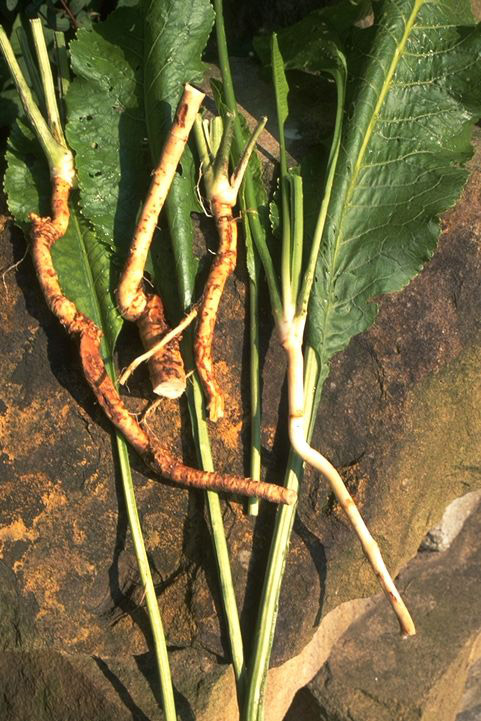
Horseradish grows up to 1.25 meters tall and is a perennial, robust plant with an angular, hollow stem that branches in the upper part. The root is thick and woody; in cultivated plants, it is thick, fleshy, and strongly pungent in smell and taste. The basal leaves are long-stalked, up to 100 cm long, and strongly notched; the lower stem leaves are lobed or comb-shaped-pinnately divided; the upper stem leaves are sessile, elongated, or lanceolate. The small white flowers are arranged in clusters consisting of numerous racemes. The fruits are siliques, spherical to ovoid, and stand at the end of thin, upright stalks 10 to 20 mm long. The flowering period is from May to July.
Medicinally used parts of the herbal drug
The fresh or dried root (horseradish root – Armoraciae radix) is used.
Horseradish roots are cultivated in Central European countries, where they are sold fresh or dried.
Constituents of the herbal drug
Horseradish root contains mustard oil glycosides (= glucosinolates). These compounds interact with an enzyme called myrosinase, stored in special cells, when the plant is cut and dried. The mustard oil glycosides are hydrolyzed (cleavage of the sugar residue), leading to the formation of volatile, mucous membrane-irritating, pungent-tasting mustard oils. Gluconasturtiin and sinigrin predominate in horseradish root, which are rearranged after hydrolysis to 2-phenylethyl isothiocyanate (phenylethyl mustard oil) and allyl isothiocyanate (allyl mustard oil), respectively. Horseradish root also contains phenolic carboxylic acids, coumarins, and vitamin C.
Quality of the herbal drug
There is no pharmacopoeial quality description available for horseradish root (Armoraciae radix).
Medicinal application
Recognised medicinal use
Horseradish roots have not been evaluated by either the HMPC or ESCOP.
In combination with nasturtium herb, clinically proven applications (approval) include the relief of symptoms in acute inflammatory diseases of the bronchi, sinuses, and urinary tract.
Traditional use
Horseradish root has not yet been classified as a traditional herbal medicinal product (Article 16a of Directive 2001/83/EC).
Herbal drug preparations in finished dosage forms
Powdered horseradish root in tablets
Tincture in ointments
Armoracia homeopathic mother tincture in ointments
Dosage
Finished medicinal products: See patient information leaflet.
Tea: Horseradish root should not be taken as a tea infusion. The recommended daily dose is 20 g of fresh root or approximately 1 g of horseradish powder. Preparations must be adjusted accordingly.
Fresh plant juice: 1 tablespoon twice daily. For external use, ointments and gels containing a maximum of 2% mustard oils.
Preparation of a tea
Not applicable.
Notes
Horseradish root should not be used in patients with stomach or intestinal ulcers or kidney inflammation. Horseradish root should not be used in children under 4 years of age.
Side effects
Gastrointestinal complaints, allergic reactions, and irritation of the mucous membrane may occur.
Interactions
Not known.