

Iris
Botanical name
Iris germanica L.
Family
Iridaceae
Common name
Bearded iris, German iris, Purple flag, Purple orris root
Information about the plant
The German iris is native to Europe as far as the Ural Mountains but is relatively rare in Central Europe. Various cultivated varieties are grown as ornamental plants in many gardens, which is why naturalized forms are also found there. It is much more common in Mediterranean countries. It is a sterile plant resulting from hybridization. It prefers sunny hillsides, walls, and rocky slopes.
The name iris refers both to its large, sword-shaped leaves and to its colorful, lily-like flowers. The genus name Iris also refers to the colorful flowers of the plant. It is derived from the Greek word “iris,” meaning “rainbow.”
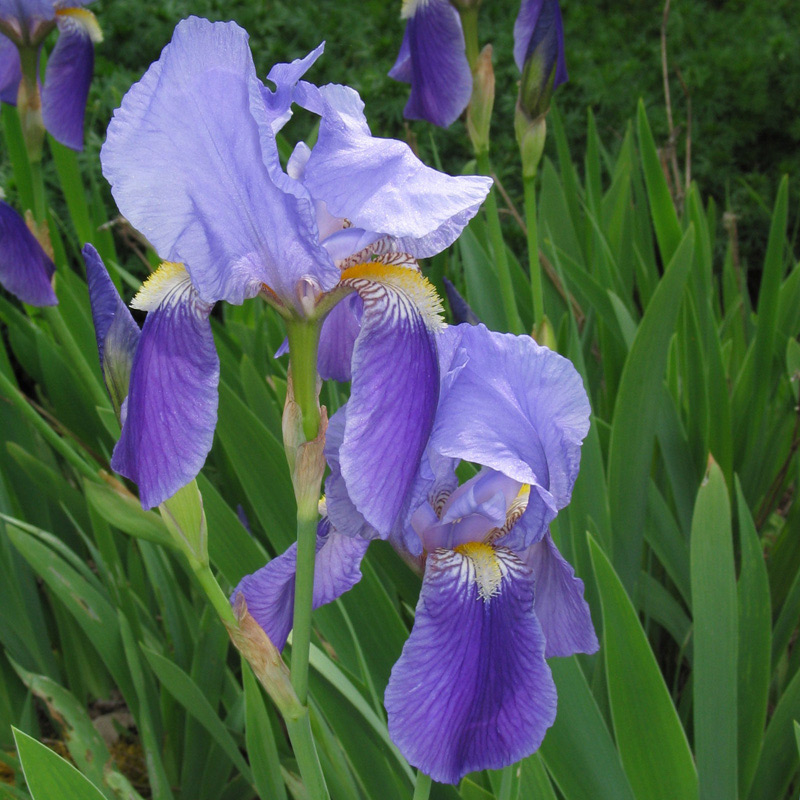
The iris is a perennial plant with a robust, creeping, branched rhizome (underground stem). As it is a hybrid, it can reproduce only vegetatively via its vigorous rhizome. In spring, hard, sword-shaped leaves up to about 80 cm long grow from this rhizome, and stems bearing several large flowers then develop above the leaves. The flowers are very distinctive, and each consists of three outer and three inner perianth segments. The three outer segments are dark violet, have yellow beards, and are reflexed (hanging segments), while the three inner segments stand upright (dome-shaped segments) and are slightly lighter in color. The flowering time is from May to June.
The Florentine iris (Iris germanica var. florentina Dykes), a subspecies of the German iris with white flowers, and the pale iris (Iris pallida Lam.) with light purple flowers are also used medicinally.
Medicinally used parts of plants (herbal drug)
The peeled, dried rhizome (iris rootstock—Iridis rhizoma) is used. Because of its violet-like scent, the herb is also called “orris root.” It is primarily imported from Morocco and Italy.
Constituents of the herbal drug
Iris rhizomes contain a semisolid essential oil with a violet-like scent (“iris butter”). The irones contained in the oil are responsible for this scent. The rhizomes also contain isoflavones, spirocyclic triterpenoids (iridales), mucilage, and starch.
Quality of the drug
Pharmacopoeias (Ph. Eur., DAB, DAC) do not specify the quality of iris rhizome. A pharmacopoeial monograph titled “Rhizoma Iridis” was included in the 6th edition of the German Pharmacopoeia (DAB 6).
Medical applications
Recognised medical use
Iris rhizome has not been reviewed by the HMPC or ESCOP.
There are no concerns regarding its use in tea blends as a flavor or aroma enhancer. In folk medicine, iris rhizome is used as an expectorant for colds.
Traditional use
Iris rhizome has not been classified as a traditional herbal medicinal product (Article 16a of Directive 2001/83/EC). It is traditionally used to help loosen mucus in the respiratory tract.
Herbal drug preparations in finished dosage forms
Extracts as fragrance components in lotions and patches.
Dosage
Finished medicinal products: See patient information leaflet.
Preparation of a tea
Not applicable.
Notes
As there is no information available on the risks associated with the use of iris rhizome, and more effective herbal alternatives are available for treating colds, the use of iris rhizome is not recommended during pregnancy and lactation, or for children and adolescents under 18 years of age.
Iris rhizomes (orris root) are still used today in the form of turned pieces as teething aids for children, especially by “health-conscious” parents. This practice is strongly discouraged, as the rhizomes are moistened by saliva and thus provide an ideal environment for bacteria (caution: risk of infection!).
Side effects
None known.
Interactions
None known.