

Walnut
Botanical name
Juglans regia L.
Family
Juglandaceae
Common name
Common walnut, English walnut, Persian walnut
Information about the plant
The walnut tree is native to Eurasia. Its real origin is difficult to determine, as it has become naturalized in many countries through cultivation. The genus name Juglans is derived from the Latin ‘Jupiter’ (= Jupiter, genitive ‘iovis’) and ‘glans’ (= acorn), suggesting that the tree was named after its fruit. The specific epithet regia can be translated as ‘royal’ (Latin ‘regius’ = royal). The name walnut dates back to the Germanic period and derives from the German ‘Welschnuss’, meaning the nut of the ‘Welschen’. This served to distinguish it from the native hazelnut, as the walnut tree was brought to the Germanic peoples by the Romans.
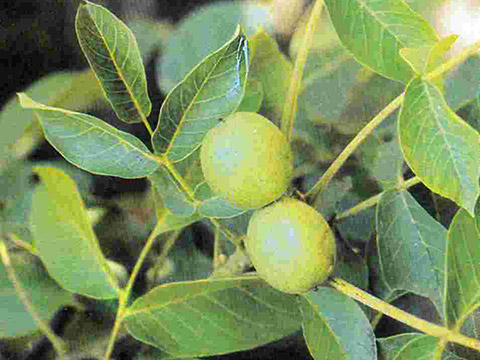
The walnut tree grows to a height of 10 to 25 m. Its crown is broad and open, with loosely arranged branches, and its bark is light gray-brown, becoming cracked and blackish-gray with age. The 40 cm long, green, glossy leaves are imparipinnate, with individual pinnae 5 to 13 cm long and the terminal leaflet up to 25 cm long. The male inflorescences hang as green catkins from the leaf axils of the previous year’s growth. The female flowers form loose, spike-like inflorescences, usually bearing one to five flowers, at the branch tips. The fruit – the ‘walnut’ – is a spherical drupe with a fleshy husk (outer fruit wall) that is initially green, later turning dark brown, and separates irregularly and fibrously from the inner fruit wall (the ‘nutshell’).
The dark color of the fruit husk is caused by juglone, a naphthoquinone. It is unstable and easily polymerizes into brown-black pigments. Juglone is also present in the leaves. Rain washes it out, preventing other plants from sprouting under the walnut tree. The inner fruit wall (the ‘nutshell’) is light brown, hard, and wrinkled, and opens in two segments along a bulging seam. The seeds are two-lobed and have large, oil-rich cotyledons, known as the tasty nut, which is highly prized and widely used. The flowering time is from April to May.
Medicinally used parts of plants (herbal drug)
The dried leaves, separated from the stem and used whole or cut (walnut leaves – Juglandis folium), are used.
Constituents of the herbal drug
Walnut leaves contain tannins (ellagitannins), naphthoquinones, flavonoids, and phenolic acids.
Quality of the drug
The quality of walnut leaves (Juglandis folium) is specified in the German Drug Codex (DAC).
Medical applications
Recognised medical use
The HMPC has classified walnut leaves as a traditional herbal medicinal product (see ‘Traditional use’).
ESCOP: For external use in cases of minor skin inflammation and excessive sweating of hands and feet. These indications are based on findings from long-standing use in humans.
Traditional use
The HMPC has classified walnut leaves as a traditional herbal medicinal product (Article 16a of Directive 2001/83/EC). Based on long-standing use, walnut leaves can be used topically to treat minor skin inflammation and excessive sweating of the hands and feet.
Herbal drug preparations in finished dosage forms
- Cut walnut leaves for infusion
- Powdered walnut leaves in coated tablets and tablets
- Alcohol-water extracts (including tinctures) in drops
Dosage
Finished medicinal products: See patient information leaflet.
Tea: Apply an aqueous decoction of walnut leaves as a compress to the affected skin areas 2 to 4 times daily; remove after 30 minutes. The aqueous decoction can also be used as a bath additive for full or partial baths.
Preparation of a tea
For external use: Pour 200 mL of hot water over 4 to 6 g of walnut leaves, let stand for 10 minutes, then strain.
Notes
Walnut leaves should not be applied to open wounds or large areas of damaged skin.
No studies are available regarding the safety of walnut leaves during pregnancy and lactation. Use in children and adolescents under 18 years of age is not recommended due to a lack of evidence.
Side effects
None known.
Interactions
None known.