
Knotgrass herb
Botanical name
Polygonum aviculare L.
Family
Polygonaceae
Common name
Common knotgrass, Birdweed, Knotweed, Doorweed, Prostrate knotweed, Pigweed, Lowgrass
Information about the plant
Knotgrass is native to Europe, has been introduced to temperate regions of other continents, and is now distributed worldwide. It prefers ruderal sites, areas heavily impacted by human activity, such as rubble piles, fallow land, roadsides, paths, railroad embankments, and weedy areas, and it also grows between paving stones.
The genus name Polygonum may be derived from the Greek “polygonos” (= producing many, fertile), as this would describe knotweed well. However, a more likely derivation is from the Greek “polys” (= many) and “gony” (= knee), meaning “many knees,” referring to the typically knotty, jointed stems. The species epithet ‘aviculare’ is derived from the Latin ‘avicularis’ (= serving as bird food; ‘avis’ = bird) and indicates that birds readily consume the fruits of knotgrass.
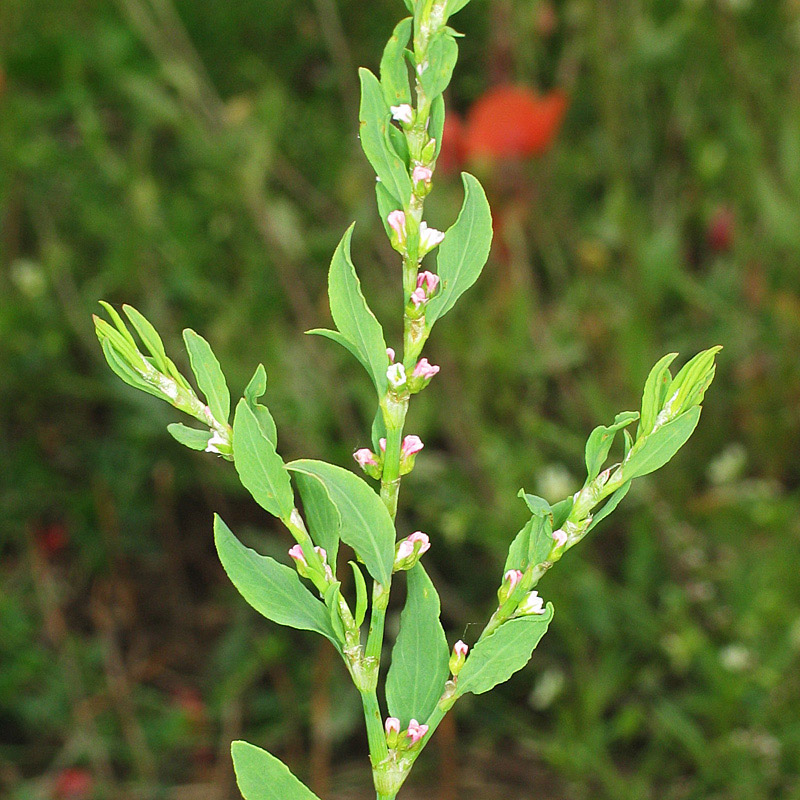
Knotgrass has low-lying or slightly ascending stems up to over 1 meter long, with elliptic-lanceolate leaves. The leaves on the side branches are slightly larger than those on the main stem. At the base of each leaf is a silvery ocrea, which is brownish at the base. The small flowers occur in clusters of 1 to 3 in the leaf axils. Their greenish-white, 5-parted perianth often has red tips. The fruits are small, brown or black, triangular nutlets. The flowering time is from May to September. The species is highly variable in form and is therefore regarded as a “group of knotgrass species.”
Medicinally used parts of plants (herbal drug)
The dried, flowering aerial parts, consisting of leaves, stems, and flowers (Polygoni avicularis herba), are used.
The commercially available herb is collected from the wild in Eastern European countries.
Constituents of the herbal drug
Knotgrass herb contains flavonoids, tannins, coumarins, phenolic carboxylic acids, aviculan (a lignan), naphthoquinones, as well as mucilage.
Quality of the drug
The quality of knotgrass herb (Polygoni avicularis herba) is specified in the European Pharmacopoeia (Ph. Eur.).
Medical applications
Recognised medical use
The HMPC has classified knotgrass herb as a traditional herbal medicinal product (see “Traditional Use”).
ESCOP: Knotgrass herb has not been reviewed.
Traditional use
Knotgrass herb has been classified by the HMPC as a traditional herbal medicinal product (Article 16a of Directive 2001/83/EC). Based upon long-standing use, knotgrass herb can be taken internally to treat the common cold and to increase urine production and flush the urinary tract, thereby relieving mild urinary tract complaints. External use: for mild inflammation of the mouth and throat.
Herbal drug preparations in finished dosage forms
- Chopped knotgrass herb for tea preparation, usually in combination with other herbs
- Aqueous extract in liquid preparations
Dosage
Finished medicinal product: See patient information leaflet.
Tea: Drink one cup of knotgrass herb tea 3 to 5 times a day. To use as a gargle, dilute the tea slightly with water and use 4 to 5 times a day.
Preparation of a tea
Pour approximately 150 mL of boiling water over 1.5 to 2 g of finely chopped knotgrass herb and strain after 5 to 10 minutes.
Notes
In cases of urinary tract infections, it is important to drink plenty of fluids. In cases of edema due to impaired heart or kidney function, flushing therapy with knotgrass herb should not be used.
No safety studies are available for the use of knotgrass herb during pregnancy or lactation. Use in children under 12 years of age is not recommended due to lack of data.
Side effects
None known.
Interactions
None known.
References
Herbal drug monographs
Further literature
Commentary on the European Pharmacopoeia (Knotgrass herb, No. 1885)