

Willowherb
Botanical name
Epilobium angustifolium L. - Narrow-leaved willowherb, Rosebay willowherb
Epilobium parviflorum Schreb. - Small-flowered willowherb, Hoary willowherb
Family
Onagraceae
Common name
Willow herb, Fireweed, Rosebay willowherb
Information about the plant
The two species of willowherb are widespread in the Northern Hemisphere and can therefore be found in Europe, Asia, and North America. They form dense clusters in sunny locations, among tall herbaceous vegetation, on embankments, in forest clearings, and in felled woodland. Small-flowered willowherb is also found on ditch banks and often on rubbish tips and roadsides.
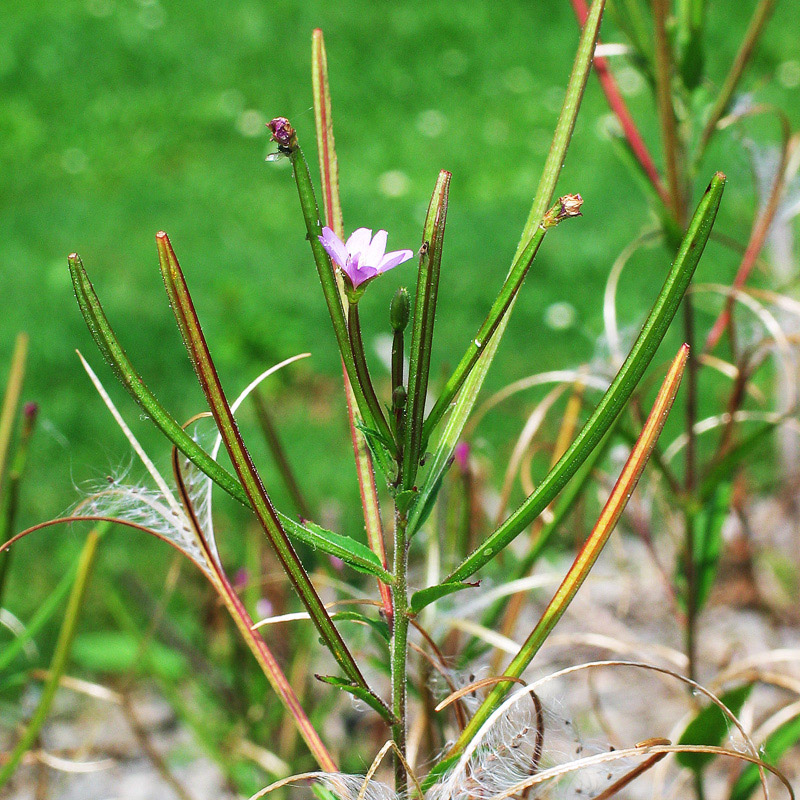
The genus name Epilobium is derived from three Greek words: ‘epi’ (= on), ‘lobos’ (= pod) and ‘ion’ (= violet). That makes ‘violet on the pod’. The flowers, which are borne on the pod-shaped ovary, do indeed resemble violets. In the narrow-leaved willowherb (angustifolium), the specific epithet refers to the shape of the leaves (Latin ‘angustus’ = narrow, ‘folium’ = leaf), whereas in the small-flowered willowherb (parviflorum) it refers to the size of the flowers (Latin ‘parvus’ = small, ‘flos’, gen. floris = flower). Narrow-leaved willowherb can grow up to 2 m tall. The stem is branched only in the upper part. The linear-lanceolate leaves, which are gray-green underneath, are alternate. The purplish-red flowers, with their four 15-mm-long petals, are arranged in elongated racemes above the leaf portion of the stem and open from the bottom upwards. The fruit is a capsule up to 3 cm long. Small-flowered willowherb grows to 80 cm tall and forms a daughter rosette at the base of the stem. The stems are densely covered with spreading hairs, and the leaves are softly hairy. The pale pink flowers, with petals 5 to 10 mm long, are significantly smaller than those of the narrow-leaved willowherb. The flowering time for both species is from July to September.
Medicinally used parts of plants (herbal drug)
The herb (willowherb – Epilobii herba), consisting of stems, leaves, flowers, and fruits, is used from both species. It is dried during or shortly before flowering.
The commercially available herbal drug is sourced from wild harvests in Central Europe. The herb of other Epilobium species is also found on the market (E. montanum, E. roseum, E. collinum, E. hirsutum).
Constituents of the herbal drug
Willowherb contains tannins, flavonoids, and sterols.
Quality of the drug
There is no pharmacopoeial quality specification available for willowherb (Epilobii herba).
Medical applications
Recognised medical use
The HMPC has classified willowherb as a traditional herbal medicinal product (see ‘Traditional use’).
ESCOP: For the symptomatic treatment of mild urinary symptoms associated with benign prostatic hyperplasia (BPH) and irritable bladder. These indications are based on findings from long-standing use in humans.
Traditional use
Willowherb has been classified by the HMPC as a traditional herbal medicinal product (Article 16a of Directive 2001/83/EC). Based upon long-standing use, willowherb may be used to relieve lower urinary tract symptoms associated with benign prostatic hyperplasia (BPH), after serious conditions have been ruled out by a medical doctor.
Herbal drug preparations in finished dosage forms
- Chopped willowherb for tea preparation
Dosage
Finished medicinal products: Not applicable.
Tea: Drink one cup of willowherb tea 2 to 5 times a day.
Preparation of a tea
Pour approximately 150 ml of boiling water over 1.5 to 2 g of chopped willowherb and strain after 5 to 10 minutes.
Notes
Because willowherb only relieves the symptoms of an enlarged prostate rather than preventing the enlargement itself (symptomatic treatment), regular medical check-ups are recommended.
Benign prostatic hyperplasia (BPH) is not relevant in children and adolescents; therefore, use in this age group is not recommended.
Side effects
None known.
Interactions
None known.