

Mustard
Botanical name
Sinapis alba L. (Syn. Eruca alba Noulet) - White mustard
Brassica nigra W.D.J. Koch (Syn. Sinapis nigra L.) - Black mustard
Family
Brassicaceae
Common name
White mustard, Yellow mustard Black mustard, True mustard
Information about the plant
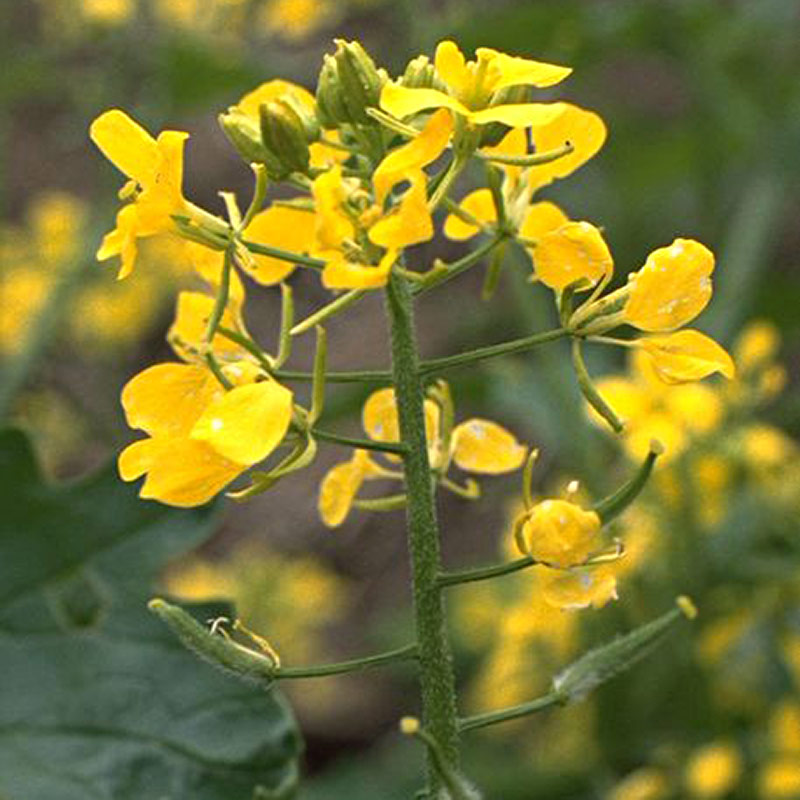
White mustard – Sinapis alba (Latin ‘albus’ = white) is native to Western Asia and India but is cultivated in Central Europe and many other countries around the world. It is an annual herb that grows 30 to 80 cm tall, with a slightly bristly stem and petiolate, lyre-shaped, pinnately compound leaves. Several pale-yellow cruciferous flowers form a terminal raceme-like inflorescence; the sepals are very narrow and spread horizontally, while the four petals are 8 to 12 mm long and obovate. The flowering time is from June to July. White mustard produces a long-stalked, long-beaked, hairy pod (2 to 4 cm long) containing two to six yellowish, spherical seeds (“mustard seeds”). These are used for pickling cucumbers and mixed pickles, as well as for seasoning sausages and canned fish; they are also used to make table mustard.
Black mustard, Sinapis nigra (Latin niger, fem. ‘nigra’ = shiny black), is very similar to white mustard. It is more branched, the upper leaves are entire, the flowers are slightly smaller, and they cluster tightly at the tips of the stem and side branches. The flowering time is from June to September. The pods (2 to 3 cm long) stand upright and cling slightly to the stem. When ripe, they burst open and release eight to 16 reddish-brown to black seeds. Black mustard is also cultivated worldwide, and the seeds are processed into mustard.
Medicinally used parts of plants (herbal drug)
The seeds are used when ripe and dried.
White mustard seeds (Erucae semen), black mustard seeds (Sinapis nigrae semen).
The commercially available drugs come from domestic production and imports from Eastern Europe.
Constituents of the herbal drug
White and black mustard seeds contain mustard oil glycosides (glucosinolates). When the plant is cut and dried, these substances come into contact with the enzyme called myrosinase, which is stored in special cells. As a result, the mustard oil glycosides are hydrolyzed (the sugar moiety is cleaved off), followed by a chemical rearrangement that produces the mucous membrane-irritating, pungent “mustard oils” (as is also the case with horseradish, among others). In white mustard seeds, sinalbin predominates, which, after hydrolysis, rearranges to form p-hydroxybenzyl isothiocyanate (pungent-tasting, non-volatile). In black mustard seeds, it is sinigrin, from which the pungent-tasting, volatile allyl isothiocyanate (allyl mustard oil) is formed. Both seeds also contain fatty oil (up to 35%), proteins (approx. 40%), mucilage, sinapine, flavonoids, and steroids.
Quality of the drug
The quality of white mustard seeds (Erucae semen) and black mustard seeds (Sinapis nigrae semen) is specified in the German Drug Codex (DAC).
Medical applications
Recognised medical use
White and black mustard seeds have not been reviewed by the HMPC or ESCOP.
Traditional use
White mustard seeds and black mustard seeds have not yet been classified as traditional herbal medicinal products (Article 16a of Directive 2001/83/EC).
Herbal drug preparations in finished dosage forms
Mustard plasters containing mustard seeds paste are available, as well as a tincture (mustard spirit—Spiritus sinapis).
Dosage
Mustard poultice: Mix four tablespoons of mustard powder (ground seeds) with lukewarm water to form a thick paste. Spread the paste onto a linen cloth and apply it to the chest, back, or neck, depending on the symptoms. Apply for 5 to 10 minutes for children and 10 to 15 minutes for adults. Follow with a cleansing bath at 36°C.
Mustard plasters must be kept in warm water for 10 to 15 seconds before application.
For application duration, see patient information leaflet.
Preparation of a tea
Not applicable.
Notes
Be sure to protect your eyes and face when using mustard poultices! Mustard oils can penetrate the skin and irritate the renal epithelium. Therefore, mustard poultices should not be used in cases of kidney disease. The use of mustard poultices is not recommended for children under 6 years of age, nor during pregnancy or lactation.
Side effects
There is a risk of skin and nerve damage after application for longer than recommended. Mustard plasters or poultices left on the skin for a prolonged period of time may cause blisters, often leading to festering, slow-healing ulcers, and necrosis.
Interactions
None known.