

Common chicory
Botanical name
Cichorium intybus L. var. intybus
Family
Asteraceae
Common name
Blue daisy, Blue dandelion, Blue sailors, Blue weed, Wild endive
Information about the plant
Common chicory is widespread in Europe, with the exception of the Arctic and sub-Arctic regions, as well as in North Africa, Western Asia, and Siberia as far as Lake Baikal, and has been introduced to East Asia, the Americas, South Africa, Australia, and New Zealand. It grows in ruderal locations such as railway embankments, rubbish dumps, and roadsides.
The genus name Cichorium is derived from the Greek ‘kichorion’, combining the Greek ‘kio’ (= I go) and ‘chorion’ (= field). This makes it clear that the plant is often found along country lanes. Due to this characteristic, it is also called “Wegwarte” in German, which translates to “wayside watcher,” as the plant waits for the sunrise before opening its flowers. The specific epithet intybus was taken from the plant’s name used before Linné. The plant was called ‘Intybus’, derived from the Greek ‘entybon’ (= endive). Indeed, the endive (Cichorium endivia L.), whose leaves are used in salads, is closely related to the common chicory. Chicory (C. intybus var. foliosum) also belongs to this close family. Another variety of Cichorium intybus is also used, C. intybus var. sativum, the root or coffee chicory, whose root is roasted and used as a coffee substitute (chicory coffee).
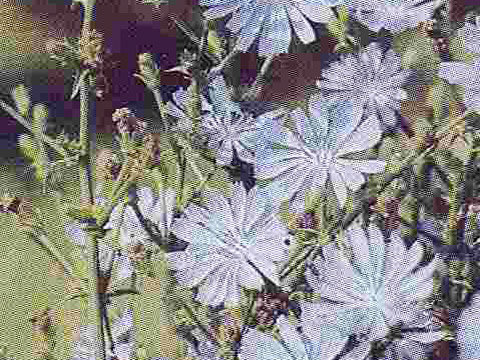
Common chicory is a sparsely branched plant that grows up to 1 m tall, with bristly hairs and a 10- to 30-cm-long root containing milky sap. The leaves are 10 to 30 cm long; the basal leaves are coarsely serrated, while the upper leaves are oblong-lanceolate. Numerous light blue, more rarely white, 3- to 4-cm-wide flower heads are borne singly or in clusters, laterally or terminally on the stiff stem. The flowering time is from July to September.
Medicinally used parts of plants (herbal drug)
The dried root, harvested in fall (chicory root – Cichorii intybi radix) is used.
Commercial herbal drugs are from ld harvests in Poland and Russia.
Constituents of the herbal drug
Chicory root contains bitter sesquiterpene lactones, coumarins, phenolic carboxylic acids, and inulin.
Quality of the drug
There is no pharmacopoeial quality specification available for chicory root (Cichorii intybi radix).
Medical applications
Recognised medical use
The HMPC has classified chicory root as a traditional herbal medicinal product (see ‘Traditional use’).
ESCOP: Chicory root has not been evaluated.
Traditional use
Chicory root has been classified by the HMPC as a traditional herbal medicinal product (Article 16a of Directive 2001/83/EC). Based upon long-standing use, chicory root can be used to treat mild digestive complaints such as bloating, flatulence and sluggish digestion, as well as temporary loss of appetite.
Herbal drug preparations in finished dosage forms
- Chopped chicory root for tea preparation
Dosage
Finished medicinal products: See patient information leaflet.
Tea: Drink one cup of chicory root tea once a day; daily dose 2 to 4 g of the herb.
Preparation of a tea
Pour approximately 150 ml of boiling water over 2 to 4 g of finely chopped chicory root and strain after 10 minutes.
Notes
There are currently no studies available on the safety of chicory root during pregnancy and lactation. Use in children under 12 years of age is not recommended due to a lack of evidence.
Side effects
None known.
Interactions
None known.