
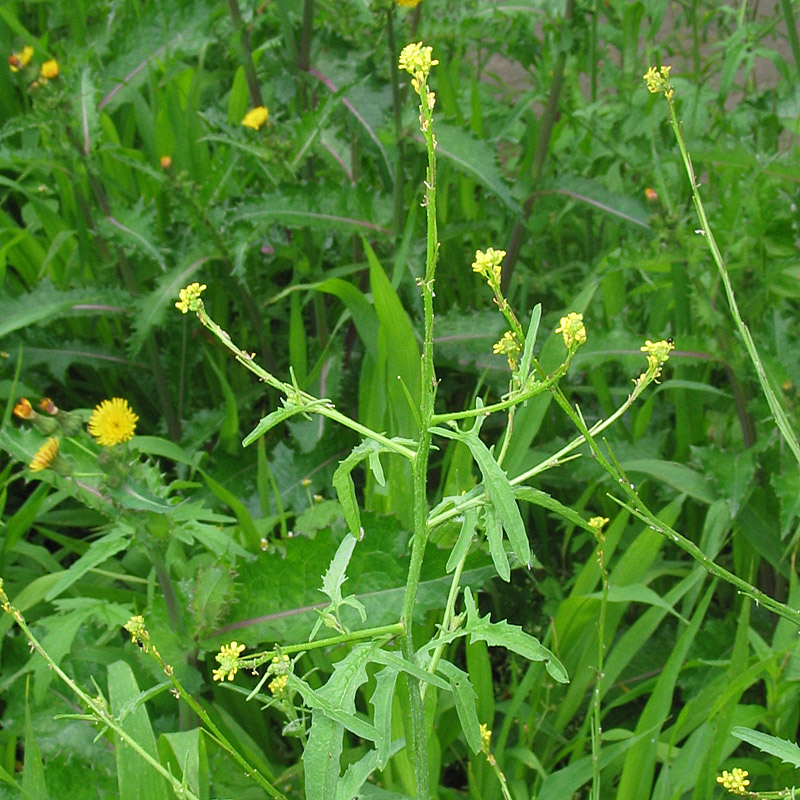
Hedge mustard
Botanical name
Sisymbrium officinale (L.) Scop.
Family
Brassicaceae
Common name
Tumble mustard, Wild mustard, Common sisymbrium
Information about the plant
Hedge mustard is widely distributed worldwide and, as such, is found throughout Eurasia as far as Eastern Siberia, the entire Mediterranean region, North and South America, Australia, and East and South Africa. It grows in nutrient-rich soils, as a weed in fields, and in ruderal vegetation around human settlements, on rubbish dumps, and along riverbanks and embankments.
The genus name Sisymbrium is derived from Latin (Lat. ‘sisymbrium’) and Greek (Gr. ‘sisymbrion’), the name of a ‘fragrant plant’, which probably originally referred to watercress (Nasturtium officinale, also Brassicaceae). The species epithet officinale suggests that this is an old medicinal plant, as the ‘officina’ is the salesroom of a pharmacy and officxinalis is commonly used in the pharmacy. In France, the plant was formerly known as ‘herbe de chantre’, meaning ‘singer’s herb’, because singers traditionally drank tea prepared from the herb before performances to relieve hoarseness. The name Erysimum officinale L., which is considered a synonym, more clearly expresses the plant’s medicinal properties, as the Greek ‘erysimon’ means ‘medicinal plant’.
Hedge mustard grows to a height of 20 to 70 cm, with an upright stem and spreading branches. The lower leaves are pinnately lobed, with 2 to 5 pairs of lateral segments and a larger, lobed, triangular terminal segment. The upper leaves have only 1 to 2 pairs of lateral segments and a narrower terminal segment. The flowers are small, with four yellow petals. The pods are 1 to 1.5 cm long, narrow, and hairy, lying close to the stem. The flowering period is from May to October.
Medicinally used parts of plants (herbal drug)
The dried herb, consisting of leaves, stems, and flowers, is harvested during the flowering period (hedge mustard – Sisymbrii herba, Erysimi herba).
Commercial herbal drugs are from wild collections in Eastern European countries.
Constituents of the herbal drug
Hedge mustard contains mustard oil glycosides (= glucosinolates). When the plant is cut or dried, the mustard oil glycosides are hydrolyzed by the enzyme (the sugar residue is cleaved off), followed by a rearrangement into volatile, mucous membrane-irritating, pungent-tasting mustard oils (e.g., mustard, horseradish, etc.).. Sinigrin and gluconapin are the predominant compounds in the herb, which, following hydrolysis, rearrange into allyl isothiocyanate (allyl mustard oil) and 3-butenyl isothiocyanate; the herb also contains cardiotonic cardenolides (steroids).
Quality of the drug
There is no pharmacopoeial quality specification available for hedge mustard (Sisymbrii herba, Erysimi herba).
Medical applications
Recognised medical use
The HMPC has classified hedge mustard as a traditional herbal medicinal product (see ‘Traditional use’).
ESCOP: Hedge mustard has not been reviewed.
Traditional use
The HMPC has classified hedge mustard as a traditional herbal medicinal product (Article 16a of Directive 2001/83/EC). Based upon long-standing use, hedge mustard can be used to treat throat irritation, such as hoarseness and dry coughs (taken orally or as a gargle).
Herbal drug preparations in finished dosage forms
- Dry extracts (water-based extracts) in solid or liquid preparations
Dosage
Finished medicinal products: See patient information leaflet.
Adults: 82.5 mg dry extract (DER 6–8:1; extracted with water) 3 to 4 times daily. Children (3–11 years): 27.5 mg dry extract (DER 6–8:1; extraction solvent: water) 3 to 4 times daily.
For gargling: Dissolve 10 mg of the dry extract (DER 3.5–5.5:1) or 7.5 to 10 mg of the dry extract (DER 6–8:1) in water and gargle 10 to 12 times daily.
Preparation of a tea
Not applicable.
Notes
No studies are available regarding afety of hedge mustard during pregnancy and lactation. Its use in children under 6 years of age is not recommended due to a lack of evidence.
Side effects
None known.
Interactions
None known.