

Black Horehound
Botanical name
Ballota nigra L.
Family
Lamiaceae
Common name
Stinking horehound, Black nettle, False horehound
Information about the plant
Black horehound is a member of the Lamiaceae family widespread in the Mediterranean region and Western Asia, and has been introduced to North America. In Europe, its range extends northwards to Ireland, Scotland, and southern Scandinavia. Black horehound grows in weed communities, on rubbish dumps, along fences and hedges, and on the sides of roads and paths.
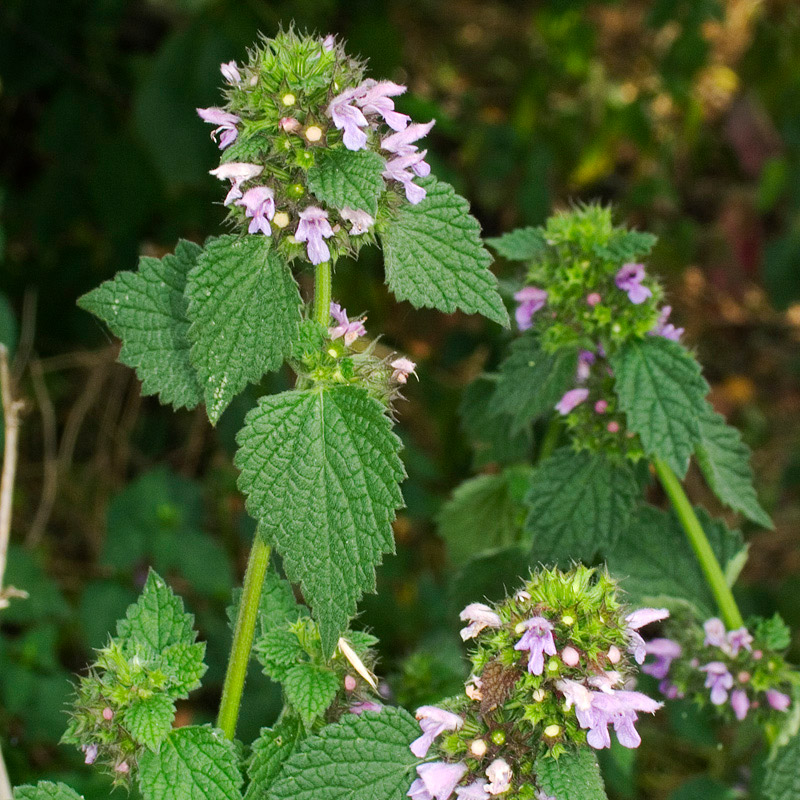
Black horehound is a perennial plant growing to a height of 30 to 80 cm, with a branched, square-shaped stem covered in bristly hairs. The short-stalked, broadly lanceolate, hairy leaves are arranged in opposite pairs on the stem and have coarsely toothed margins. They appear wrinkled due to the strong veins on the underside. The unpleasant smell of the leaves is caused by essential oil contained in glandular scales on the leaf surface. Rubbing the leaves damages these glands, releasing the essential oil. Four to ten violet to pink flowers are clustered in several leaf-axillary pseudo-whorls, densely arranged at the stem tip. The corolla is up to 14 mm long. The upper lip is almost flat and hairy on the upper surface, while the lower lip has a large central lobe and smaller lateral lobes. The flowering time is from June to October. In autumn, black horehound turns brownish-purple and smells increasingly unpleasant.
Medicinally used parts of plants (herbal drug)
The dried flowering tops of the stems are used (black horehound – Ballotae nigrae herba).
The commercially available herbal drug comes from various Mediterranean countries (wild-harvested).
Constituents of the herbal drug
Black horehound contains essential oil consisting mainly of sesquiterpenes. Its unpleasant odor is due to its furan content. It also contains caffeic acid derivatives, diterpenoid bitter compounds, flavonoids, chlorogenic acid, and Lamiaceae tannins (main component: rosmarinic acid).
Quality of the drug
The quality of black horehound (Ballotae nigrae herba) is specified in the European Pharmacopoeia (Ph. Eur.).
Medical applications
Recognised medical use
The HMPC has not reviewed black horehound.
ESCOP: For internal use in cases of tension, restlessness, and irritability accompanied by difficulty sleeping and mild stomach cramps.
Traditional use
Black horehound has not been classified as a traditional herbal medicinal product (Article 16a of Directive 2001/83/EC).
Herbal drug preparations in finished dosage forms
- Black horehound as a tea
Dosage
Finished medicinal products: Not applicable.
Tea: Drink one cup of freshly prepared warm tea 3 times a day.
Preparation of a tea
Pour 150 mL of hot water over 2 to 4 g of finely chopped black horehound (do not boil!), leave to stand for 5 to 10 minutes, then strain.
Notes
There are currently no studies available on the safety of using black horehound during pregnancy and lactation. The use in children and adolescents under the age of 18 is not recommended due to a lack of evidence.
Side effects
None known.
Interactions
None known.
References
Herbal drug monographs
ESCOP (2016)
Further literature
Commentary on the European Pharmacopoeia (Black horehound, No. 1858)