

White Dead-nettle
Botanical name
Lamium album L.
Family
Lamiaceae
Common name
White nettle, Deaf nettle, Blind nettle, Bee nettle
Information about the plant
White dead-nettle is native to a region extending from Portugal across Europe and Asia to the Himalayas and Japan, but is absent in the north. It has been naturalized in North America. It tends to grow in typical ruderal habitats influenced by human activity, such as rubble sites and courtyards, along the verges of paths and roads, on railway embankments, and along hedges and fences.
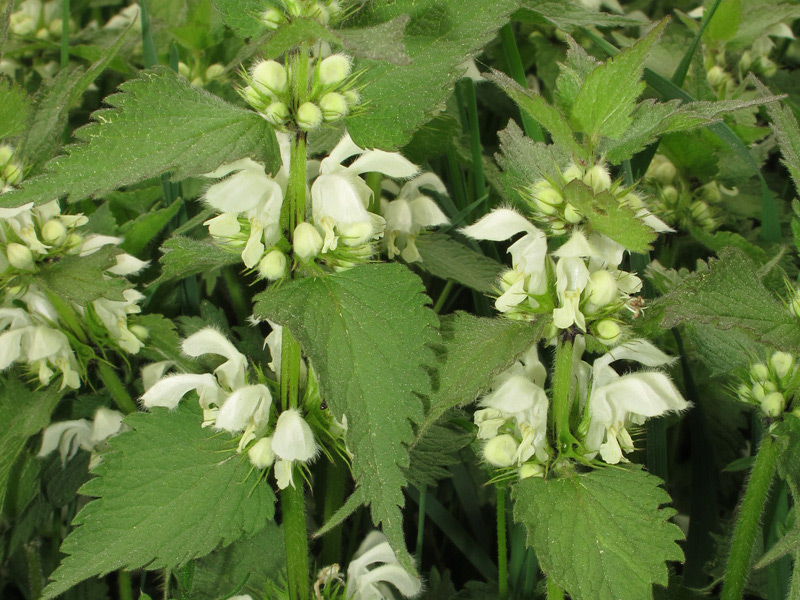
The genus name Lamium, derived from the Greek ‘lamos’ (= throat, gullet) or from the Greek ‘lamia’ = a large, voracious sea fish (shark), refers to the flower. The corolla is a white corolla tube (Latin ‘albus’ = white), approximately 2 cm long, set within a five-lobed calyx. It is throat-shaped, with a large, arched upper lip and a slightly longer, three-lobed lower lip. Owing to this distinctive flower structure, the genus name Lamium was adopted as the basis for the Latin family name for the Lamiaceae in the 1970s. The Lamiaceae had previously been known as ‘Labiatae’.
The stem of this plant, which is about 40 cm tall, is square in cross-section, as is characteristic of all Lamiaceae. The cordate leaves, with serrated margins, are arranged in opposite pairs. The flowers are arranged in whorls in the leaf axils. When the dead-nettle is not in flower, it looks almost identical to the stinging nettle. However, as its leaves do not ‘sting’ (the stinging nettle has stinging hairs!), it is known as a ‘dead’ nettle or, indeed, a ‘deaf’ nettle. The flowering time is from April to August.
Medicinally used parts of the herbal drug
Both the white flowers (white dead-nettle flowers – Lamii albi flos) and the herb, consisting of stems, leaves, and flowers (white dead-nettle herb – Lamii albi herba), are used. The herbal drugs are imported from Eastern European countries.
Constituents of the herbal drug
White dead-nettle flowers and herbs contain iridoids, flavonols, phenylpropane derivatives, and mucilage.
Quality of the herbal drug
The quality of the following drugs and drug preparations is specified in the German Drug Codex (DAC):
- White dead-nettle flowers (Lamii albi flos)
- White dead-nettle herb (Lamii albi herba)
Medicinal application
Recognised medicinal use
White dead-nettle herb and white dead-nettle flowers have not been evaluated by the HMPC or ESCOP.
Traditional use
White dead-nettle flowers and white dead-nettle herb have not been classified as a traditional herbal medicinal product (Article 16a of Directive 2001/83/EC).
Herbal drug preparations in finished dosage forms
White dead-nettle flowers for tea preparation. Occasionally used in bronchial teas (4 g per 100 g of tea blend)
Dosage
Finished medicinal products: Not applicable.
Tea: To loosen mucus, drink one cup of white dead-nettle flower tea, sweetened with honey, several times a day. Daily dose: 3 g of the herb.
The tea can also be used for rinses and moist compresses. For a sitz bath, use 5 g of white dead-nettle flowers.
Preparation of a tea
Pour approximately 150 mL of boiling water over 1 g of finely chopped white dead-nettle flowers and strain after 5 minutes.
Notes
No studies have been published on the safety of white dead-nettle flowers during pregnancy and lactation. Internal use in children under 12 years of age is not recommended due to a lack of evidence. These symptoms should be addressed by a doctor.
Side effects
None known.
Interactions
None known.