
Pansies
Botanical name
Viola tricolor L. – Wild pansy
Viola arvensis Murray – Field pansy
Family
Violaceae
Common name
Heartsease, Johnny-jump-up, Love-in-idleness, Field violet
Information about the plant
The genus Viola includes around 400 species, which are divided into numerous sections and subsections. Members of five sections are found in Europe. The wild pansy (Viola tricolor) is native to temperate regions of Europe and Asia. In Europe, its range extends northward to Iceland and southward to the Mediterranean. It occurs in a wide variety of forms. Some books also list various subspecies. For example, the field pansy (Viola arvensis) is sometimes also listed as a subspecies of V. tricolor. This species has a cosmopolitan distribution and occurs as a weed. Both Viola species are annuals or perennials, 10 to 25 cm tall, and grow on the edges of meadows and fields and on nutrient-poor grasslands.
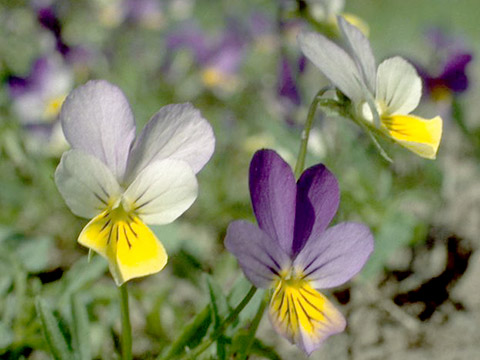
Viola means ‘violet’. The specific epithet tricolor is Latin and means ‘three-colored,’ referring to the three colors of the petals: violet, yellow, and white. The five petals form a zygomorphic flower: The lower petal is large, yellow with ray-like dark markings; the next two upwards also bear ray-like markings, while the top two petals are a single color. The unpaired lower petal is the stepmother, followed by the two ‘daughters’ of equal standing. The final petals, the ‘stepdaughters’, are a single color. The mother sits on two chairs (= 2 sepals), each daughter on one chair (1 sepal each), while the two stepdaughters must share a chair; this explains the German name ‘Stiefmütterchen’ which translates as stepmother (Sauerbruch, Etymological Dictionary). The flowers of the wild pansy are over 1.5 cm in size, while those of the field pansy are slightly smaller; both have a short spur. The shape of the leaves of pansies varies, ranging from cordate to oblong-ovate, usually with a bluntly serrated margin. The stipules are pinnate. The flowering time is from May to October.
Medicinally used parts of the herbal drug
The parts of the plant harvested during flowering – including the leaves, stems and flowers (wild pansy with flowers – Violae herba cum flore) – are used.
The commercially available herbal drug is obtained from wild-harvested and cultivated plants in the Netherlands.
Constituents of the herbal drug
Wild pansy with flowers contains flavonoids, salicylic acid derivatives, plant acids, anthocyanins, and mucilage.
Quality of the herbal drug
The quality of wild pansy with flowers (Violae herba cum flore) is specified in the European Pharmacopoeia (Ph. Eur.).
Medicinal application
Recognised medicinal use
The HMPC has classified wild pansy as a traditional herbal medicinal product (see ‘Traditional use’).
ESCOP: For skin complaints such as eczema, seborrhoea, impetigo, acne, cradle cap and for the treatment of nappy rash in children (for both internal and external use). These indications are based on findings from long-standing use in humans.
Traditional use
Wild pansy with flowers (pansy herb) has been classified by the HMPC as a traditional herbal medicinal product (Article 16a of Directive 2001/83/EC). Based upon long-standing use, pansy herb can be used both internally and externally to treat mildly seborrheic skin conditions.
Herbal drug preparations in finished dosage forms
- Chopped pansy leaves with flowers for tea or infusion preparation for external use
- Fluid extracts in liquid preparations
- Viola tricolor homeopathic mother tincture in creams and liquid preparations
Dosage
Finished medicinal products: See patient information leaflet.
Tea: Drink one cup of pansy tea 1 to 3 times a day. Daily dose: 9 g of the herb. External use: Apply an aqueous decoction as a compress to the infected skin areas 3 times a day. The aqueous decoction may also be used as a bath additive.
Preparation of a tea
Pour 150 mL of boiling water over 3 g of pansy herb with flowers and strain after 10 minutes. For compresses, an aqueous decoction of 2 to 20 g per liter of water is suitable. For use as a bath additive, 1 liter of a decoction made from 5 to 10 g of the herb is recommended.
Notes
Pansy herb with flowers must not be used in cases of hypersensitivity to salicylates (e.g., Aspirin®). Furthermore, pansy herb with flowers should not be applied to open wounds or large areas of damaged skin.
No studies have been published on the safety of using wild pansy during pregnancy and lactation. Internal use is not recommended for children and adolescents under the age of 18 due to a lack of evidence. For external use, this applies to children under the age of 12.
Side effects
None known.
Interactions
None known.
References
Herbal drug monographs
HMPC (2011, 2021), ESCOP (2016)
Further literature
Commentary on the European Pharmacopoeia (Wild pansy with flowers, No. 1855).