

Thornapple
Botanical name
Datura stramonium L.
Family
Solanaceae
Common name
Jimson weed, Yugoslavian stramonium, Datura, Devil’s trumpet
Information about the plant
Originally native to Central America, thornapple is now widespread in temperate and subtropical regions. It was introduced to Europe in the 16th century as an ornamental plant and has been growing in the warmer parts of Germany ever since. Thornapple is a poisonous plant (!). It grows along roadsides, on rubbish tips, in derelict areas, and in vineyards.
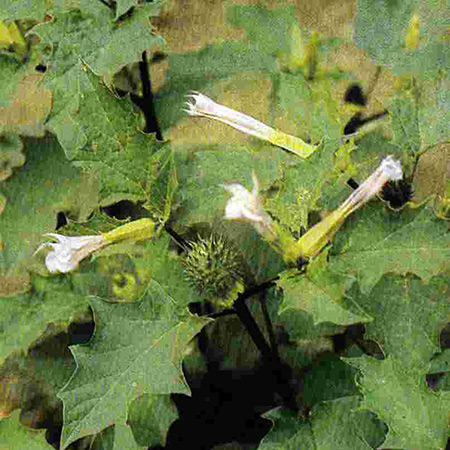
The name thornapple refers to the fruits of this plant. It grows to a height of around 1.2 m and has forked branches. These are capsules up to 5 cm long, densely covered in spines (hence the name thornapple!), a characteristic feature of this plant. The leaves are up to 20 cm long, stalked, and deeply lobed. The decorative, 6 to 10 cm wide, trumpet-shaped, white flowers grow in the leaf axils. They are half-covered by a five-lobed calyx tube. The spiny fruits contain numerous kidney-shaped, blackish-brown seeds. The flowering time is from June to October.
Medicinally used parts of plants (herbal drug)
The dried leaves (stramonium leaves – Stramonii folium) are used.
The commercially available herbal drug comes from wild collections in Eastern Europe.
Constituents of the herbal drug
Stramonium leaves contain potent tropane alkaloids, the most important of which are L-hyoscyamine, scopolamine, and atropine (the racemic mixture of hyoscyamine). They also contain withanolides, flavonoids, and coumarins. The tropane alkaloids are responsible for the toxicity of the plant.
Quality of the drug
The quality of the following drugs and drug preparations is specified in the European Pharmacopoeia (Ph. Eur.):
- Stramonium leaves (Stramonii folium)
- Standardized stramonium powder (Stramonii pulvis normatus)
- Stramonium for homeopathic preparations (Datura stramonium ad praeparationes homoeopathicas)
Medical applications
Recognised medical use
In the past, stramonium leaves were used to treat epileptic seizures, asthma, spasmodic cough, and similar conditions. Due to their narrow therapeutic index (the potent toxic effects of tropane alkaloids!), this treatment is problematic and should no longer be practiced. Stramonium leaves and the alkaloids isolated from them (hyoscyamine, scopolamine) are highly potent drugs and must not be used in phytotherapy. Stramonium leaves have not been assessed by the HMPC or ESCOP.
Traditional use
Due to their content of highly potent alkaloids, which are also responsible for the plant’s toxicity, stramonium leaves cannot be classified as a traditional herbal medicinal product (Article 16a of Directive 2001/83/EC).
Herbal drug preparations in finished dosage forms
None available.
Scopolamine isolated from stramonium leaves is used in ophthalmology in the form of scopolamine bromide as a mydriatic, i.e. to dilate the pupils during examinations of the fundus. Furthermore, the central sedative effect of scopolamine is used to prevent the symptoms of travel sickness or seasickness, such as dizziness, nausea, and vomiting. For this use, a scopolamine patch is applied behind the ear 5 hours before the start of the journey, from where the scopolamine is gradually absorbed into the body. The patches are available on prescription only and are not suitable for children under 10 years of age.
Dosage
Not applicable.
Preparation of a tea
Not applicable.
Notes
Stramonium leaves are poisonous. They have a powerful effect on the central nervous system! Therefore, the drug or any finished medicinal products containing it should only be used under the supervision of a doctor. Children and adolescents under the age of 18 must not use stramonium leaves.
Side effects
Not applicable.
Interactions
Not applicable.
References
Herbal drug monographs
Not applicable.
Further literature
Commentary on the European Pharmacopoeia (Stramonium leaves, No. 0246; Stramonium powder, No. 0247; Stramonium for homeopathic preparations, No. 2734)