

Tea Plant
Botanical name
Camellia sinensis (L.) Kuntze
Family
Theaceae
Common name
Tea shrub, Tea bush
Information about the plant
Linné derived the genus name Camellia from the name of the Moravian Jesuit Georg Joseph Kamel (Latinized as ‘Camellus’), who described the tea plant on the island of Luzon (Philippines). The species epithet sinensis is the Latin word for ‘Chinese’. The tea plant is native to the highlands of South and Southeast Asia (Assam and Mainland Southeast Asia) and reached China as early as 2700 BC. Separate cultivation led to the development of two varieties: var. assamica (Mast.) Kitam and var. sinensis (L.) Kuntze. The former variety is sensitive to cold and drought and produces Assam tea with large leaves and a high yield. The var. sinensis is less sensitive and produces Chinese tea with smaller, tougher leaves. The yield is lower, but the aroma is more fragrant. Apart from these two varieties, various other varieties and forms of C. sinensis are cultivated for tea production in the tea-growing regions of temperate and tropical Asia.
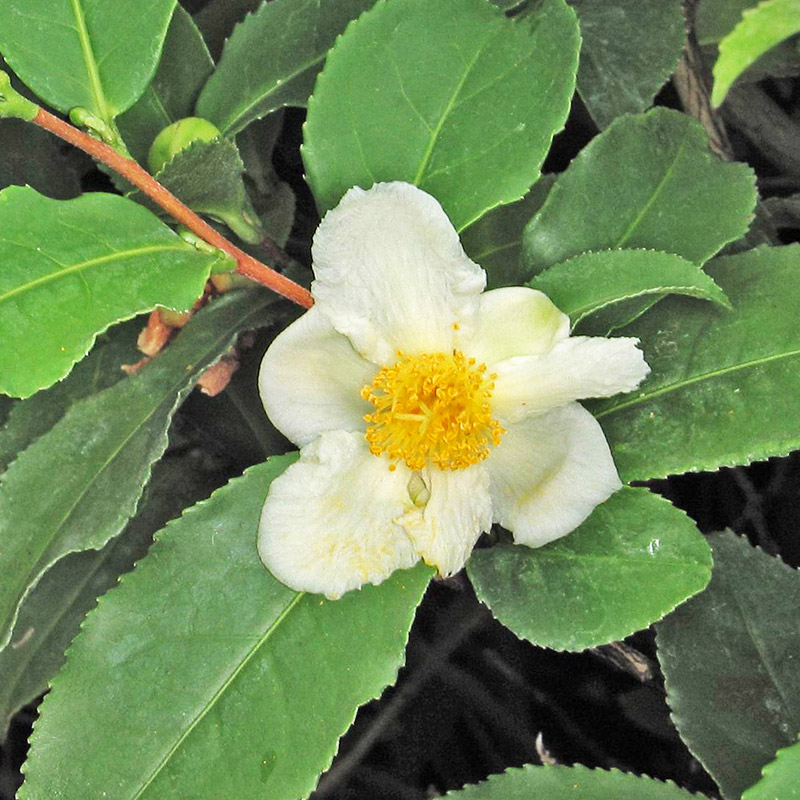
The tea plant, when left to grow naturally, is an evergreen tree that reaches a height of between 6 and 10 meters without any cultivation. In cultivation, the tea plant is pruned into a shrub-like shape to make it easier to harvest the leaves and to stimulate the formation of side shoots. The small, spatulate or lanceolate, somewhat leathery leaves are arranged alternately on the stems. The white flowers are 3 cm in diameter and appear in clusters of one to four in the leaf axils. They form rounded capsules containing 1 to 3 seeds after pollination. The tea leaves are harvested several times a year. In low-lying areas, there can be up to 30 harvests per year. Only the terminal buds (pekoe tips) with the two or three adjacent leaves (‘fine pluck’) are considered high-quality. The lower leaves contain less caffeine and tannins and are classified as ‘coarse pluck’. It is not possible to discuss in greater detail here the specific methods used to harvest the tea leaves or the various grades of tea.
Black tea is made by fermenting the leaves for over 4 hours at temperatures between 25 and 35°C. During this process, complex enzymatic reactions take place which significantly alter the composition of the tea, and the leaves become reddish-brown to black. The characteristic tea aroma also develops.
Green tea is made by inactivating the enzymes immediately after harvesting using hot steam. Fermentation does not occur, and the leaves remain olive-green.
Medicinally used parts of the herbal drug
The leaves used are young, unfermented leaves that have been stabilized by brief heating and then dried (green tea – Camellia sinensis folium non fermentatum). Green tea is also known by its Latin name, ‘Theae viridis folium’, in the market. Green tea is predominantly classified as a foodstuff.
The commercially available leaves are sourced from tea-growing regions in South and East Asia.
Constituents of the herbal drug
Green tea contains caffeine (2 to 4%), theobromine (0.05%), and theophylline (trace amounts); polyphenols (up to 30%): (-)-epigallocatechin-3-O-gallate (EGCG, up to 12%), (-)-epicatechin-3-O-gallate (ECG), catechin tannins, gallotannins, ellagitannins, flavonoids, phenolic carboxylic acids, theanine (amino acid), ascorbic acid, triterpene saponins, minerals, and fluorides.
Quality of the herbal drug
The quality of green tea (Camellia sinensis folium non fermentatum) is specified in the European Pharmacopoeia (Ph. Eur.).
Medicinal application
Recognised medicinal use
The HMPC has classified green tea as a traditional herbal medicinal product (see ‘Traditional use’).
ESCOP: Green tea has not been evaluated.
Traditional use
Green tea has been classified by the HMPC as a traditional herbal medicinal product (Article 16a of Directive 2001/83/EC). Based upon long-standing use, green tea can be used to treat tiredness and a feeling of weakness.
In folk medicine, green tea is also used to treat diarrhea and an upset stomach.
Herbal drug preparations in finished dosage forms
- Whole or cut green tea leaves, loose or in tea bags, for tea preparation
- Powdered herb in capsules (tonic)
Dosage
Finished preparations: See patient information leaflet or instructions for use.
Tea: For symptoms of tiredness, drink a cup of warm green tea 3 to 5 times a day. Daily dose: 6 to 10 g of the herb.
Preparation of a tea
Pour 150 mL of hot water (not boiling) over 2 to 3 g of green tea and strain after 3 to 5 minutes. As with black tea, the stimulating effect is stronger when the tea is brewed briefly than when it is left to stand for a long time.
Notes
Green tea should not be used in cases of existing stomach and duodenal ulcers, hypertension, cardiac arrhythmias, or hyperthyroidism. Green tea should not be drunk before going to bed, as its caffeine content may cause sleep disturbances.
The use of green tea in children and adolescents is not recommended due to a lack of evidence.
Side effects
None known.
Interactions
To avoid interactions, green tea should not be consumed together with medication. The caffeine contained in green tea reduces the effects of sedatives and increases the side effects of sympathomimetics (agents that act on the sympathetic nervous system). People taking MAO inhibitors should consume green tea only with caution, as it enhances the effects of these medicines.
References
Herbal drug monographs
HMPC (2014, 2022)
Further literature
Commentary on the European Pharmacopoeia (Green tea, No. 2668).