

Soybean - Soy Lecithin
Botanical name
Glycine max (L.) Merr.
Family
Fabaceae
Common name
Soya lecithin, Soya bean, Soya, Soy
Information about the plant
The soy plant is native to East Asia and was domesticated as a food crop from the wild species Glycine soja Sieb. et Zucc. It is now an important global crop and a source of protein and fat. It was not introduced to Europe and America until the end of the 19th century. Today, apart from East Asia, it is cultivated in North America and in the countries of the former USSR. In terms of climate, Europe is not well suited to soy cultivation, although it is possible with certain specially bred varieties, which are, however, not very profitable.
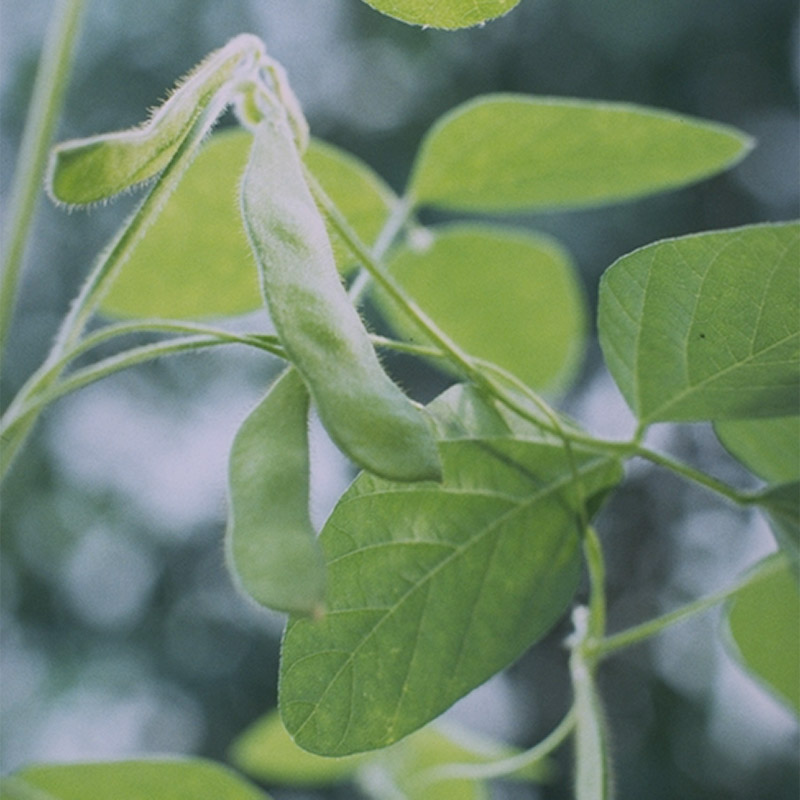
Soy is an annual, deep-rooted, bristly-haired plant. It grows to a height of up to 80 cm and bears leaves with three to five ovate leaflets, which are also hairy along the margins and on the veins of the underside. The flowers are purple or white, short-stalked, and arranged in clusters of 3 to 20 in the leaf axils. They are self-pollinating. The fruits are short, brownish-yellow, hairy pods containing 2 to 3 round to oval seeds that may be white, yellow, or brown.
Soybeans contain approximately 18% fatty oil, which is found in the cotyledons. The oil is pressed or extracted and then purified and deodorized. The refined oil is light yellow. During the refining of the oil, 2–3% lecithin is produced, which is used as an emulsifier in the food industry and in pharmaceuticals.
Medicinally used parts of the herbal drug
The refined fatty oil extracted from crushed seeds (refined soy oil – Sojae oleum raffinatum) and lecithin (soy lecithin – Lecithinum ex soja) are used.
Constituents of the herbal drug
Soy oil
Soy oil consists of triglycerides, with diunsaturated linoleic acid as the predominant fatty acid (35 to 60%). The proportion of γ-linolenic acid, a tri-unsaturated fatty acid, is 2 to 15%.
Soy lecithin
Lecithin is a general term for the phosphatidylcholines found in vegetable oils. Two hydroxyl groups (OH) of glycerol are each bound to a fatty acid, while the third hydroxyl group is esterified with phosphoric acid, which is in turn esterified with another alcohol, choline. The lecithin content in soy oil is particularly high compared with that in other vegetable oils.
Quality of the herbal drug
The quality of the following preparations is specified in the European Pharmacopoeia (Ph. Eur.):
- Hydrogenated soy oil (Sojae oleum hydrogenatum)
- Refined soy oil (Sojae oleum raffinatum)
- Partially hydrogenated soy oil (Sojae oleum ex parte hydrogenatum)
- De-oiled soy lecithin (Sojae lecithinum desoleatum)
Medicinal application
Recognised medicinal use
The HMPC has classified soy oil and soy lecithin as traditional herbal medicinal products (see ‘Traditional use’).
ESCOP: Soy oil and soy lecithin have not yet been evaluated.
Traditional use
Soy oil
The HMPC has classified soy oil as a traditional herbal medicinal product (Article 16a of Directive 2001/83/EC). Based upon long-standing use, soy oil can be used as a bath additive for dry skin and associated chronic eczema.
Soy lecithin
The HMPC has classified soy lecithin as a traditional herbal medicinal product (Article 16a of Directive 2001/83/EC). Based upon long-standing use, soy lecithin can be used for the relief of temporary fatigue and feelings of weakness.
Herbal drug preparations in finished dosage forms
Soy oil is available in its pure form, while soy lecithin is available in capsules.
Dosage
Soy oil
Baths containing soy oil may be taken two to three times a week. Adolescents and adults: full bath 15–45 mL soy oil, partial bath 5–15 mL (bathing time 20 minutes). Infants and children: 20 mL soy oil, bathing time 5 to 10 minutes.
Soy lecithin
Finished medicinal products: See patient information leaflet.
For tiredness and feelings of weakness, adults should take 750–2,700 mg of soy lecithin 2 to 3 times a day. Adolescents should take 750 mg twice a day. For lipid metabolism disorders, adults should take approximately 3.5 g of soy lecithin daily.
Preparation of a tea
Not applicable.
Notes
Soy oil and soy lecithin
Soy oil and soy lecithin must not be used in cases of hypersensitivity to soy lecithin, soybeans, peanuts, and other plants of the Fabaceae family, or to birch pollen.
Soy oil
The bath temperature must not exceed 36 °C. If the oil comes into contact with the eyes, they must be rinsed immediately with cold water to prevent conjunctivitis.
Side effects
Soy oil
Skin reactions and hypersensitivity reactions have been reported.
Soy lecithin
Allergic reactions (including anaphylaxis and angioedema) have been reported, although the frequency is not known. Skin reactions (itching, inflammation, rashes, and hives) and gastrointestinal disturbances may also occur.
Interactions
None known.
References
Herbal drug monographs
HMPC (2017)
Further literature
Commentary on the European Pharmacopoeia (Refined soy oil, No. 1473). Commentary on the German Pharmacopoeia (Partially hydrogenated soy oil, De-oiled soy lecithin)