

Lemon Verbena
Botanical name
Aloysia citrodora Palau
Family
Verbenaceae
Common name
Lemon beebrush
Information about the plant
Lemon verbena is native to northwestern Argentina, Paraguay, and western Bolivia. From there, it has spread further across South America and is now found in Mexico, southern Brazil, and the Caribbean. Lemon verbena is also found in Europe, particularly in France, Spain, and Sardinia. It has now become a popular garden and culinary herb in warm and temperate climates.
Several botanical names are used for lemon verbena (also known as lemon beebrush). Synonyms include Aloysia triphylla (L’Hér.) Kuntze, Lippia citriodora Kunth, Verbena citrodora (Palau) Cav., and V. triphylla L’Hér. The latter names, as well as their classification within the Verbenaceae family, have led to lemon verbena sometimes being referred to simply as ‘verbena’. However, this name is commonly used for common verbena (Verbena officinalis L.), which frequently leads to confusion between the names of these two plants. The specific epithet citrodora or citriodora (Latin odor = scent, smell) refers to the lemon-like scent that rises when the leaves are crushed. Citrus is the botanical genus name for the lemon.
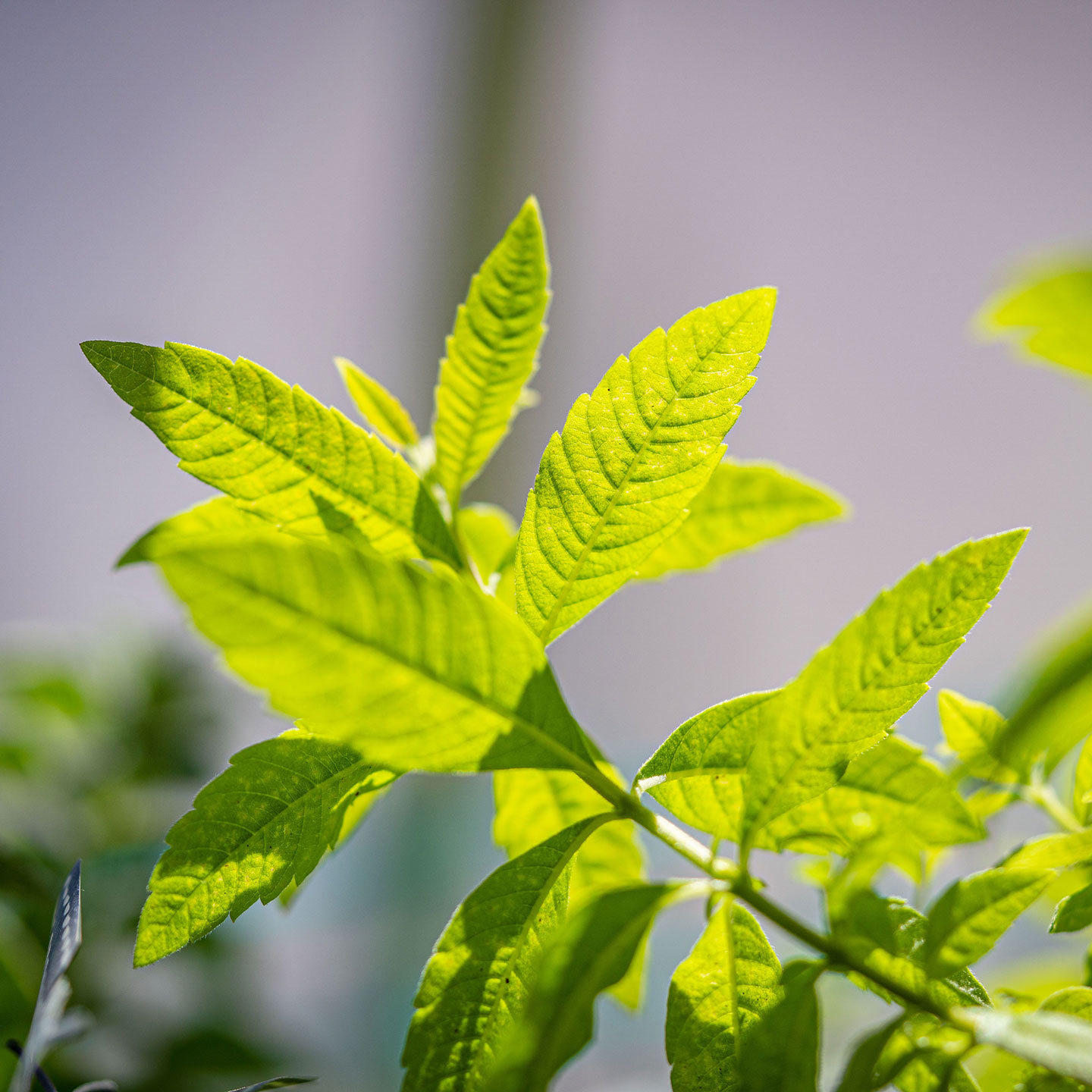
Lemon verbena is a shrub growing to a height of 1 to 2.5 m, with pale green, long, pointed leaves featuring a prominent midrib on the underside. The lemon-scented leaves grow in whorls of three – this is where the species epithet triphylla comes from (Greek ‘tria’ = three, ‘phyllon’ = leaf). Numerous small, white-purple flowers are arranged in large terminal panicles. The four petals are fused at the base into a 4 to 5 mm long tube with spreading lobes; the sepals are also fused into a small tube. The flowering time is from July to August.
Medicinally used parts of plants (herbal drug)
The dried leaves (lemon verbena leaves – Verbenae citriodorae folium) are used.
Commercial herbal drugs are derived from cultivated plants, primarily from Chile, Israel, and Morocco.
Constituents of the herbal drug
Lemon verbena leaves contain essential oil. The lemon-like scent is due to citral, a mixture of the monoterpenes geranial (citral A) and neral (citral B). They also contain phenyl ethanol glycosides (including acteoside), flavonoids, and iridoid glycosides.
Quality of the drug
The quality of lemon verbena leaves (Verbenae citriodorae folium) is specified in the European Pharmacopoeia (Ph. Eur.).
Medical applications
Recognised medical use
The HMPC has classified lemon verbena leaves as a traditional herbal medicinal product (see ‘Traditional use’).
ESCOP: Lemon verbena leaves have not been evaluated.
Traditional use
The HMPC has classified lemon verbena leaves as a traditional herbal medicinal product (Article 16a of Directive 2001/83/EC). Based upon long-standing use, lemon verbena leaves can be used to relieve mild symptoms of stress and as a sleep aid, as well as for the symptomatic treatment of mild digestive disorders such as bloating and flatulence.
Herbal drug preparations in finished dosage forms
- Chopped lemon verbena leaves for tea preparation
Dosage
Finished medicinal products: see patient information leaflet.
Tea: Drink one cup of lemon verbena leaf tea 3 to 5 times a day to treat mild symptoms of stress and indigestion. As a sleep aid, drink 200 mL half an hour before going to bed. For more detailed dosages, see HMPC.
Preparation of a tea
Pour 200 mL of boiling water over 1 to 3 g of crushed lemon verbena leaves and strain after 10 minutes. For other preparation methods, see HMPC.
Notes
Lemon verbena leaves are mainly used in traditional medicine; there is no detailed evidence regarding their effects or side effects. Therefore, their use during pregnancy and lactation, and in children under 12 years of age, is not recommended.
Side effects
None known.
Interactions
None known.
References
Herbal drug monographs
HMPC (2021)
Further literature
Commentary on the European Pharmacopoeia (Lemon verbena leaves, No. 1834)