

Saffron
Botanical name
Crocus sativus L.
Family
Iridaceae
Common name
Saffron Crocus, Autumn Crocus
Information about the plant
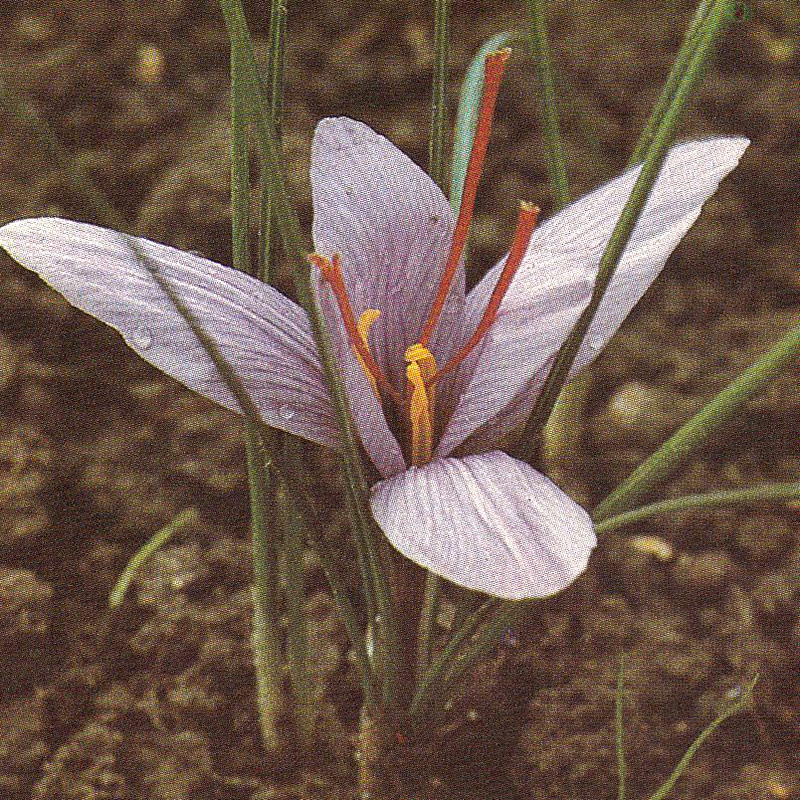
The saffron crocus is probably native to Western Asia. The plant is now cultivated in many countries, including Afghanistan, Kashmir, Iran, India, the Mediterranean countries, and southern France. The genus name Crocus is derived from the Greek ‘kroke’ (= thread), which refers to the long, thread-like stigmatic branches (stigma branches) of the pistil. In the saffron crocus, these are particularly long (up to 4 cm), strikingly brick-red, and pleasantly fragrant. The dried stigmas play a major role as a spice in the culinary traditions of southern countries, particularly in Iran. Dishes seasoned with them acquire a yellow color. In Arab countries, saffron has been used since ancient times and was known there as ‘za’farǎn’ (= the yellow, being yellow), from which the names azafrán (Spanish), safran (French), zafferano (Italian), and saffron (English) are derived. The dried stigmas are sold as ‘saffron’ and are very popular as a spice and as a coloring additive for baked goods.
The saffron crocus is a small rosette plant with grass-like leaves and an underground corm. In autumn, like spring crocuses, it develops approximately 15 cm long flowers consisting of six lilac-colored perigone segments that are fused into a tube at the base. They resemble meadow saffron. The ovary sits underground, slightly above the corm, and the style grows from there through the corolla tube. It is approximately 10 cm long. At its tip are the three orange-red, funnel-shaped stigma branches, which are used as ‘saffron’. The stigma is located at the tip of each of these. The saffron crocus is sterile, as it descends from the triploid mutant of a Crocus species native to the Aegean Islands. Therefore, it must be propagated vegetatively in cultivation by dividing the corms.
Saffron is harvested by painstaking manual work. Every single flower must be picked by hand, with the stigma and its attached saffron threads plucked off with the fingers. This takes place only once a year during the flowering period, i.e., in autumn; 200,000 to 400,000 stigmas are needed to produce 500 g of saffron (dry weight). Saffron is one of the most expensive spices (‘red gold’), and therefore, counterfeits are on the market, e.g., the petals of the dyer’s safflower Carthamus tinctorius L. (= ‘false saffron’) or the artificially colored outer petals of the marigold. Turmeric (Curcuma longa), red sandalwood, or powdered red paprika are used as adulterants in the powder form.
Medicinally used parts of plants (herbal drug)
The dried stigmas harvested during the flowering period are used, usually held together by a small piece of the style (saffron – Croci stigma).
The commercially available saffron comes mainly from Spain, but also from Greece and Italy.
Constituents of the herbal drug
Saffron contains essential oil (0.4–1.0%) with safranal as its main component, which is primarily responsible for saffron’s distinctive scent. It is formed during drying from the bitter-tasting picrocrocin (saffron bitter). The pigments are crocins (A to E, 10–25%), which belong to the carotenoid group and are (presumably) formed during drying from protocrocin. Carotenoids (including lycopene), xanthophylls (including zeaxanthin), crocusatins F to I, flavonoids, vitamin B2, fatty oil, heteropolysaccharides, and starch are also present.
Quality of the drug
The quality of saffron (Croci stigma) has been specified in the German Drug Codex (DAC). The quality of ‘Crocus for homeopathic preparations (Croci sativi stigma ad praeparationes homoeopathicas)’ is specified in the European Pharmacopoeia (Ph. Eur.).
Medical applications
Recognised medical use
Saffron has not been reviewed by the HMPC or ESCOP.
In traditional folk medicine, saffron was used as a nerve sedative and to treat cramps and asthma. Saffron extracts are also found in dietary supplements marketed as ‘natural mood enhancers’. Research into the potential medicinal uses of saffron has been ongoing for around 20 years. The focus is on its cytotoxic properties (against cancer), the positive effects on cardiovascular diseases, its blood pressure-lowering and anti-atherosclerotic properties, and the neuroprotective effects of the drug and its constituents.
Traditional use
Saffron has not been classified as a traditional herbal medicinal product (Article 16a of Directive 2001/83/EC).
Herbal drug preparations in finished dosage forms
Saffron is a component of homeopathic mono- and combination preparations (Crocus sativus hom.), available in capsule form, as globules, coated tablets, and drops. Saffron is also found in dietary supplements in the form of extracts (see above).
Saffron is available as a spice in the form of whole threads or as a powder.
Dosage
When consumed in high doses, saffron is highly toxic. It should only be used in the form of finished preparations, in which the respective dosage instructions must be followed. The safe maximum dose is 1 g of saffron per day.
Preparation of a tea
Not applicable.
Notes
No adverse effects are known to be associated with the use of saffron as a spice in cooking.
Side effects
At higher doses, vomiting, uterine bleeding, bloody diarrhea, and other symptoms may occur, and yellowing of the skin may be possible.
Interactions
None known.
References
Herbal drug monographs
None known.
Further literature
Commentary on the European Pharmacopoeia (Crocus for homeopathic preparations, No. 1624)