
Fucus/Bladderwrack
Botanical name
Fucus vesiculosus L. - Bladderwrack
Fucus serratus L. – Toothed wrack
Ascophyllum nodosum Le Jol. – Knotted wrack
Family
Fucaceae
Common name
Popweed, Black tang, Sea grapes, Bladder fucus, Sea oak, Cut weed, Dyer’s fucus, Red fucus, Rock wrack
Serrated wrack, Saw wrack
Egg wrack, Norwegian kelp, Knotted kelp
Information about the plant
All three seaweed species are perennial brown algae that grow in meadow-like formations along the coastlines of the North Atlantic and in the surf zone and upper intertidal zones of the North Sea and the Baltic Sea. The algal body (= thallus) consists of leaf-like assimilators (= phylloids), a stem-like supporting organ (= cauloid), and a root-like anchoring organ (rhizoid). With their leaf-like, leathery phylloids, brown algae reach the sea surface and can use surface light to generate energy through photosynthesis.
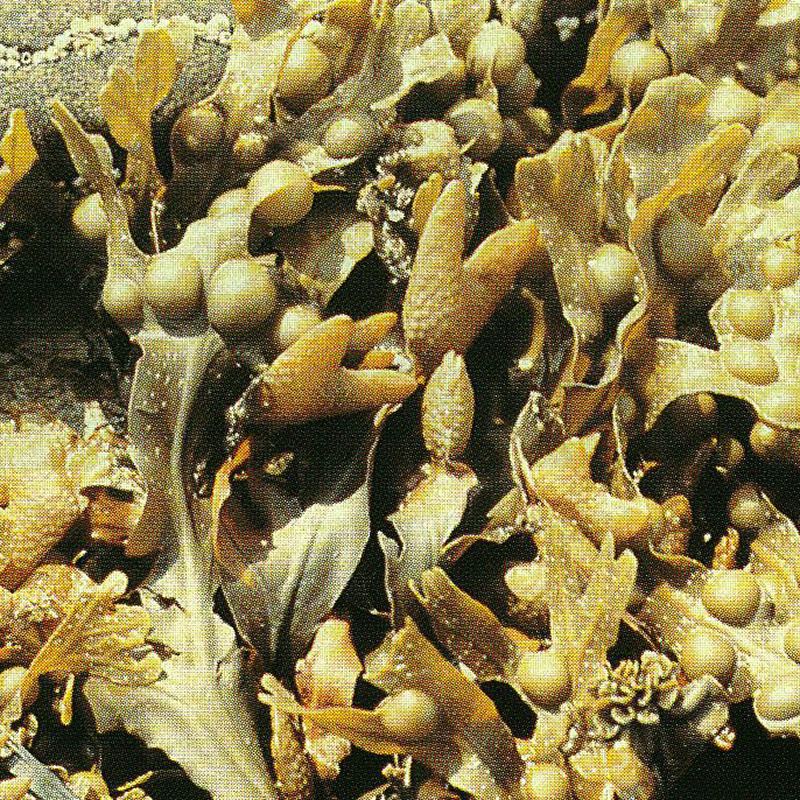
The thallus of bladderwrack is 2 to 5 m in length, leathery, olive-colored to yellowish-brown, and forked. The specific epithet vesiculosus is derived from the Latin ‘vesicula’ (= vesicle) and means abundant in vesicles. This refers to the rounded, gas-filled swim bladders (‘bladder’ wrack), which are arranged in pairs along the midrib of the phylloids and singly at the branches. These enable the thalli to remain upright while floating in the water.
The olive-brown toothed wrack, which grows up to 1 m in length, has no swim bladders and grows in a bushy form. The phylloids are simply or doubly serrated, reflected in the specific epithet serratus, derived from the Latin ‘serra’ (= saw).
The thallus of knotted wrack grows to a length of up to 1.5 m, is structured by forked long shoots and short shoots, has no midrib, and its swim bladders are oval. The genus name Ascophyllum is derived from the Greek ‘askos’ (= a bag made of leather or animal hide) and ‘phyllum’ (= leaf); the specific epithet refers to the ‘knots’: Latin ‘nodus’ = knot, ‘nodosus’ = knotty.
Alginic acid is extracted from various brown algae. It is used in the food industry in the form of its salts, known as alginates, as a thickening agent, gelling agent, emulsion stabilizer, or protective colloid.
Medicinally used parts of the herbal drug
The crushed, dried thallus (Fucus – Fucus vel Ascophyllum) is used.
The seaweed is harvested from wild populations. The main supplying countries are France, Ireland, and the states on the east coast of the USA.
Constituents of the herbal drug
Bladderwrack contains 0.03–0.1% total iodine, which is present either as an inorganic salt or bound to proteins or lipids. It is also present in the form of iodoamino acids (including diiodotyrosine = iodogorgic acid). Bladderwrack also contains alginic acid (a cell wall polysaccharide, up to 30%), laminarin, fucans, fucols, fucophloretols, and phlorotannins. It also accumulates arsenic and heavy metals (lead, cadmium, and mercury).
Quality of the herbal drug
The quality of Fucus (Fucus vel Ascophyllum) is specified in the European Pharmacopoeia (Ph. Eur.).
Medicinal application
Recognised medicinal use
The HMPC has classified bladderwrack as a traditional herbal medicinal product (see ‘Traditional use’).
ESCOP: Bladderwrack has not yet been evaluated.
Traditional use
Bladderwrack has been classified by the HMPC as a traditional herbal medicinal product (Article 16a of Directive 2001/83/EC). Based upon long-standing use, bladderwrack may be used as an adjunct to a calorie-restricted diet for weight loss in overweight adults, provided that a physician has ruled out any serious medical condition.
Herbal drug preparations in finished dosage forms
Bladderwrack and knotted wrack are commercially available as ground powders, either loose or in capsules as finished preparations, or as extracts in the form of coated tablets. These are not medicines, but dietary supplements.
Dosage
For finished preparations, see the patient information leaflet or consumption instructions.
Preparation of a tea
Not applicable.
Notes
Bladderwrack is a dietary supplement with the claim that iodine contributes to ‘normal cognitive function’ or to ‘normal energy metabolism’. Brown seaweed preparations are also marketed as ‘fat-burning’ or ‘slimming’ aids. There is no evidence of their efficacy, and as the iodine content varies considerably, therapeutic use cannot be recommended. Use during pregnancy or lactation, and in children and adolescents under 18 years of age, is strongly discouraged.
Side effects
Rare hypersensitivity reactions in the form of a severe systemic reaction.
Interactions
None known.
References
Herbal drug monographs
HMPC (2014, 2022)
Further literature
Commentary on the European Pharmacopoeia (Fucus, No. 1426)