

Onion
Botanical name
Allium cepa L.
Family
Amaryllidaceae
Common name
Garden onion, Common onion
Information about the plant
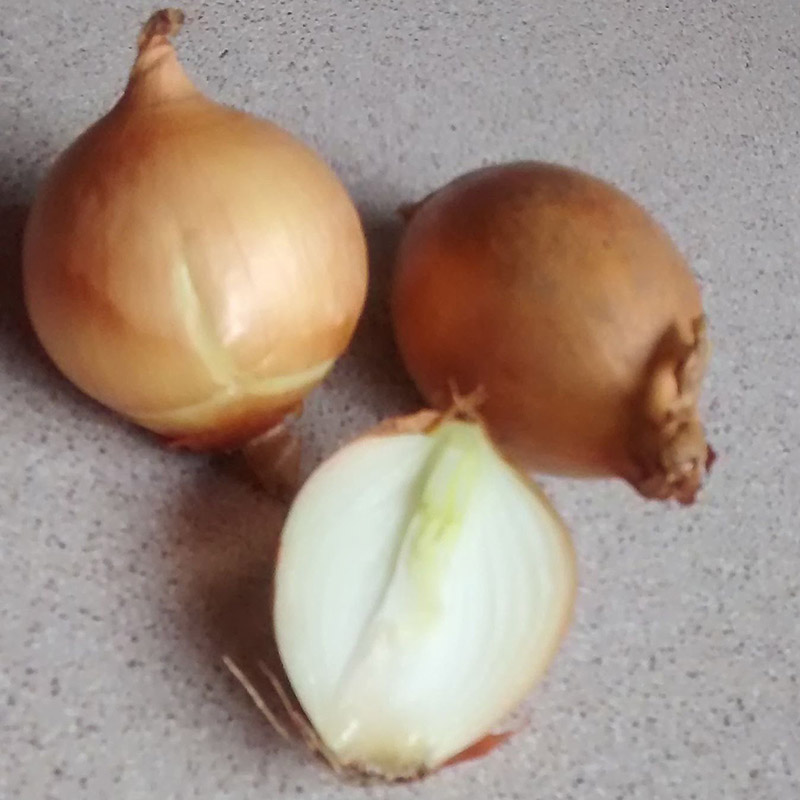
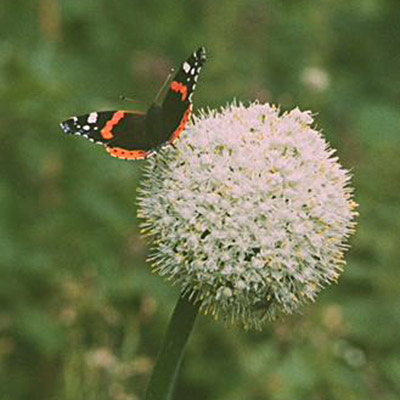
Photo: Stahl-Biskup
The onion is a cultivated plant that has been used since prehistoric times. Originally native to Central Asia (Afghanistan), it is now cultivated in countless varieties and grown worldwide every year. Annual production amounts to several million tons.
The genus name Allium is derived from the Latin word ‘allium’ (= leek, garlic), because leeks were a popular spice and food in Rome and the rest of Italy, as well as in the East, at least among the common people. The species epithet cepa also comes from Latin and means ‘onion’.
The garden onion (Allium cepa), as used in cooking, is the strongly compressed shoot axis of the plant, whose leaf sheaths are fleshy and swollen. It develops when a bulb is planted in the ground for propagation. This forms roots that sprout downward and green upper leaves that sprout upward to ensure energy production. It then reproduces by means of side buds, whose shoot tips repeatedly form new leaves. These are arranged in a shell-like pattern and swell strongly in the lower area, thus forming new onions. If an onion is cut lengthwise, the firm onion disc (= compressed shoot axis) can be seen in the middle, surrounded by fleshy, thickened leaf sheaths, often with daughter onions (= side buds) between them. The outer leaves gradually die off and form a dry, brown, paper-like shell (“skin”). If the plant is allowed to develop unhindered, it forms white flowers that stand in a spherical inflorescence. In cultivation, the inflorescences are removed so that the storage compounds in the bulb are not used for seed formation.
Medicinally used parts of the herbal drug
The fresh, chopped onions, or dried onions in powder form (onion – Allii cepae bulbus) are used.
Constituents of the herbal drug
Fresh onions contain various alliin compounds, primarily isoalliin, which comes into contact with the enzyme alliinase when the onion is chopped. This hydrolyzes it into prop-1-enylsulfenic acid, which is partially converted into the tear-inducing thiopropanal-S-oxide. Onions also contain flavonoids, γ-glutamyl peptides, phenols, vitamins, and carbohydrates.
Quality of the herbal drug
No pharmacopoeial quality description is available for onion (Allii cepae bulbus).
Medicinal application
Recognised medicinal use
HMPC: The monograph was rejected because classification as a medicinal product with recognized medical efficacy (well-established use) and as a traditional herbal medicinal product (traditional use) could not be supported.
ESCOP: Onion has not yet been evaluated.
Traditional use
Not classified as a traditional herbal medicinal product (Article 16a of Directive 2001/83/EC).
Herbal drug preparations in finished dosage forms
Freshly pressed plant juice
Dosage
50 g fresh or 20 g dried onions per day, prepared accordingly.
Onions are also commonly used to treat coughs and colds. Onion juice can be mixed with honey for this purpose. For young children, chopped onions can also be placed around the room, allowing the volatile sulfur compounds to enter the respiratory tract.
Preparation of a tea
Not applicable.
Notes
Eating onions can alter the smell of the skin and breath.
Side effects
Lower abdominal discomfort, such as flatulence and bloating, may occur.
Interactions
None known.